
The Winter Olympics are always a whirlwind: new sports, unfamiliar names, and suddenly you’re emotionally invested in someone you met 12 seconds ago, Googling “what is a good time in skeleton.”
At the 2026 Winter Olympics, everything happens at once: blades scraping ice, skis carving mountains, bodies flying down a track at “why would a human do this?” speed. The Games will bounce between Milan and Cortina d’Ampezzo, Italy. Still, the vibe is universal: precision, chaos, and the kind of pressure that turns one clean run into a career-defining clip.
This year, Jewish and Israeli athletes will be in the mix across the rink, the slopes, and the sliding track, and part of the fun is realizing how wide that mix actually is. Some names you’ll recognize right away. Others are the classic Winter Olympics experience: you learn them mid-competition, fall a little in love with their grit, and then spend the rest of the week acting as if you’ve always been a fan.
Here’s a running list of all the Jewish and Israeli athletes competing in the 2026 Winter Olympics — which begin Friday, February 6, 2026 — what they’re competing in, and why they’re worth watching.
Use it as your cheat sheet, your bracket-free rooting guide, and your “wait, which event is this again?” lifesaver. Also, because Olympic rosters can shift with injuries and late selections, consider this a living watchlist.
Editor’s note: This list is of all the athletes we have confirmed to be Jewish or Israeli. If you know of any other Jewish or Israeli athletes competing in the 2026 Winter Olympics, send us an email at content@unpacked.media.
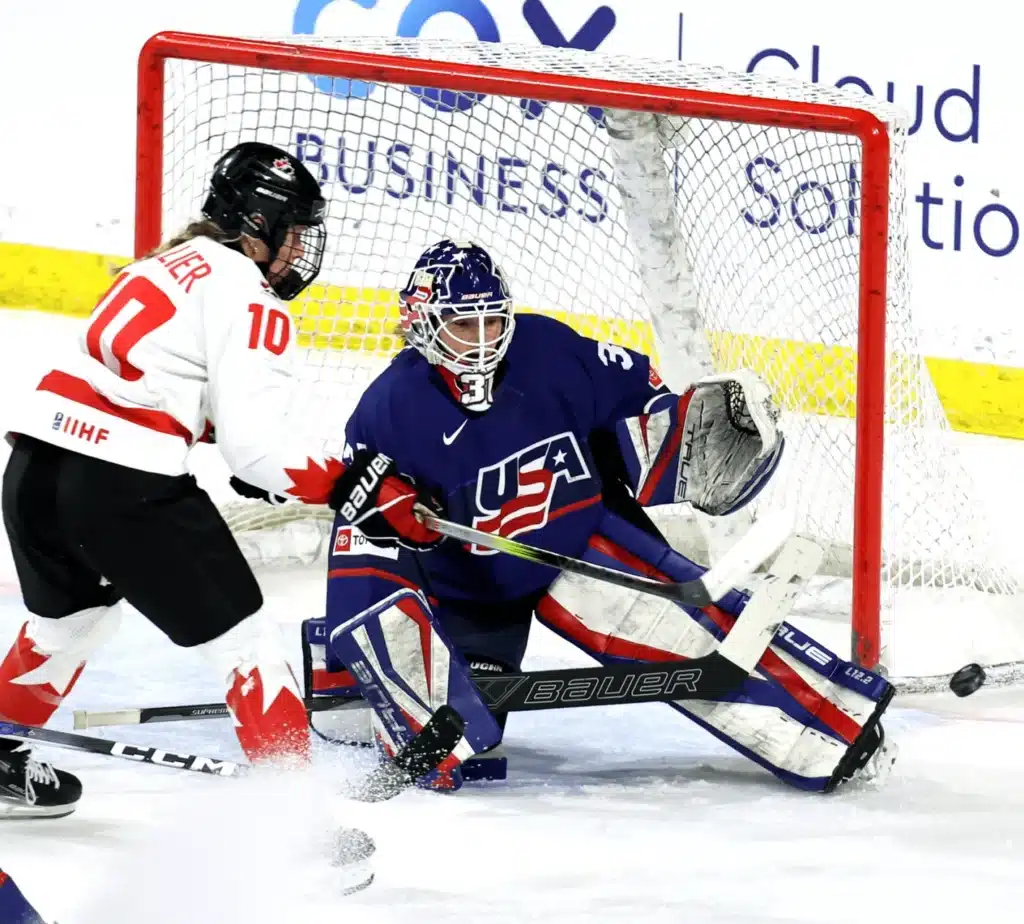

Aerin Frankel — United States, women’s ice hockey
First-time Olympian Aerin Frankel has established herself as one of the top goaltenders in the Professional Women’s Hockey League, anchoring the Boston Fleet with the kind of consistency teams build around.
Internationally, the 26-year-old’s been even more dominant. From 2023 through 2025, Frankel was Team USA’s No. 1 starter at the Women’s World Championships, backstopping the Americans to gold in 2023 and 2025 and silver in 2024. She was also part of the U.S. squads that took silver in 2021 and 2022, giving her a multi-year run as a fixture in the program’s medal pipeline.
Her workload at the 2023 tournament also signaled how fully USA Hockey trusted her: Frankel, known as the “Green Monster” in Boston, became the first U.S. women’s goalie in 26 years to start five straight games at a major international event (Olympics or Worlds). In other words, when the games mattered most, she was the plan.

A.J. Edelman, Ward Fawarsy, Menachem Chen, and Omer Katz — Israel, bobsleigh
A.J. Edelman has been chasing Israeli bobsledding greatness for the past 12 years, working to build a program that could compete on an Olympic level. Now, for the first time, Israel will make its debut.
The Boston native, who made aliyah in 2016, is the first Israeli athlete to qualify for the Olympics in two different sports, competing in skeleton at the 2018 Games in PyeongChang. He is believed to be the first Orthodox Jew to compete in the Winter Games.
Edelman — brother of comedian Alex Edelman — grew up in a traditional Jewish home, went to Jewish day school, and spent a year learning in yeshiva. On the circuit, “The Hebrew Hammer” is known for a routine that includes putting on tefillin before training and races, and for visuals that are unapologetically Jewish and Zionist: a helmet featuring Samson and a Theodor Herzl quote (“If you will it, it is no dream”), plus a sled marked with a blue Star of David. He’s also used that visibility for advocacy, including previously racing with a yellow ribbon to spotlight the hostages held in the Gaza Strip.
Bobsledding (called bobsleigh in international competition) has no official infrastructure in Israel, meaning the team trained primarily in Lake Placid, New York. Edelman’s sled, the least-funded team on the competitive circuit, did not receive government funding or subsidies while training. Besides prepping for competitions, Edelman spent much of his time fundraising for equipment, training, travel, lodging, coaching, and costly track runs.
The hustle-till-you-make-it culture of the Israeli bobsleigh program has led to many comparisons to the 1993 movie “Cool Runnings” about the Jamaican bobsled team that defied the odds to compete in the Olympics in 1988. Edelman has described Israel’s success as “shul runnings.”
The team’s “what makes them special” isn’t only the unprecedented nature of their success, but also the timing. In late 2023, Edelman said that on his then-six-person team, he was the only one in New York while the others were back in Israel serving in the military after October 7. By March 2024, he was describing how the call-up hit right as the season was about to start, and he had to scramble just to field a sled, having Israeli-American and Israeli athletes filling in for competitions.
As Olympic qualification neared, members of the team traveled between reserve service and training in the U.S.
In addition to Edelman, the four-man sled will be made up of five-time consecutive Israeli shot put champion Menachem Chen, Israeli national CrossFit champion Omer Katz, and Ward Fawarsy, who is believed to be the first Druze Olympian.
Attila Mihály Kertész — Israel, cross-country skiing
Attila Mihály Kertész does not read like a typical Olympic résumé. He’s 37, born and raised in Hungary, now based in Thailand, and he pays the bills as a veterinarian. He only started training in cross-country skiing in 2018, then kept going anyway. The result is genuinely singular: he’s Israel’s first Olympic cross-country skier.
The skier, who trained seriously in kayaking as a teenager, had an equally winding road to Israeli citizenship. Kertész, whose wife is Jewish, spent years working toward Israeli citizenship through a process repeatedly knocked off course by world events, including COVID-19, Russia’s invasion of Ukraine, and the October 7 attack on Israel. His family finally completed citizenship in the summer of 2024. He pursued all this while pushing uphill against the basic infrastructure problem that Israel doesn’t have a national skiing federation, and even Olympic officials initially doubted the plan.
Avital Carroll — Austria, mogul skiing
Avital Carroll, 29, is a New York City born moguls skier who built her career on American snow, then made a deliberate midstream pivot toward Europe.
She moved to Utah in her early 20s to chase moguls seriously and competed in the U.S. system before switching to race for Austria, a change made possible after she obtained Austrian citizenship through a law that grants citizenship to descendants of people driven out by the Nazis.

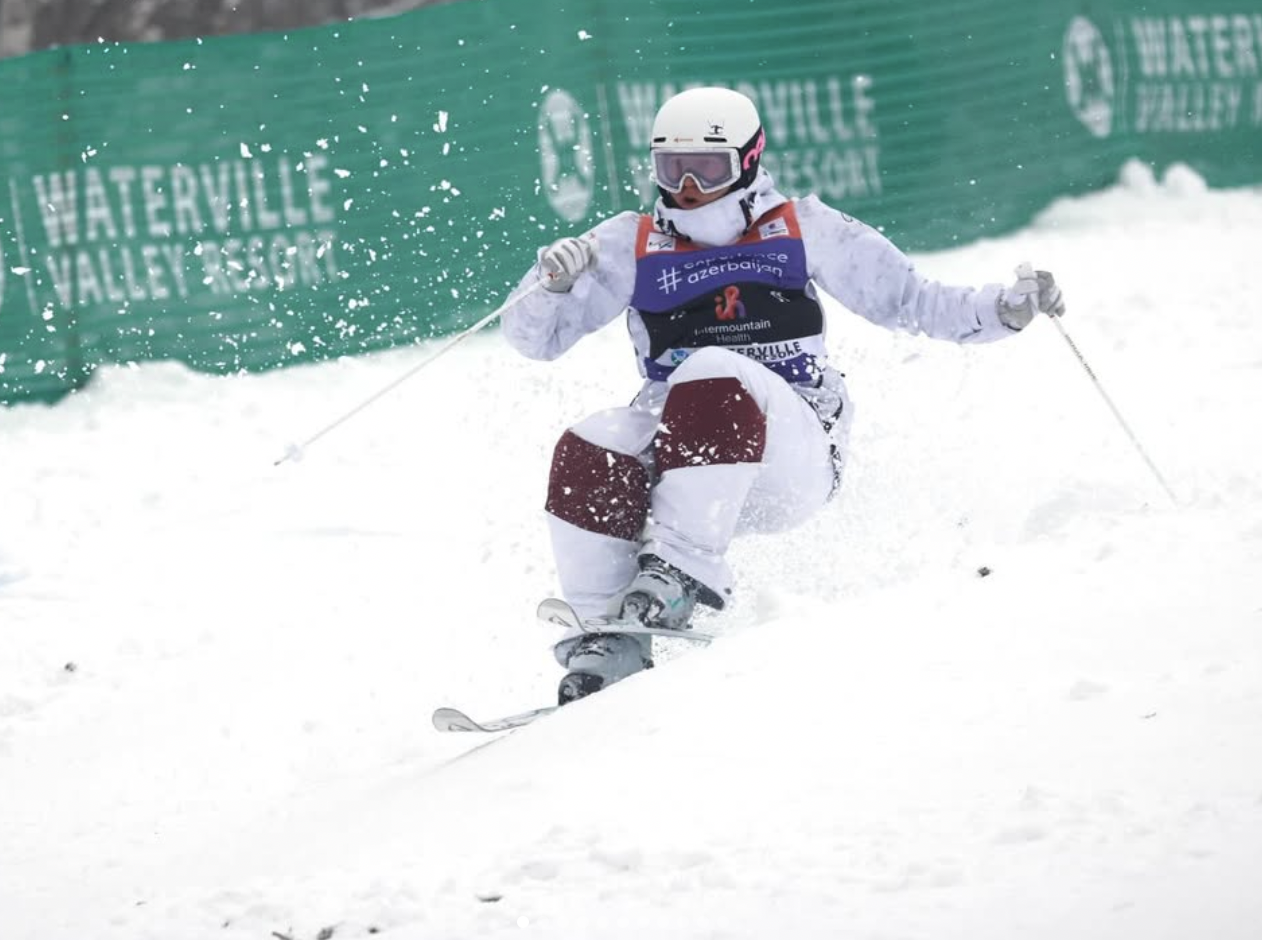
Carroll has spoken about her family’s Holocaust story and has used her platform to encourage other descendants of Austrian Jews to reclaim citizenship and to widen Jewish participation in skiing.
Before deciding to compete for Austria. Carroll was already a junior-world medalist (silver in 2015), and she broke through in a major way at the 2023 World Championships in Bakuriani, winning two bronze medals (moguls and dual moguls) for Austria.
Emery Lehman — United States, speed skating
The most experienced Jewish Olympian of 2025, American speed skater Emery Lehman, will return for his fourth consecutive Winter Games.

He grew up in Oak Park outside Chicago, came to long-track speed skating through hockey, and was pushed toward the oval by his Jewish mom, who has worked with the American Friends of the Hebrew University of Israel. At 13, he was the national champion in the sport. By 17, he was already on the plane to Sochi; at 29, he’s headed to Milan.
In Beijing, Lehman helped Team USA take bronze in the men’s team pursuit, and the group has only accelerated since, winning a world title and dropping its own world record on the World Cup circuit. He qualified again by winning the 1,500 meters at U.S. trials and is set to skate the 1,500 plus team pursuit at Milano Cortina for Team USA.
Lehmann has announced that he plans on retiring from competitive speed skating after the 2026 Olympics.
Jack Hughes, Quinn Hughes, and Jeremy Swayman — United States, men’s hockey
Team USA’s men’s hockey roster includes three Jewish standouts making their Olympic debuts: brothers Quinn and Jack Hughes, and Boston Bruins goaltender Jeremy Swayman.


For the Hughes brothers, Jewish identity is part of the family story. Jack Hughes said his family observed Passover when they were younger, and that the brothers also had bar mitzvahs. Their connection comes through their mother, Ellen Weinberg-Hughes, a high-level player in her own right who won silver with the U.S. women’s national team at the 1992 Women’s World Championship, is in the University of New Hampshire Athletic Hall of Fame, and was named to the International Jewish Sports Hall of Fame’s 2024 induction class.
On the ice, Quinn Hughes enters the Olympics as one of the NHL’s elite defensemen. The 26-year-old won the James Norris Memorial Trophy in 2024, awarded to the league’s top defenseman, and he has been a fixture in USA Hockey’s system for years, including a gold medal at the 2017 World U18 Championship. His brother Jack, 24, is the engine of the New Jersey Devils’ offense: a former first overall draft pick, a multi-time All-Star, and the tournament MVP of the 2018 World U18 Championship.

On net, Jeremy Swayman will represent Team USA. The Alaska native starred at the University of Maine before joining the Bruins in 2021, later sharing the William M. Jennings Trophy in 2022–23 for the fewest goals allowed and earning an All-Star nod in 2024.
Swayman’s father is Jewish, and he’s spoken about the meaning of his bar mitzvah, including how his family passed down a handmade tallit. In the playoffs, his father recalled seeing Jeremy wear the same tallit he wore at his own bar mitzvah, and Swayman has described his own bar mitzvah as a small, memorable ceremony outdoors in Alaska with just him and his dad.
Jared Firestone — Israel, Skeleton
Jared Firestone, known as Israel’s “Jewish Jet,” will make his Olympic debut at 35 in Italy.
After retiring from athletics after running track in college, the Miami-born Firestone found the sport during a difficult stretch. In his first semester of law school at Yeshiva University’s Cardozo School of Law, Firestone experienced a transient ischemic attack, often called a “mini-stroke,” and began sliding as part of his recovery.

Since then, he’s become one of the most significant breakthroughs in Israel’s winter sports program. Firestone was the first Israeli to win gold in an Olympic discipline sliding sport, taking the top spot at a North American Cup race in Lake Placid. In 2025, he also became the first Israeli finalist at the International Bobsleigh and Skeleton Federation World Championships.
Firestone became an Israeli citizen in 2019, and he has said that representing Israel carries particular meaning because there are so few Israeli Winter Olympians. He has also been open about how Jewish experiences shaped that goal: a Jewish day school education, the March of the Living in 2008, and a 2012 Birthright trip that, he writes, strengthened his commitment to Israel and his desire to push back on how “flattened” and misunderstood it can be. That commitment shows up in his advocacy as well. Alongside A.J. Edelman, Firestone co-founded Advancing Jewish Athletics, a nonprofit that supports Jewish athletes.
In 2024, Firestone began racing without ads on his sled, replacing them with stickers bearing the names of hostages taken on Oct. 7. He has described rotating the names, one per race, and said the stickers led to conversations with athletes and spectators, some of whom knew little about what happened and asked him to explain.


Kayle Osborne — Canada, women’s ice hockey
Kayle Osborne is a 23-year-old Canadian goaltender from Ontario who has gone from the Colgate crease to the PWHL and now to an Olympic debut with Team Canada in Milan.
At Colgate, she stacked the kind of résumé goalies dream of, including ECAC Rookie of the Year as a freshman and MVP honors at the 2024 ECAC tournament, then turned pro with the New York Sirens and earned a contract extension that keeps her in New York through 2027–28.
The Canadian goalie represented her country as a member of its Maccabiah Games team.
Korey Dropkin — United States, mixed doubles curling
Curling is one of those Olympic sports that looks polite until you realize it’s basically speed chess with granite. Jewish-American athlete Korey Dropkin will represent the United States in mixed doubles, the two-person format, where each player throws five stones per end, with Cory Thiesse.
As a youth competitor, the Massachusetts-born Dropkin clinched three U.S. Junior Curling Championships. As an adult, the licensed realtor moved to Duluth, Minnesota, to pursue curling at an Olympic level.

Dropkin has earned gold medals at the U.S. Men’s Championships in 2021 and 2025. He also won the Mixed Doubles National Championships in 2015, 2018, and 2023.
Dropkin’s father, Keith Dropkin, is Hebrew College’s Chief Financial & Administrative Officer and is an accomplished developmental curling coach. Keith was Korey’s first coach and has trained over three dozen athletes for national and international competition.
Korey’s mother, Shelley Dropkin, is also an accomplished curler, earning a bronze medal at the Senior World Championships in Sochi, Russia, in Jan. 2015, while also serving as the women’s team’s coach. Shelley and the U.S. Women’s Seniors returned stateside with a silver medal in the 2022 World Championships.

Mariia Seniuk — Israel, women’s figure skating
Russian-born Mariia Seniuk is Israel’s top women’s singles figure skater, training with coach Polina Tsurskaia and representing Ice Peaks Holon.
A four-time Israeli national champion (2023–2026), the 20-year-old broke through internationally with a 13th-place finish at the 2025 European Championships and a 16th-place finish at the 2025 World Championships in Boston, a result that secured Israel a women’s singles quota for Milano Cortina 2026.
After competing for Russia earlier in her career, Seniuk switched federations and made her junior debut for Israel in 2019. In the lead-up to Milano Cortina, she was also swept into Israel’s winter-sports passport dispute: Olympic officials said she was among a small group of athletes training abroad most of the year (as there are not adequate training facilities in Israel) who didn’t yet have full Israeli passports in hand because they couldn’t easily prove full-time residency.

Noa Szőllős and Barnabás Szőllős — Israel, Alpine skiing
Noa and Barnabás Szőllős are Hungarian-born alpine skiing siblings who race for Israel, even though most of their day-to-day life and training happens in Europe. Their father, Peter Szőllős, is a Hungarian-born Israeli who made aliyah and competed for Israel, and the siblings inherited Israeli citizenship through him under the Law of Return.
In Beijing 2022, Barni Szőllős, racing in Israeli colors, finished 6th in the men’s alpine combined, the best Olympic skiing result Israel has ever had. He backed it up with real run-by-run authority, placing 2nd in the slalom and 11th in the downhill to climb into the top tier overall.
Noa Szőllős arrived with her own early proof: at the 2020 Winter Youth Olympics in Lausanne, she won silver in the combined and bronze in Super-G, the first Winter Youth Olympic medals for an Israeli skier. And she’s still adding new “firsts”: in January 2026, she cracked the World Cup top 30 in slalom at Kranjska Gora, becoming the first Israeli woman to score World Cup points in alpine skiing.
Noa has said that their father initially wanted both siblings to wait until adulthood to choose whether they’d represent Israel or Hungary, but ultimately steered them toward Israel because it gave them more flexibility in how they trained and where they competed. The Szőllős home wasn’t especially religious, but Noa has described Team Israel as something that sharpened her sense of Jewish identity and deepened her connection to Israel, especially as antisemitism has surged globally and made the symbolism of showing up and excelling feel heavier. This has even more meaning as Peter Szőllős’ grandmother was a survivor of Auschwitz. Practically, their lives still reflect the geography of winter sports: because Israel doesn’t have the climate or infrastructure for regular alpine training, they spend most of their time in Austria and Hungary, with periodic trips to Israel threaded in.