
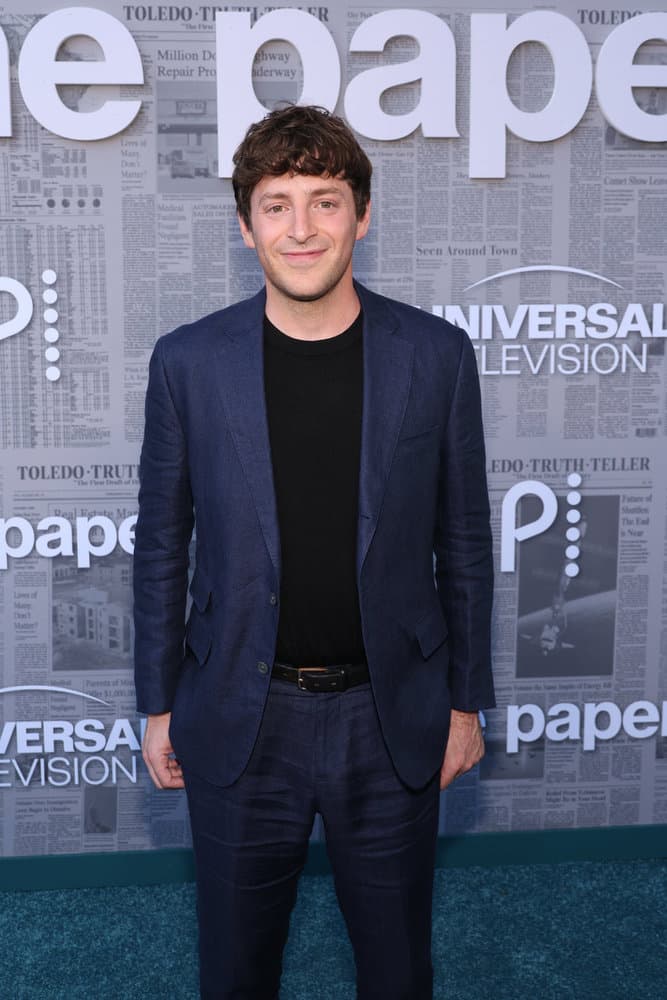
Alex Edelman usually headlines comedy clubs — now he’s making headlines of his own in “The Paper,” Peacock’s new newsroom comedy.
The Jewish comedian both writes for and appears in the much-anticipated spinoff of “The Office,” which premiered on the streaming platform Sept. 4. Edelman, who portrays volunteer reporter and accountant Adam Cooper, whose writing experience includes high school essays and being in one group text chain.
Like the rest of the Truth-Teller’s ragtag staff, Cooper is caught between the lofty ideals of local journalism and the absurd realities of keeping a small-town newspaper afloat.
Before you binge “The Paper,” let’s unpack what Alex Edelman has said about his Jewish identity.
The basics
Alex Edelman was born on March 20, 1989, to real estate lawyer Cheryl and biomedical engineer Elazar Edelman, who, as Alex jokes, “was raised a Jew in Boston at a time when it was really hard to be Jewish, which was between the years 1500 and 1992.”
He grew up in Brookline, Mass., alongside his brothers Austin and AJ. AJ went on to compete for Israel in skeleton, including at the 2018 Winter Olympics. The Edelman children attended the Maimonides School, a Modern Orthodox day school.
Edelman started performing stand-up at 15, and after high school spent a year at a yeshiva in Jerusalem. While in Israel, he helped establish the city’s first comedy club, Off the Wall Comedy.
He kept performing while studying at New York University, and after graduation won the Best Newcomer Award at the 2014 Edinburgh Festival Fringe for his show “Millennial” — the first American to do so since 1997.

His solo piece “Just for Us” debuted Off-Broadway in 2022 and transferred the following year to Broadway’s Hudson Theatre. The show was named a New York Times Critic’s Pick in both runs and earned him a special Tony Award and an Emmy in 2024. That same year, Time included him on its annual list of the 100 most influential people in the world.
In addition to his stage work, Edelman has written for TV, including CBS’s “The Great Indoors” (2016–17) and Netflix’s “Teenage Bounty Hunters” (2020). He was head writer of “Saturday Night Seder,” a virtual, star-studded Passover program created during the pandemic that raised $3.5 million for the CDC Foundation’s COVID-19 Emergency Response Fund. He later collaborated with rabbis to bring humor into High Holiday services during the height of the pandemic.
In October 2023, Edelman joined hundreds of artists in signing the #NoHostageLeftBehind open letter to President Joe Biden. Organized after Hamas’s October 7 attacks, the statement urged the administration to prioritize the safe return of all hostages taken into Gaza. By signing, Edelman added his voice to a wide coalition of cultural figures insisting that “every human life matters” and that no hostage should be forgotten.
Alex Edelman’s Jewish identity
Edelman’s comedy frequently zeroes in on his Jewish identity and the complications of being Jewish in the modern world.
As a Modern Orthodox Jew who’s “tried cocaine” but “never tried bacon,” he has spoken openly about the ways he negotiates faith and practice as an adult.
Over the years, his religious observance has shifted — sometimes keeping Shabbat, sometimes not, and varying in how strictly he follows kosher laws.
“It’s so funny because I identify as Modern Orthodox, but even the people that I’m related to are like, you’re not Modern Orthodox! You’re not strictly kosher!” he said in 2021 when asked how he identified. “But I consider myself a Modern Orthodox Jew. I’ve just never been able to shake the label. Recently, someone said to me that I’m ‘ReFrum’ which really made me laugh.”
In “Just for Us,” Edelman — who attends the Orthodox synagogue Kehilath Jeshurun on Manhattan’s Upper East Side — explores both how others perceive his Jewishness and how his own relationship to it has evolved. “Sometimes I worry I’m not Jewish enough. And to my comedian friends, I’m the most Jewish person they’ve ever met. But to my family I’m Episcopalian,” he jokes, before riffing that his full Hebrew name — David Yosef Shimon ben Elazar Reuven Alexander Halevi Edelman — makes him sound like a member of Slytherin house from “Harry Potter.”
Edelman often jokes about the contradictions of identity, but when pressed on how he defines himself, he doesn’t hedge, much to his own chagrin, oftentimes.
“I see myself very much as a Jew. More than anything else. And I hate that. Like my first thought every morning waking up is ‘Jew waking up.’ And not just Jewish. Religious. Thoughtful. It’s invested in every part of myself.”
Even in moments of celebration, he weaves that identity into the spotlight. After earning his Emmy in 2024, in the backstage “thank you cam,” Edelman slipped in a tongue-in-cheek acknowledgement: “I’d like to thank Hashem,” he said, invoking the Hebrew word for God. “Jesus gets a lot of love, Hashem gets very little and so I gotta thank him for this, even though I’m not sure I believe in him, but that’s probably enough for the thank you cam.”

Crafting Jewish comedy
Edelman often draws humor from the friction between his Orthodox upbringing and his personal identity, spinning contradictions into punchlines. As he once put it: “If I was raised secular I would consider myself bisexual. But because I was raised religious, I consider myself straight with some secrets.”
One theme he returns to is how baffling Judaism can seem to outsiders, even though for him it’s inseparable from who he is.
“It blows my mind when I meet non-Jews; they’re usually Christians, and they say things like ‘Ah, well, I used to be Christian but I’m not anymore,” Edelman explains in “Just for Us.” “That is not how it works in Judaism. Judaism is the Hotel California of religions. It is a mailing list you can never unsubscribe from.”
Edelman credits his grandfather as one of his comic inspirations: “My grandfather was this great man who somehow projected stoicism, devoutness, good humor, love of Judaism, and a healthy disregard for authority…He embodied all these great contradictions,” he explained, adding, “There’s so much comedy in inherent paradox.”
He also delights in opening his shows with unexpected tangents. “My comedy barely works if you’re not from the Upper West Side,” he jokes, before launching into a bit about Koko the gorilla, who befriended Robin Williams through sign language. “Robin Williams crossed the species barrier… Did they have to tell the gorilla that Robin Williams had passed away? She wasn’t gonna see it on CNN or anything like that!”
Still, Edelman is wary of leaning on easy tropes. Even when speaking directly to Jewish audiences, he tries to avoid falling into shtick. For him, there are ways to make Jewish comedy deeply rooted in identity without it devolving into caricature.
“When we were writing ‘Saturday Night Seder’ I was super militant about, like, no bubbes, no briskets, no bagels. I didn’t want this very superficial engagement of old school, mid-century Judaism,” Alex explained. “Because I think that gets in the way of really, really getting into it, and wondering what it means to be Jewish in the 21st century in the United States. I really like seeing people who are younger than me, and my age, examining their Judaism in a thoughtful way.”
Alex Edelman’s fight against antisemitism
At the heart of “Just For Us” is Edelman’s account of attending a white nationalist gathering in Queens in 2017, an event he learned about on Twitter. Driven by curiosity, he decided to walk in and see it for himself.
“If I’m being honest I thought it was going to be a little more of a salon,” he said. “I thought it was going to be a little more of an exchange of ideas and then I got there and I was like, Well, it’s the exchange of one idea, handed back and forth.”
That night’s lack of nuance became the foundation of his show — not just a story about sitting in a room with extremists, but a way to spark broader conversations about belonging, race, and how far empathy can reach. At its core, the show wrestles with the conditional nature of identity, particularly the uneasy overlap between Jewishness and whiteness.
Edelman dissects the contradictions of race and the arbitrary boundaries of “whiteness,” questioning where Jews fit in — and how much that depends on the eye of the beholder.
“If you don’t like white people, Jews are the whitest possible people in the world. If you think being white is awesome, then Jews are-absolutely-not-white-never-been-white. So that’s really what we call a lose-lose situation,” he jokes in the special.
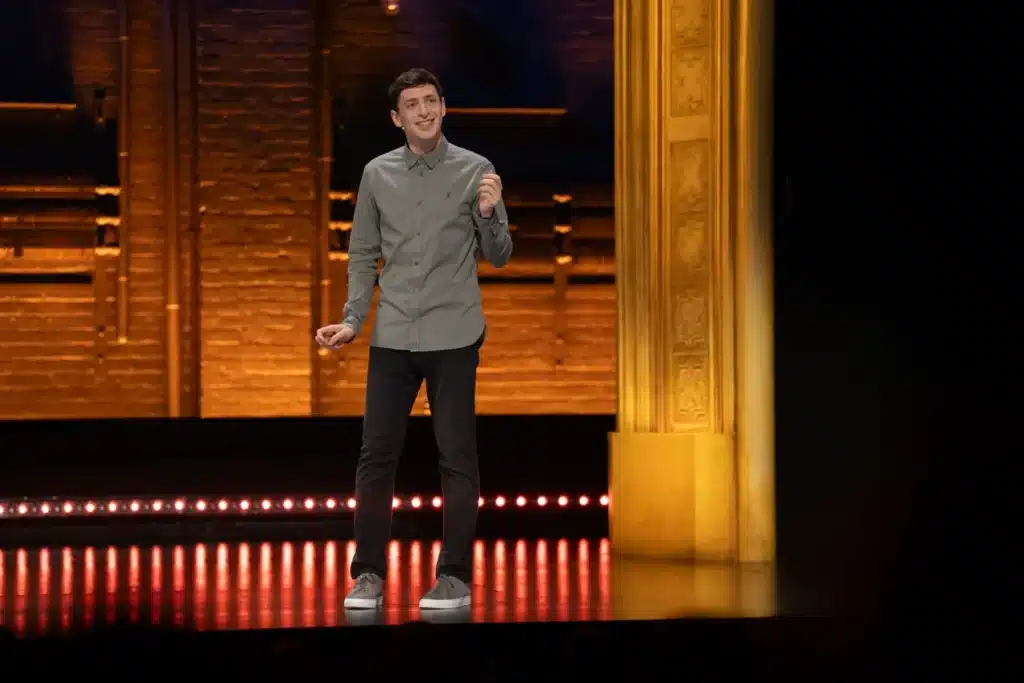
In telling the story, Edelman frequently veers into sharp digressions. One tangent recalls his time hosting a radio program for the BBC in London, and the moment a listener tweeted — not to critique the broadcast, but to complain that Edelman himself was Jewish.
“Sometimes people can tell that I’m Jewish because of my name, or my face, or anything about my personality,” he says. But this guy is very upset because I’m a Jew and on his radio and he lets me know and because I’m insecure about the obscurity of my radio show, I make a mistake. I write back to the tweets.”
In the five years Edelman performed his Jewish-themed show — full of riffs on Talmud study and throat-clearing Yiddish names — he estimates that “four or five” self-described antisemites have lingered afterward to talk with him. “They feel proud of having sat through my show,” he explained to Vanity Fair. “They’re like, I listened to you and now you’re going to listen to me.”
When confronted with those encounters, Edelman relies on a consistent approach: “I always ask the same question, I’ll lean in and go, ‘Hey, would you say that you don’t particularly care for Jews? Like, generally.’” If the person doesn’t immediately own up to it and instead insists they’re fine with Jewish people, he’ll suggest moving the conversation somewhere private.
For Edelman, it’s frustrating when audiences or critics describe “Just For Us” as suddenly relevant only when antisemitism spikes in the headlines. He pushes back on the notion that prejudice against Jews ever truly fades, arguing instead that it’s a constant undercurrent. In a 2021 interview, he explained that while people often treat his material as “timely,” the reality is that the show would have felt urgent in almost any decade.
“Antisemitism has never not been in style. In 2018 everyone was like, God, the show is prescient. There’s so much antisemitism around. And I’m just like, it’s never going away. I could’ve been doing the same show in 1984 and people would’ve been like, on the heels of XYZ, this is so timely,” he said. “The show’s not quite a rumination on antisemitism. But there are little ground-up zests of what I’ve seen or what I think people have experienced.”
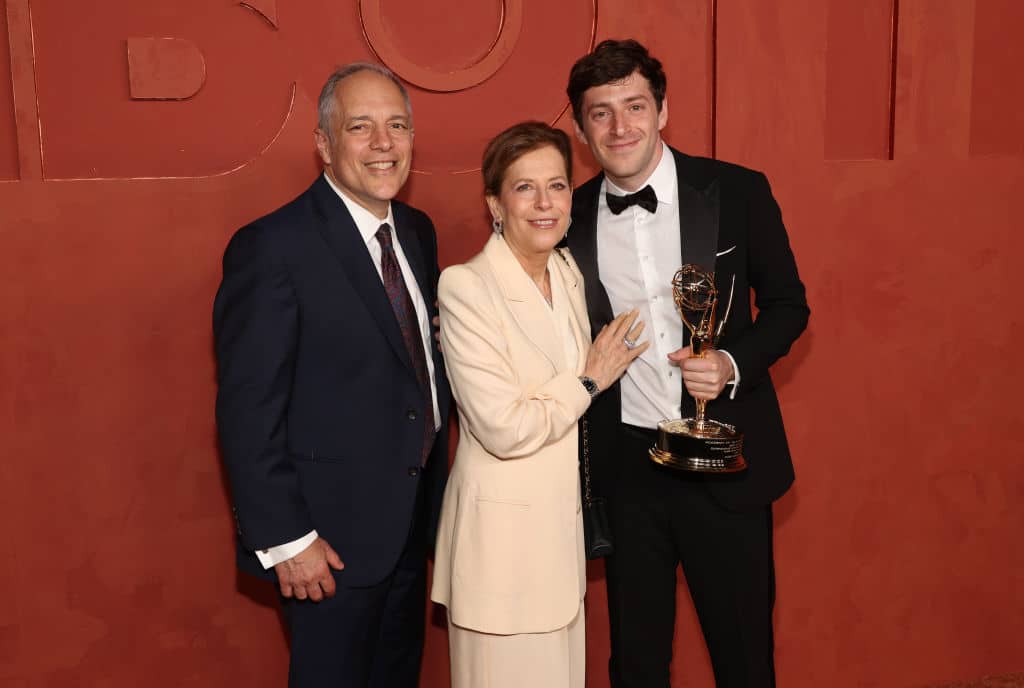
When he accepted his Emmy in 2024, Edelman was asked what he hoped audiences would take away from “Just For Us.” “The show is kind of about what happens when we sit down with people who are fundamentally opposed to us, and what we learn about ourselves. I think, given what’s going on in the country right now, given what’s going on in the world, I like the idea that people who are fundamentally opposed to one another, maybe even hate one another, can have productive conversations.”
He suggested that looking inward through those kinds of interactions is “a really interesting way forward,” lamenting that such moments are rarely shown in popular culture. That absence, he speculated, might explain why the show has resonated so strongly.
“Having conversations with people who hate you, I think that’s going to become necessary. We get further and further apart as a country, our environment gets more and more rancorous,” he said.
Edelman said he hopes people recognize there’s a real appetite “for content like that” and “for conversations like that,” capable of bridging divides.