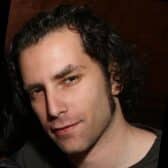

Boy George has never been afraid of courting controversy. Now, the Culture Club frontman is wading directly into one of the most contentious debates in the music industry.
The 65-year-old British pop icon, whose real name is George Alan O’Dowd, released an AI-assisted pro-Israel reggae song, “We Will Dance Again,” or “Od Nirkod” in Hebrew, in late July. The song invokes the Hamas-led Oct. 7, 2023, attack on the Nova music festival, pushes back against accusations that Israel has committed genocide in Gaza and declares Boy George’s solidarity with Jews.
“You say genocide, I say war,” the song begins. Later, Boy George sings, “But if you’re ever confused, I stand with the Jews,” adding, “I don’t feel brave; I just need to behave like a human.”
The song quickly sparked a fierce backlash — one that has already had consequences for the “Karma Chameleon” singer.
Days after its release, Boy George withdrew from a planned run as King Herod in the London Palladium production of “Jesus Christ Superstar.” His manager, Paul Kemsley, said he made the decision so the production could “remain the focus” amid the controversy.
Boy George also parted ways with Tony Pontius, the longtime manager of his record label, BGP, after Pontius refused to release the song. Boy George said Pontius told him, “I want nothing to do with this song,” to which the singer responded, “OK, we are done.”
The track and Boy George’s Bandcamp page were subsequently removed from the platform. Boy George has said artificial intelligence helped create the song, describing his use of the technology as “AI for good.” Bandcamp prohibits music generated “wholly or in substantial part by AI.”
Despite the consequences, Boy George has shown no sign of backing away from the message behind the song.
Boy George’s support for the Jewish community
The song did not come out of nowhere.
In April, Boy George found himself in Golders Green, the heart of London’s Jewish community, shortly after two Jewish men, Shloime Rand and Moshe Shine, were stabbed in what police investigated as a terrorist attack.
“I was in Golders Green yesterday. I arrived just as the police presence was building,” Boy George wrote afterward on social media. “My heart goes out to the two Jewish victims and to their loved ones. We need to make our Jewish community know we support them.”
A few weeks later, during an appearance on Ireland’s “The Late Late Show,” Boy George spoke more extensively about his relationship with the Jewish community.
“I’ve kind of had a lot of abuse online for my support of my Jewish friends,” he said. “But if you’ve got an Amy Winehouse record, you’re probably going to Hell, so get over it.”
“For me personally, growing up, I’ve had so many beautiful Jewish friends that I still have,” he continued. “And being asked to kind of turn against a whole race of people is just not acceptable to me.”
Host Patrick Kielty noted the suffering in Gaza and described the Israeli-Palestinian conflict as complex.
“Well, I think you don’t blame a whole nation for what’s going on in America, or in Russia, or anywhere else,” Boy George responded. “I don’t choose my friends based on their race or their sexuality or their age. I choose people because I like them. Because they’re good people.”
He then turned to the studio audience.
“Do you know any Jewish people?” he asked.
The room initially went silent.
“Look at the quiet,” Boy George said. “So weird.”
The moment appeared to stick with him.
Boy George has said his connection to Jews stretches back decades. Earlier this year, while participating in San Marino’s Eurovision entry, he defended his decision to remain involved in the contest amid calls to boycott Eurovision over Israel’s participation.
“I have many Jewish friends, whom I’ve known since I was 15 or 16 years old,” he said. “Are people asking me, as someone with principles, to turn my back on my Jewish friends? That is not going to happen — it will never happen.”
He added that he had worn a Star of David early in his career and felt “very connected to the Jewish people,” while distinguishing that connection from support for every Israeli government policy.
What is “We Will Dance Again” about?
“We Will Dance Again” centers on the Nova music festival massacre, one of the deadliest sites of the Oct. 7 attacks.
According to the IDF’s investigation into the massacre, 344 civilians and 34 security personnel were killed in and around the festival as attendees attempted to escape, while 44 people were taken hostage.
“We will dance again” became a rallying cry of Nova survivors and Israelis in the aftermath of the attack. The phrase was also used as the title of director Yariv Mozer’s 2024 documentary about the massacre.

Boy George’s song references the festivalgoers killed while dancing and criticizes artists he believes have condemned Israel while overlooking Oct. 7.
“Musicians holding flags, mouthing like sheep,” he sings, accusing them of having “selective memory.”
The song ends partly in Hebrew.
Its message also represents something of an evolution in Boy George’s public comments. Earlier this year, he emphasized that his support was primarily for Jewish people rather than Israel itself, saying, “I’m not necessarily connected to Israel. I don’t really have an opinion on that.”
“We Will Dance Again” offers a much more explicit defense of Israel’s military response to Oct. 7.
“You say genocide, I say war”
The song’s most controversial lyric may also be its first: “You say genocide, I say war.”
Whether Israel’s conduct in Gaza constitutes genocide has become one of the central legal and political disputes surrounding the war.
Genocide has a specific definition under international law: certain prohibited acts committed with the intent to destroy, in whole or in part, a national, ethnic, racial or religious group.
South Africa brought a genocide case against Israel before the International Court of Justice in December 2023. The court has issued a series of provisional measures ordering Israel, among other things, to prevent acts prohibited under the Genocide Convention and facilitate humanitarian assistance. Contrary to a common characterization of its 2024 ruling, the ICJ did not rule that Israel was committing genocide, and as of August 2026 it has not issued a final judgment on the merits of the case.
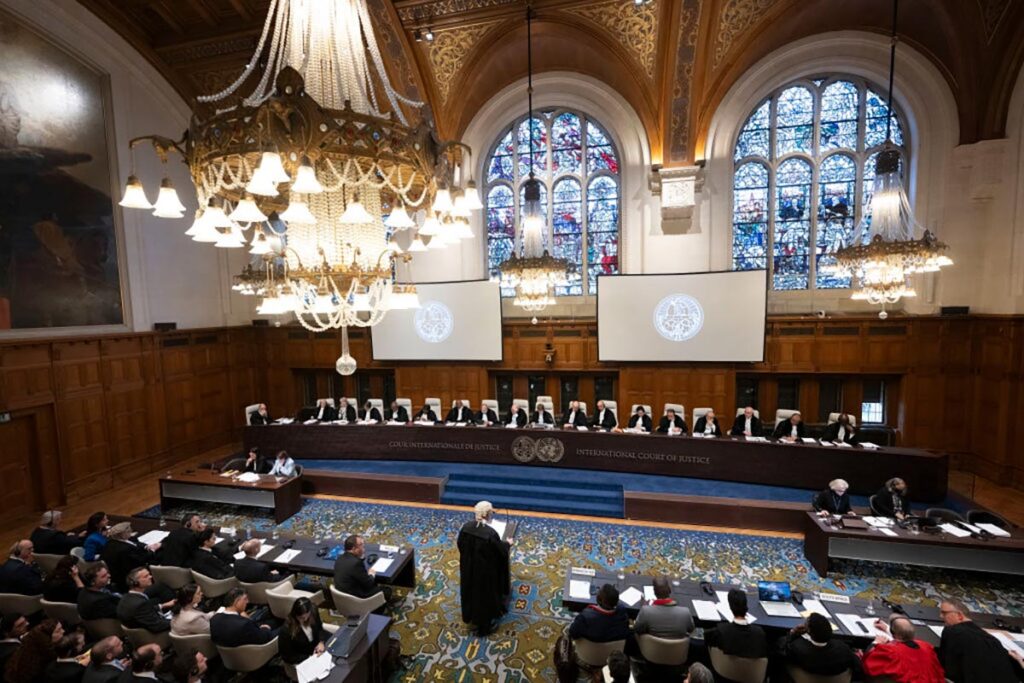
However, allegations of genocide are no longer limited to protesters or activists. A U.N. Commission of Inquiry concluded in 2025 that Israel had committed genocide in Gaza, while human rights organizations including Amnesty International and the Israeli groups B’Tselem and Physicians for Human Rights Israel have reached similar conclusions.
Israel has vehemently rejected those findings, arguing that its war is directed against Hamas rather than the Palestinian people and that its military operations followed Hamas’ Oct. 7 attack, in which approximately 1,200 people were killed and 251 were taken hostage.
That unresolved and deeply contentious debate is precisely where Boy George plants his flag.
The backlash
Reaction was swift.
Martyn Ware, a founding member of the Human League and Heaven 17 and a former friend of Boy George, called the track “an overtly pro-genocide, anti-Palestinian piece of musical propaganda.”
“George, you should be ashamed,” Ware wrote on X.
Boy George responded to criticism by saying he understood that people disagreed with him but would not retreat from his position.
“I accept that many people disagree with my point of view but that is what is great about democracy,” he wrote on Threads.
He also stressed that he does not view support for Israelis or Jews as incompatible with concern for Palestinians.
“It doesn’t mean that I don’t have compassion for Palestinians, it doesn’t mean that I agree with what’s going on in Israel,” he previously told the Telegraph. “But I am always going to defend the people that I love.”
Music becomes another battleground
The controversy arrives amid an increasingly bitter debate within the music industry over Israel and Gaza.
Irish-language rap trio Kneecap has become one of the most prominent pro-Palestinian acts in Europe, repeatedly condemning Israel during its performances. At Coachella in 2025, the group displayed messages accusing Israel of genocide and led the audience in pro-Palestinian chants.
Separately, British punk-rap duo Bob Vylan sparked widespread condemnation at the 2025 Glastonbury Festival after frontman Bobby Vylan led the audience in chanting “Death, death to the IDF.” British police investigated the performance but ultimately announced in December 2025 that there was insufficient evidence to bring criminal charges.
On the other side, a number of Jewish musicians have become particularly outspoken about Israel and antisemitism since Oct. 7.
Disturbed frontman David Draiman has frequently used his platform to defend Israel and challenge fellow musicians he believes have ignored antisemitism. In an April 2026 appearance on Billy Corgan’s podcast “The Magnificent Others,” Draiman spoke about the criticism he has received for doing so.
“To see so many of my colleagues fall prey to the narratives that are being spun is disheartening,” Draiman said. “It’s shocking to see how normalized this hatred has become.”
Draiman, who has family members and friends in Israel, said he opposes the killing of innocent civilians but believes Israel has the right to defend itself against Hamas.
“Contrary to public opinion,” he said, “Jews are allowed to fight back.”
Boy George’s anti-war past
There is another reason “We Will Dance Again” is particularly striking coming from Boy George.
More than four decades ago, Culture Club released “The War Song,” a 1984 anti-war single that became a major hit in the United Kingdom. Its message was unambiguous: war is destructive and senseless.
Boy George argues that his new track is not a rejection of that principle.
“There will be no war,” he sings in its chorus, before declaring his solidarity with Jews.
Whether listeners hear that as a plea for peace, a defense of Israel’s war in Gaza or both will likely depend on where they already stand in a conflict that has sharply divided the music industry and much of the world.
Boy George, for his part, seems prepared for the controversy.
“I saw the slogan ‘we will dance again’ and it resonated,” he said after the song’s release. “Writing has to reflect the world we live in.”