
The Jewish calendar is full of anniversaries, but so is the regular calendar.
Every week marks the anniversary of events that helped shape Jewish history, whether that’s a Nobel Prize-winning discovery, a pivotal Supreme Court decision, the birth of an iconic artist, the founding of a community, or a moment that changed the course of the Jewish people.
Welcome to Unpacked’s latest series, “This Week in Jewish History.” Each week, we’ll take a look back at the stories worth remembering and why they still matter today.
Check out previous editions here.
The October 7th Massacre (October 7, 2023)
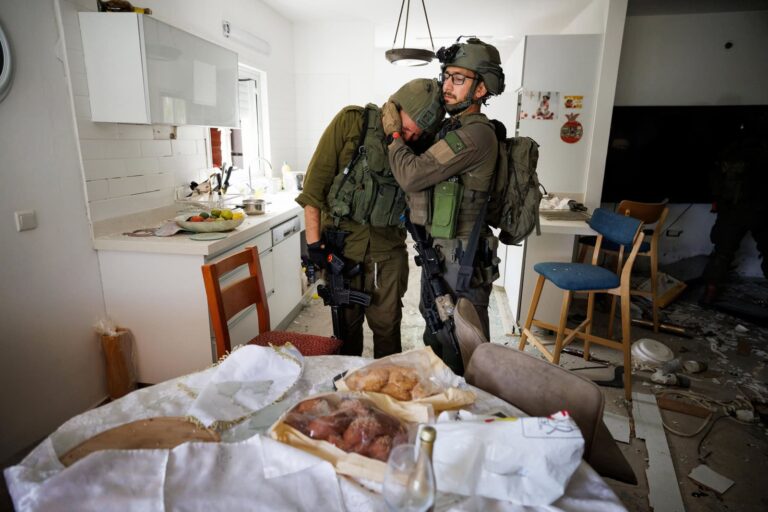
It’s difficult to imagine a more somber anniversary in post-Holocaust Jewish memory than October 7. Just three years ago, thousands of terrorists belonging to Hamas, Palestinian Islamic Jihad and other armed groups, joined by Palestinian civilians, crossed the Israel-Gaza border and attacked Israel’s southern communities.
Within hours, they ravaged kibbutzim and moshavim, cities and towns, music festivals, a beach, and military bases and border posts. About 1,200 people were killed, including civilians, soldiers, police officers and local community security personnel. The victims included Jewish and Arab Israelis, foreign students and foreign workers.
Among the youngest victims was Naama Abu Rashed, an Arab Israeli baby whose mother, Sujood Abu Rashed, went into labor on the morning of October 7. On the way to Soroka Hospital, terrorists ambushed her car and opened fire. A bullet struck Sujood in the abdomen, injuring her unborn child. Doctors delivered Naama and fought to save her, but she died hours later. Sujood survived the attack.
Among the oldest victims was Moshe Ridler, a 91-year-old Holocaust survivor murdered in Kibbutz Holit alongside his caregiver, Pietro Bosco. Having survived the Holocaust and built a life in Israel, Ridler was killed in his own home.
The killings were carried out through gunfire, grenade attacks and the burning of homes. The violence also included mutilation and the desecration of bodies. A United Nations mission later found reasonable grounds to believe that sexual violence, including rape and gang rape, occurred at multiple locations during the attacks. It also found clear and convincing information that hostages were subjected to sexual violence in captivity.
Beyond being the deadliest attack in Israeli history, October 7 also saw 251 people taken hostage into Gaza. They included Israelis and foreign nationals, civilians and soldiers, children and older adults. The youngest was nine-month-old Kfir Bibas, abducted alongside his four-year-old brother, Ariel, and their mother, Shiri. According to Israeli authorities, forensic findings and intelligence indicated that the boys were murdered by their captors in November 2023.



Because October 7 remains an open wound in Israeli society, it can be difficult to regard it as a historical event. For survivors and bereaved families, it is still painfully present. Meanwhile, much of the world’s attention has turned to the war that followed in Gaza, where the death toll has been far higher.
And yet, three years later, the scale of the October 7 massacre — and the grief it left behind — remains difficult to comprehend.
Jewish history is a story of both tragedy and triumph. This week is no exception.
Hamas agrees to return Gilad Shalit (October 11, 2011)
Though the October 7 kidnappings were much larger in scale than anything Israel had experienced before, hostage-taking has long been a feature of Palestinian terrorism.
On June 25, 2006, terrorists from Hamas and other Palestinian armed groups crossed into Israeli territory through an underground tunnel and attacked an IDF position near the Gaza border. They killed two soldiers, Lt. Hanan Barak and Staff Sgt. Pavel Slutsker, and wounded several others, including 19-year-old Gilad Shalit, whom they abducted into Gaza.

Much like the October 7 hostage crisis nearly two decades later, Shalit’s capture tore at the very heart of Israeli society. His family led a highly publicized national campaign demanding his return, making his name and face familiar across the country.
His captors demanded the release of Palestinian prisoners in exchange for his freedom. Israeli peace activist Gershon Baskin established a back channel with Hamas official Ghazi Hamad that would eventually help secure Shalit’s release. But negotiations repeatedly stalled over which prisoners Israel would agree to free.
The Israeli government, initially led by Prime Minister Ehud Olmert and later by Benjamin Netanyahu, faced an agonizing dilemma: how to bring Shalit home without releasing prisoners who could carry out further attacks.
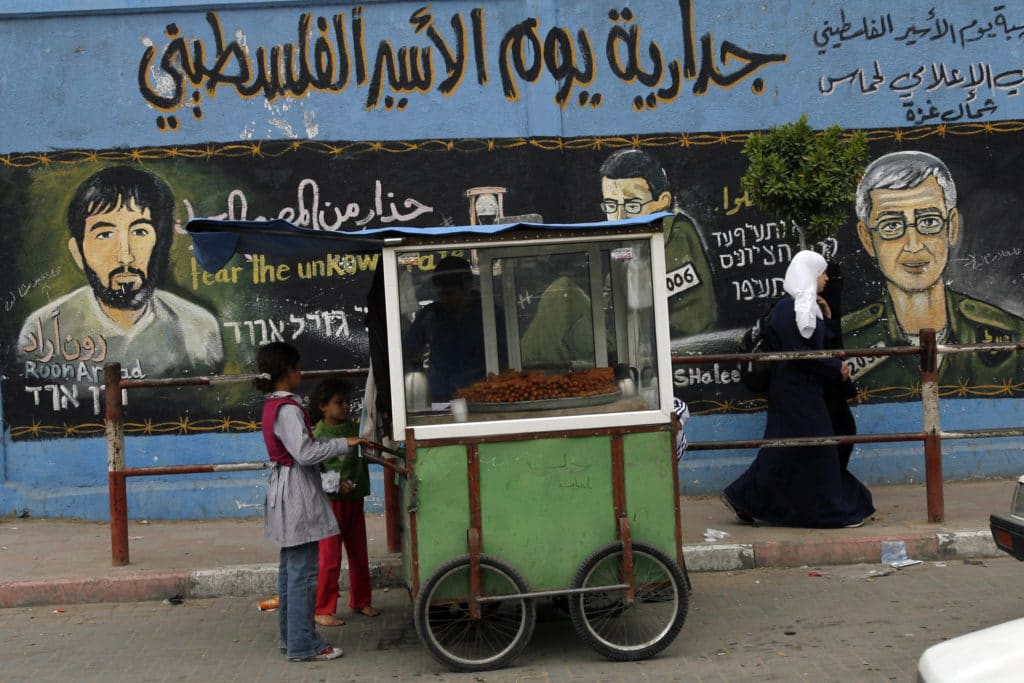
All in all, Shalit spent 1,941 days in captivity — more than five years — without a single visit from the Red Cross. When he returned, he was thin and pale, suffering from nutritional deficiencies and a lingering shrapnel injury. Reports also indicated that his captors had denied him the eyeglasses he needed.
Finally, on October 11, 2011, Israel and Hamas reached an agreement for his release, following mediation by Egypt and Germany. Shalit returned home a week later, on October 18. In exchange, Israel agreed to release 1,027 prisoners in two stages.
A poll conducted before his return found that 79% of Israelis supported the deal. For many, bringing Shalit home outweighed the risks of the exchange. But his freedom came at a heavy price: Among those released was Yahya Sinwar, who would later become Hamas’s leader in Gaza and a central architect of the October 7 massacre.