
The Jewish calendar is full of anniversaries, but so is the regular calendar.
Every week marks the anniversary of events that helped shape Jewish history, whether that’s a Nobel Prize-winning discovery, a pivotal Supreme Court decision, the birth of an iconic artist, the founding of a community, or a moment that changed the course of the Jewish people.
Welcome to Unpacked’s latest series, “This Week in Jewish History.” Each week, we’ll take a look back at the stories worth remembering and why they still matter today.
Check out previous editions here.
Ariel Sharon visits Temple Mount (September 28, 2000)
Before October 7, there was the Second Intifada.
Younger readers may know the word intifada mainly from chants such as “Globalize the Intifada.” For many Israelis and Jews who lived through the early 2000s, it evokes something far more specific: years of suicide bombings, shootings and other attacks on buses, in restaurants and on city streets.
There had been an intifada before. The First Intifada, which began in 1987, included strikes and boycotts as well as stone-throwing and other violence. The Second, which erupted in 2000, became especially notorious for its suicide bombings. More than 1,000 Israelis were killed over the years of violence, along with thousands of Palestinians.
But how did the Second Intifada begin? That question remains fiercely contested.
On September 28, 2000, opposition leader Ariel Sharon visited the Temple Mount, known to Muslims as Haram al-Sharif, accompanied by a large Israeli police contingent. The site is sacred to both Jews and Muslims, and Sharon’s visit, coming after the collapse of Israeli-Palestinian peace talks at Camp David that summer, was widely seen by Palestinians as a provocation. Clashes broke out soon afterward.
Sharon’s visit is often described as the event that started the uprising. But was it its cause — or the spark that landed amid tensions already building?

Some members of Yasser Arafat’s circle later said the Palestinian leader had anticipated, or even intended, an uprising after Camp David. In a 2012 television interview, Arafat’s widow, Suha, recalled him telling her that he would start an intifada. Imad Falouji, a Palestinian Authority minister, also said in 2001 that the uprising had been planned after the talks failed. Those statements raise serious questions about the claim that the violence was entirely spontaneous.
They do not, however, settle the matter. A U.S.-led fact-finding committee chaired by former Sen. George Mitchell found no persuasive evidence that the Palestinian Authority had planned a campaign of violence. It also concluded that Sharon’s visit did not cause the Intifada, though its provocative effect should have been foreseeable.

Twenty-six years later, Sharon’s visit remains central to accounts of the Second Intifada’s beginning. The harder history lies in what that familiar account can obscure: a failed peace process, an escalating confrontation, and the choices that turned it into years of bloodshed.
Jewish history is a story of both tragedy and triumph. This week is no exception.
Israel and the Palestinian Authority sign Oslo II (September 28, 1995)
Nearly three years after October 7, the prospect of an Israeli-Palestinian peace agreement can feel more elusive than ever. Thirty-one years ago, many Israelis believed they were moving toward a very different future.
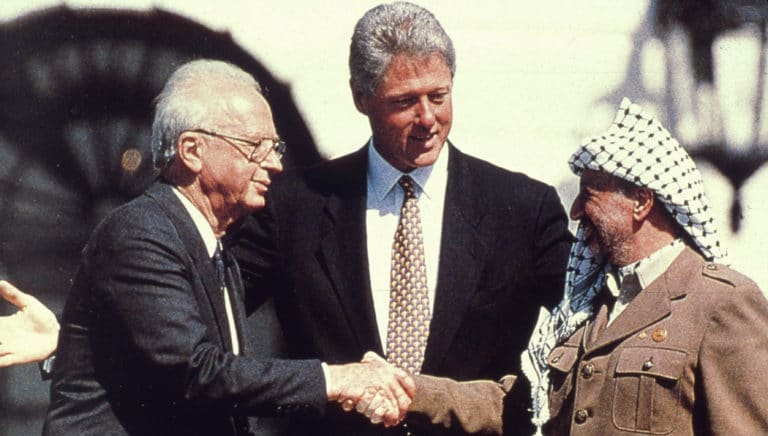
On September 28, 1995, Israeli Prime Minister Yitzhak Rabin and Palestine Liberation Organization Chairman Yasser Arafat met in Washington, D.C., to sign Oslo II. The agreement expanded the limited Palestinian self-government established the year before and laid out a plan for Israeli forces to withdraw from major Palestinian population centers in the West Bank. It also set the stage for Palestinian elections and further negotiations toward a permanent settlement.
Oslo II divided the West Bank into three administrative areas. The Palestinian Authority would take responsibility for civil affairs and internal security in Area A, which included major Palestinian cities. In Area B, it would administer civil affairs while Israel retained overriding security authority. Israel would retain control of Area C. These were meant to be temporary arrangements, pending a final agreement.
Whether the Oslo Accords were a triumph or a tragedy remains a matter of perspective—and hindsight. But at the time, they offered something extraordinary: the possibility that Israelis and Palestinians might resolve their conflict through negotiation. For many Israelis, peace no longer seemed like a distant hope. It felt close enough to imagine.
That hope was fragile. Hamas and Palestinian Islamic Jihad carried out attacks aimed at derailing the peace process, while opposition to the accords also grew within Israel. Just over a month after the signing, an Israeli extremist, Yigal Amir, assassinated Rabin. The peace process continued, but it never delivered the final agreement its supporters had imagined. By 2000, negotiations had broken down, and the Second Intifada had begun.