
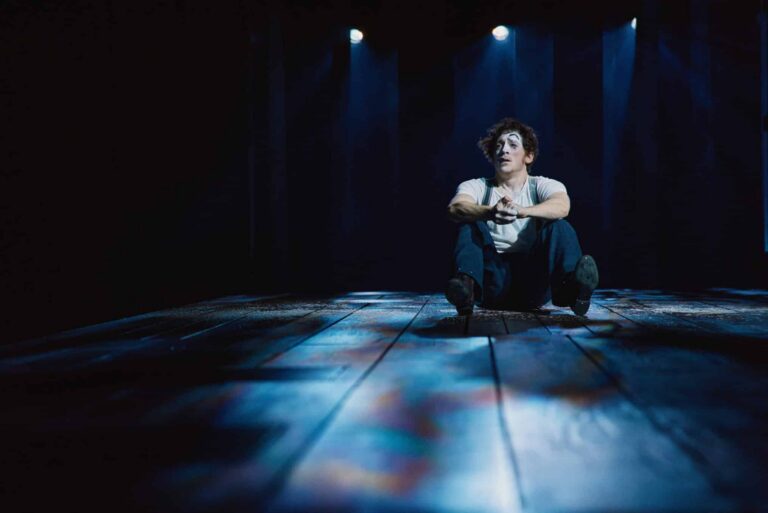
At the heart of the new play “Marcel on the Train” is a question its director, Marshall Pailet, says the show refuses to dodge: what does “delight” do in a world built to crush it? By tracing a fictionalized train escape inspired by Marcel Marceau’s real wartime rescues, the production turns survival into a kind of stage light, insisting that even in history’s darkest corridors, comedy can be a lifeline.

“Marcel on the Train,” now at New York’s Classic Stage Company, turns that question into a pressure-cooker story. Co-written by Pailet and its star, Ethan Slater, the play drops audiences onto a single, fictionalized 1943 train ride through Vichy France, following Marceau at 20, years before he became “Marcel Marceau,” as he helps smuggle Jewish children toward safety, using stillness, silence, and quick physical “bits” to keep them calm and quiet.

Marcel Marceau (born Marcel Mangel) was a French Jewish mime artist and actor who became a global symbol of wordless performance through his signature character, Bip the Clown, and a career that helped turn mime into a full dramatic language, not a novelty. The play zooms in on the part of his story many people never learned: the wartime work that shaped him before the world knew his name.
How “Marcel on the Train” came to be
Pailet traces the project’s origin to an oddly perfect life moment: the day his son was born four and a half years ago. Slater called with congratulations and then, almost immediately, with a story. “This might not be the right time,” Pailet recalled him saying, “but did you know that in 1943 a young Marcel Marceau smuggled Jewish orphans?”
Slater had been chasing a rumor that Charlie Chaplin was Jewish, Pailet said. The rumor wasn’t true, but the research led him to Marceau, who was Jewish, inspired by Chaplin, and, according to accounts Pailet and Slater had never heard growing up, part of an escape effort that used performance as cover.
What grabbed Pailet wasn’t only the headline, but the collision of identity and form. Marceau, he said, was 20 and hadn’t even gone to art school yet, but he was already a fighter with the French resistance, smuggling children by train out of Nazi-occupied France into Switzerland, and keeping them “quiet” and “feeling safe” by doing “little bits” and “little acts.” For Pailet, it clicked as both a story and a staging opportunity, the chance to tell a suspenseful rescue using the very tools that would later make Marceau famous.
From the start, Pailet said, they didn’t want a cradle-to-curtain biography. They wanted an origin story, one trip that imagines the pressure, terror, and split-second performance choices that could have shaped “how Marcel became Marcel.”

Research, history, and compression
To build that origin story, Pailet said he and the team went deep on the world Marceau moved through, especially Vichy France, the puppet government that was doing Germany’s bidding during World War II. They also tried to get as close to Marceau’s own voice as possible, including translating portions of an autobiography later published by his family.
The play is clear-eyed about what’s historical and what’s invented. Pailet said Marceau is believed to have made three trips, smuggling between 25 and 30 kids at a time, but onstage the story narrows to four children. He also noted that Marceau’s work went beyond trains. Before the trips, Pailet said, Marceau was forging identification papers to help Jews pass as non-Jewish.
That compression is the point: by shrinking a broader rescue operation into a single, fictionalized ride, the play turns history into an intimate pressure chamber.


Comedy within the train car
For Pailet, Marceau’s story was “a marriage of all the things that compel me,” and the theatrical challenge arrived hand-in-hand with the premise. He wanted the form and the content to match, borrowing “stillness and silence and silliness and vignette” to tell the story of “a very famously theatrical person.”
The train setting makes that match unavoidable. Onstage, Pailet said, “there is no escape from this train car,” which creates a literal and emotional claustrophobia: an “enemy standing at the one door,” nowhere to run, and the constant need to improvise solutions inside a locked box. It’s a space that allows “a sense of movement,” but also “stillness and tension,” as the story unfolds almost in real time.

That container is also where the play’s central moral argument does its work. Pailet described the script’s core question in blunt terms: “What is the role of delight in a world that f–king sucks?” and why an artist might reach for comedy anyway, not to distract from catastrophe, but to face it head-on and make room for people to actually absorb what they’re seeing. The play tests that tension through Marcel’s relationship with one child who challenges him almost immediately: “Why are you making jokes? This isn’t funny.”
Pailet said the model wasn’t to soften the horror, but to look to artists like Marceau and Chaplin who confronted authoritarianism head-on, sometimes mocking it, sometimes letting the sadness sit in the room, and trusting that humor can lower an audience’s guard without lowering the stakes. “The point of the show is not to distract or deflect,” he said. “The point of the show is to address it head-on with a full understanding of the weight of it.”
Telling Jewish history
Pailet said the team’s choices weren’t only about how to tell this story, but who gets to tell it in the room. From early on, he aimed not just for Jewish performers onstage, but for what he called a “Jewish room,” including stage management and designers. The goal, he said, was to create a space where nobody has to tiptoe around the big, loaded topics that hover near a Holocaust story, and where people can have “heated, safe” debates because everyone involved has “a stake in it.”

That comfort shows up in the small stuff, too. Pailet talked about the room’s shorthand, the jokes that get darker because nobody’s performing their Jewishness for “mixed company,” and the everyday rituals that make a rehearsal day feel like community. And he was clear: he didn’t build that environment so the audience would clock it. He did it for the experience of making the show itself.
The project also pulled him into his own knots of identity. Pailet grew up with a “robust reform upbringing” on the Upper West Side, and although he hasn’t been a practicing Jew since he was a teenager, his relationship to Judaism has stayed complicated.
What changed the temperature, he said, was parenthood. Having kids made the story feel less like historical distance. Whether he raises his children religiously or not, he said, if “this thing happens again, they’re on the train.” That urgency, he explained, is part of why he wanted to help tell a story about saving Jewish children, “who committed no crime other than being born Jewish,” and who aren’t even portrayed as particularly observant in the play.
Pailet said his goal is immersion before anything else: he wants the audience to lose themselves for the length of the show, to get so locked into the train car’s logic that they start breathing with the characters and feeling each decision in real time.
After that, he’s aiming for something less like catharsis and more like recalibration. If the play works, he said, it doesn’t erase fear; it changes your relationship to it, taking that ambient dread and helping to “defang and disarm” it, until the world feels a little more “do something about it.”