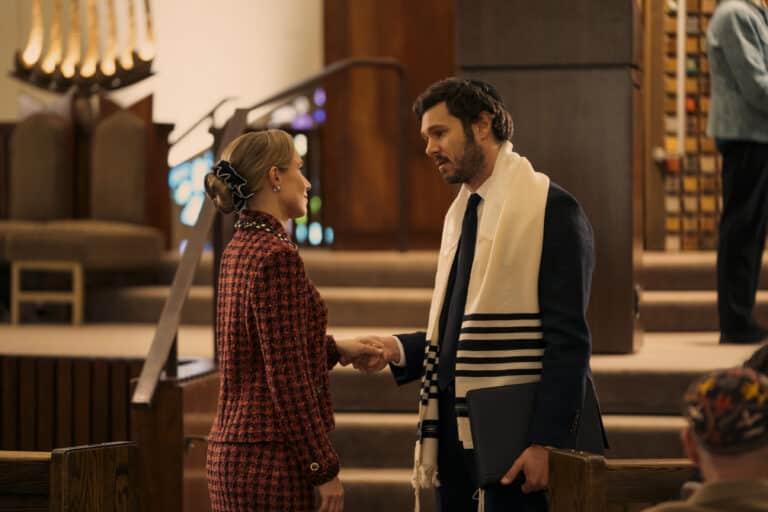
For two seasons, “Nobody Wants This” kept viewers invested in whether a rabbi and a woman who isn’t Jewish could make their relationship work. Adam Brody and Kristen Bell supplied the chemistry; competing expectations about religion, family and marriage supplied the complications.
In season three, Noah Roklov (Brody) and Joanne (Bell) are living together, and Joanne is taking a conversion class at his former synagogue. Their relationship is moving forward. Their insecurities, however, haven’t disappeared.
That gives the Netflix comedy somewhere worthwhile to go. Falling in love was one challenge. Building a life together — while managing careers, relatives and the occasional unwelcome ex — is another.
The show’s best season yet succeeds partly because it gives the people around Noah and Joanne more room to carry the story. Justine Lupe and Timothy Simons are particularly good as Joanne’s sister Morgan and Noah’s brother Sasha, whose conversations provide some of the series’ strongest scenes. But for all its confidence with romance and family friction, “Nobody Wants This” remains less convincing when it explores the faith at the center of its premise.
Moving in doesn’t settle everything
Noah may have chosen Joanne over a professional opportunity, but that doesn’t mean he has stopped wanting the job. When he hears that some congregants at Temple Chai are unhappy with his replacement, “Big Noah” (Alex Karpovsky), he lets them know he would still be interested in becoming senior rabbi.
It’s a useful complication. Choosing a relationship doesn’t automatically erase the ambitions someone set aside for it, and Noah’s renewed interest gives him something to pursue beyond keeping Joanne happy.
Joanne, meanwhile, is discovering that a stable relationship may be better for her personal life than for her career. When she misses an episode of the sex-and-relationships podcast she hosts with Morgan, the numbers jump. A possible book deal for Morgan adds to the discomfort, while Joanne’s loss of 1,000 social media followers leaves her wondering whether her audience preferred her unhappily single.

That is one of the season’s sharper ideas: If your work involves telling people about your romantic problems, what happens when those problems start to resolve? Joanne has found something she wants to keep, but she still has to figure out what she has to say.
Her ex-boyfriend Travis (Avan Jogia) supplies a less welcome reminder of her past. Invited to a housewarming party, he pulls Noah aside to warn him that Joanne is “crazy,” dressing up an insult as an act of male solidarity. His presence tests the confidence of a couple who would like to believe they have moved beyond this sort of thing.

Brody and Bell keep these situations entertaining because their rapport still feels easy. They can make a conversation flirtatious without making every exchange sound like a declaration of love. A romantic gesture involving a trip to Napa is an especially good surprise, showing that an established relationship can still deliver the big moments viewers come to a romantic comedy to see.
The supporting cast makes the season
As good as the leads remain, Lupe and Simons give this season much of its appeal.
Morgan’s brashness could easily become exhausting, but Lupe makes her someone worth following even when she is behaving badly. Her professional momentum also shifts the balance between the sisters: Joanne’s happiness doesn’t prevent her from feeling threatened by Morgan’s success.
Simons, meanwhile, gets more to work with as Sasha navigates his separation from Esther (Jackie Tohn). His conversations with Morgan are among the show’s highlights. Their connection gives viewers another relationship to invest in, with its own awkwardness and uncertainty. Lupe deserves Emmy consideration, and Simons is even better than he was last season.

Tohn brings verve to Esther, particularly in a scene in which a prospective homebuyer asks her to dinner while she is showing him a property. She tells him the approach would be creepy if he weren’t hot. It’s a funny admission of a double standard, delivered by a character who has little interest in disguising what she thinks.
Tovah Feldshuh remains effective as Noah’s mother, Bina, although the writing too often falls back on the controlling Jewish-mother stereotype. Her advice that Joanne dress more conservatively at synagogue is familiar territory; Feldshuh deserves opportunities to show more than disapproval.
Sherry Cola provides solid support as Ashley, the podcast’s producer, while Andrew Rannells brings energy to Sebastian, Joanne’s nemesis in conversion class.

Sarah Silverman is the most welcome addition as Rabbi Eden, who teaches the class. Noah worries that she holds something she saw him do on Yom Kippur against him, putting him in the uncomfortable position of seeking another rabbi’s approval. Silverman makes good use of her limited screen time, and I wish she had a larger role. Her casting also has a fitting personal connection: Her sister, Susan Silverman, is a rabbi.
Plenty of laughs, a few clunkers
The writing is often excellent. Noah and Joanne’s dialogue is fun, the story finds room for unexpected turns, and the supporting characters get jokes that make them more than obstacles to the central romance.
A sports-gambling joke is a timely touch, and a fabricated story about a tornado is another highlight. Morgan’s “Will you make me into a taco?” may be the funniest line in the series.

Not every attempt lands. Esther’s threat to kill herself if Noah and Joanne don’t join her for a double date feels like an exaggerated way to establish her anxiety. Rabbi Eden’s warning that newly converted Jews shouldn’t be like Bernie Madoff or Harvey Weinstein is an especially awkward clunker. Neither joke reveals much about the person delivering it, and both strain for a laugh.
Those moments are frustrating because the show is capable of getting humor out of much smaller, more recognizable tensions: envy between siblings, discomfort around an ex, or the difficulty of admitting what you want. It doesn’t need to push every character to an extreme.
A rabbi whose faith deserves more attention
The larger weakness is Noah’s religious life.
Brody makes him charming, affectionate and easy to root for. But when Noah speaks as a rabbi, the writing rarely gives him the depth that would help explain his appeal as a spiritual leader. His speeches don’t need to become lectures. A thoughtful observation, a difficult exchange with a congregant or a moment that shows how Jewish learning informs his choices would do more to establish his vocation.

Instead, the show sometimes seems more concerned with assuring viewers that he is a cool rabbi — including having him smoke weed with Joanne — than with showing why being a rabbi matters to him.
That gap becomes harder to overlook when his professional ambitions are part of the plot. We understand that Noah wants to lead the synagogue. We get less sense of what he hopes to offer the people in it.
The same problem extends to the family. Jewish identity is frequently named, but too often expressed through objections to Joanne, expectations about conversion or Bina’s efforts to control a situation. Noah’s Magen David necklace and Sasha’s chai necklace are welcome details, but they can’t substitute for a fuller picture of Jewish life.
Related post: I still don’t want this — A rabbi’s take on ‘Nobody Wants This’
The ninth episode makes room for a substantial Christmas scene. I wish Hanukkah had received comparable attention, or that the season had offered a meaningful synagogue scene showing what draws this community together.

The absence of any discussion of rising antisemitism or Israel also feels conspicuous in a family whose son is a rabbi. There is room for disagreement about how much current events belong in a romantic comedy. Still, even a passing conversation could help these characters feel connected to a world beyond their immediate relationship problems.
The point isn’t that the series needs to cover every Jewish issue or explain every ritual. But when a rabbi’s relationship and a woman’s conversion drive the story, viewers should get some sense of what makes this faith meaningful to the people practicing it. Too often, we see what Joanne is being asked to navigate without seeing enough of what she might find fulfilling.
We still want this
Even with those shortcomings, “Nobody Wants This” remains easy to keep watching. The score and soundtrack suit the show, the romantic surprises still work, and the ensemble gives the season enough variety that Noah and Joanne don’t have to sustain every scene.
Creator Erin Foster, who converted to Judaism before marrying a man who is not a rabbi, has found more stories to tell as her central couple grows closer. Joanne’s professional uncertainty, Noah’s lingering ambition and the changing lives of Morgan, Sasha and Esther give this season momentum beyond the question of whether its leads will stay together.
That is what makes it the strongest of the three seasons: The show can let its central relationship progress while finding fresh complications around it.
I wish its portrayal of Jewish life had developed as much as its relationships have. But Brody and Bell’s chemistry remains a pleasure, and Lupe and Simons make an increasingly strong case for sharing the spotlight.
With two previous nominations for outstanding comedy series, “Nobody Wants This” could find that the third time is the charm.