On “RuPaul’s Drag Race,” “Snatch Game” is the challenge fans wait for because it’s simple and brutal: contestants must improvise jokes while impersonating a character, answering prompts in rapid succession, hoping to make RuPaul laugh. It’s not just about an impression. It’s about point of view. The best performances don’t only mimic someone, but build a point of view around them.
That’s why The Only Naomy’s choice on the most recent episode of “RuPaul’s Drag Race: UK vs. the World” was so shocking. The German drag queen introduced an original character billed as “Hitler’s long-lost gay brother,” and framed it as a political act: a way to “speak out against the far right,” a way to turn Germany’s present-day anxiety into drag comedy, because “silence is complicity.”
Then, almost immediately, she cut the knees out from under her own premise: “It sounds super complicated, but I’m staying away from all the crazy, historic things. We have enough of that in the world right now.”

Naomy does articulate what she thinks is at stake. She links the character to the political moment in Germany and says it outright: “Intolerance is on the rise, antisemitism, sadly, is on the rise. I fear that history is about to repeat itself.”
That clarity is exactly why the Snatch Game itself feels like such a disconnect: the stated target is extremism, but the jokes rarely touch it. If your stated goal is to humiliate the roots of far-right politics, you can’t also decline to engage the history that gives those roots their meaning. You don’t have to deliver a lecture, but satire needs a target, and the target needs to be visible.

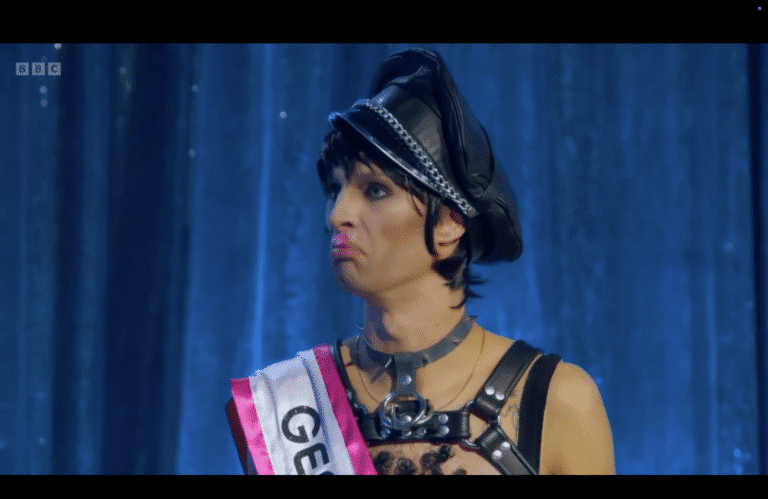
What we got instead for the “Miss Snatch Game Pageant” was a broadly camp German man orbiting RuPaul: lederhosen played as fetishy costuming, schnitzel references, exaggerated hair-and-sexuality bits, the hot-pink moustache as the only signal that this character was Hitler-adjacent. Strip away the character’s label, and it plays less like a deliberate political skewering and more like a culture-costume character, the kind Snatch Game sometimes slides into when the joke becomes a bundle of stereotypes rather than an idea. Even in the room, the show treats the name like it’s radioactive. The judging panel barely even uses the name Hitler in relation to the character, referring to the Nazi dictator who oversaw the Holocaust as “that horrible man.” Even Naomy’s sash reads only ‘Gerhardt H.”
Crucially, the performance didn’t make the far right look silly. It didn’t make fascism look pathetic. The performance didn’t aim at fascism; it barely acknowledged it.
It didn’t expose hypocrisy, grievance, or the way extremist politics tries to rebrand itself as “common sense.” It mostly gave us a gay German guy who wanted RuPaul’s attention. That’s not satire. That’s camp with a dangerous prop in its hand.
Satire isn’t just “making an audience uncomfortable.” Satire needs a point of view. It needs to make power look small. It needs to turn the ideology into something laughable for specific reasons. Without that, a character like “Hitler’s gay brother” becomes a missed opportunity at best, and accidental softening at worst: the audience remembers the camp and the nerve to perform, not the critique.
While Naomy explains that in Germany, “we don’t make jokes about the Second World War,” that hasn’t been true for Jews around the world. The impulse to mock Nazis isn’t new, or automatically frivolous, especially in Jewish contexts. Humor has long been one way Jews have processed trauma, resisted despair, and reclaimed a sense of agency, even during the Nazi era itself. Museums and historians have documented jokes and satire as tools people used under the regime to relieve tension and express criticism, and survivor-focused storytelling has explored how comedy functioned as a coping mechanism even in unimaginably brutal conditions.
There’s also a tradition of explicitly “punching up” at Nazis as a form of defiance: mocking them denies them the mythic, intimidating aura they crave. That’s why, for many Jews, Nazi jokes can feel less like making light of the Holocaust and more like affirming survival: you tried to erase us, and we still get to narrate you, and shrink you, on our terms.
This is where the Mel Brooks comparison matters. “If Mel Brooks can do it” is a tempting shield, because “The Producers” does turn Nazi imagery into ridicule, famously through “Springtime for Hitler.” But Brooks’ joke isn’t “Nazis, but flamboyant.” The joke is that Nazism is grotesque, ridiculous, and desperate for applause. The comedy behind “The Producers” is that self-mythology can be punctured. The satire has teeth because it’s pointed: it’s not just transgression, it’s humiliation of the ideology.
Naomy’s goal was admirable: use drag to push back against rising intolerance and the normalization of far-right language. On paper, that’s exactly what satire is for. But Snatch Game only works when the comedy is tethered to a clear target. Here, the tether snapped. What aired felt less like “humiliating the roots” and more like a stereotype who just happens to be labeled Hitler’s brother.
Germany’s modern culture of remembrance, of proclaiming “never again,” sits alongside strict rules about extremist symbols outside narrow exceptions like art, research, or teaching. When you pull Hitler into the room, you’re not just borrowing a villain. You’re summoning an entire history, whether you want to or not.
Naomy also situated the character in a present-day fear: that far-right politics in Germany is growing more mainstream. That anxiety isn’t abstract. In 2025, Germany’s domestic intelligence agency designated the AfD as a “right-wing extremist” organization, a move the party challenged in court (and coverage noted the agency later paused publicly using that label while litigation proceeded).
The frustrating part is that the fix is obvious, and it didn’t require gore, slurs, or shock-for-shock’s sake. It required layers. She could have played the contradiction itself: a character insisting he’s “not political” while parroting reactionary talking points; someone obsessed with “tradition” but desperate for Ru’s approval; an extremist trying to launder hate as respectability and cracking the second someone pushes back. That’s satire: exposing how the far right sells itself, how it begs to be normalized, and how thin the performance of “decency” really is.
As it aired, though, the performance didn’t feel like a statement on anything. It felt like a dare The Only Naomy didn’t fully take.