
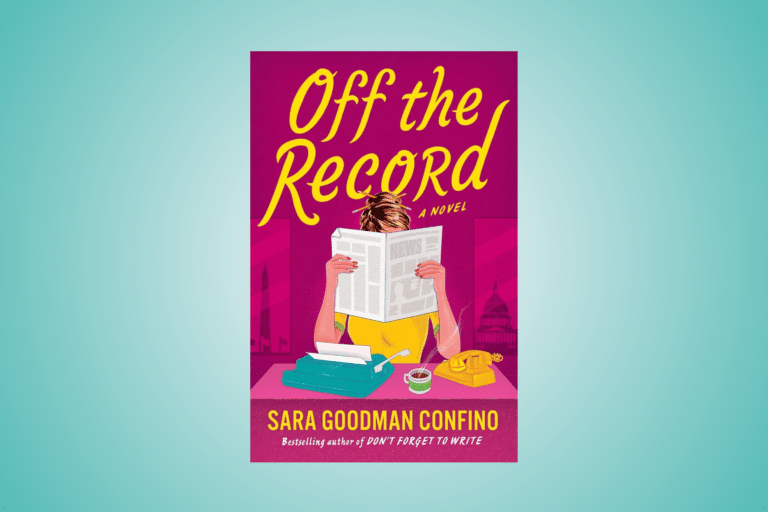
For decades, Jewish stories in American publishing have often been defined by persecution, immigration, or tragedy. Sara Goodman Confino wants to expand that picture.
The bestselling author has built a devoted following by writing novels filled with Jewish families, sharp humor, complicated relationships, and characters whose Jewishness is an integral part of their lives rather than the sole focus of their stories. From the family secrets of “She’s Up to No Good” to the coming-of-age journey at the center of “Don’t Forget to Write,” Confino’s books blend history, romance, and comedy while exploring what it means to be Jewish in America.
Her latest novel, “Off the Record,” takes readers to 1962 Washington, D.C., where aspiring reporter Judy Greenberg is stuck in a secretarial role at a newspaper despite her ambitions to become a journalist. When a mysterious phone call hints at a possible national security story, Judy teams up with reporter Jack Fields to investigate, pulling them into a world of Cold War intrigue, political secrets, and newsroom rivalries.
Drawing on her own background as a journalism teacher, Confino blends newsroom drama, historical fiction, romance, and comedy into a fast-paced story that feels surprisingly contemporary. Along the way, she explores many of the themes that have defined her work: women’s ambition, Jewish identity, and what it means to tell stories that are joyful, complicated, and unapologetically Jewish.
Ahead of the book’s release, Unpacked spoke with Confino about the real-life inspirations behind “Off the Record,” the women who paved the way for Judy Greenberg, and why she believes Jewish characters deserve adventures, laughs, and happy endings, too.
Finding modern stories in the past
While “Off the Record” is set in 1962, Confino wasn’t interested in writing a nostalgic portrait of a simpler time.

In many ways, she sees the decade as remarkably familiar.
“I really liked writing in that era where everything looked so bright and happy and colorful, but there was a lot going on under the surface that wasn’t,” Confino told Unpacked. “A lot of the women’s rights issues, a lot of the civil rights issues, all of that stuff is still kind of there.”
That tension between appearance and reality has become a recurring theme throughout Confino’s novels. Since her breakout bestseller “She’s Up to No Good,” which follows a granddaughter as she uncovers family secrets tied to her grandmother’s past, Confino has repeatedly used historical settings to explore issues that still resonate today. Her novels often center on women pushing against the expectations placed upon them, whether in the 1960s or the present day.
Judy, the aspiring reporter at the center of “Off the Record,” fits squarely within that tradition.
When readers meet her, women are still largely confined to secretarial roles in many newsrooms. Yet Judy’s world is beginning to change. Trailblazers like Jewish journalist Barbara Walters and Helen Thomas are beginning to break into spaces long dominated by men.
“We know that this is coming, but it isn’t there yet,” Confino said. “This whole world of women in journalism was really about to take off, and I love that Judy gets to kind of be in at the ground floor of that.”
The novel’s newsroom setting is particularly personal for Confino, who studied journalism in college before spending more than two decades teaching high school journalism.
“This was kind of the book of my heart,” she said. “I really liked writing it. It was just a blast.”

That experience helped shape everything from Judy’s determination to the reporting techniques woven throughout the story. Confino even slipped in a few journalism lessons her former students may recognize.
“Some of the rules that Judy is teaching Jack, for example, were things we were doing in our classroom,” she said.
There’s also a more practical reason she enjoys writing in the 1960s.
“I also actually hate writing cell phones,” she laughed. “So I love that I don’t have to write any kind of real technology into these stories.”
A mystery inspired by Washington lore
While “Off the Record” explores workplace sexism and Jewish identity, it is also, at its core, a mystery.
The novel follows Judy and Jack as they investigate a possible national security scandal against the backdrop of the Cold War, a storyline that grew out of an unexpected combination of Washington folklore, presidential history, and one of Confino’s favorite college classes.
The spark came years ago during a night out in Washington, D.C., when a stranger told her a story about a local bar allegedly frequented by people connected to President John F. Kennedy.
“I was talking to some random guy who was telling me that this bar is where Kennedy used to send people to bring women back to the White House for him,” Confino recalled.
The story ultimately turned out not to be true, but it sparked an idea. Confino became fascinated by Off the Record, the famous basement bar inside the Hay-Adams Hotel near the White House.
That idea eventually became the foundation for the novel.
Originally, Confino planned for the mystery to revolve around the Soviet Union and the KGB. However, after learning that another forthcoming book from her publisher covered similar territory, she pivoted toward Cuba, a decision that opened up an entirely new area of research.
“My favorite non-journalism college class provided a lot of the background knowledge for this,” she said, referring to a course on the United States in the 1960s that focused heavily on the Kennedy administration and U.S.-Cuba relations.
As she dug deeper into the Cuban Revolution, she found herself captivated by stories that rarely make their way into popular fiction, including the role women played in the conflict.
“I remember I was looking for pictures of Cuban women,” she said. “And the first thing that I come upon is one fighting in the revolution.”
What began as a simple image search turned into days of research and eventually helped shape one of the novel’s major storylines.
What’s in a name?
Like many American Jews in the mid-20th century, some of the novel’s characters wrestle with assimilation and how visibly Jewish they want to be.
Throughout the late 19th and 20th centuries, some Jewish immigrants and their descendants shortened, anglicized, or changed their names entirely in an effort to avoid discrimination or blend more easily into American society. Similar decisions were made by immigrants from many backgrounds, including Italians, Eastern Europeans, and Latinos seeking opportunities in workplaces where ethnic prejudice remained common.
Confino wanted to explore those tensions through Jack, the novel’s male lead. His Jewish identity remains partially hidden behind a more conventionally American-sounding name, reflecting a common strategy employed by Jews and other immigrant communities throughout the 20th century.
“It was something that did happen,” she said. “People did change their last names to get ahead.”

At the same time, “Off the Record” presents a different path through its protagonist.
“I like that Judy doesn’t do this,” Confino said. “It doesn’t even occur to her to try to go by a different last name.”
For Confino, Judy’s confidence is part of what makes her compelling. She moves through a world where antisemitism and sexism are real, but she refuses to make herself smaller to accommodate them.
“She is who she is, and she is unapologetic about it,” Confino said.
That contrast between Jack and Judy reflects a broader reality of American Jewish life in the decades after World War II. Some Jews sought safety through assimilation. Others embraced a more visible Jewish identity. Many found themselves somewhere in between.
Laughing through the hard parts
Although “Off the Record” tackles sexism, antisemitism, and the political tensions of the Cold War, the novel never loses its sense of humor.
That’s intentional.
For Confino, comedy isn’t a way of avoiding difficult subjects. It’s often how people survive them.
“One of those things, like when you look at the world today, you can either laugh at it, or you can start screaming,” she said. “And there’s kind of no in between there.”
Much of that perspective comes from her own family.
Growing up, she heard stories from her grandmothers about encountering antisemitism, but what stuck with her wasn’t just the prejudice itself. It was the way they responded.
One grandmother, while applying for a receptionist job at a country club, was told that management needed to fire the current receptionist because “she’s Jewish.”
Rather than accept the position, Confino recalled, her grandmother ripped up the application and walked away.
Another family story involved her Romanian immigrant grandmother, who was volunteering at a hospital and helping patients choose their meals. When she offered one woman a bagel, the patient responded, “I am not Jewish. I do not eat bagels.”
Without missing a beat, Confino said, her grandmother replied: “Do I look Chinese to you? Because I enjoy lo mein and egg rolls.”
For Confino, those moments reveal something important about Jewish storytelling.
“I think if you bog it down in antisemitism without letting there be humor in those situations, you’re going to lose some readers,” she said.
Why Jewish joy matters
Confino’s commitment to writing joyful Jewish stories grew partly out of what she wasn’t seeing on bookstore shelves.
While participating in the Jewish Book Council’s author network, she found herself listening to fellow writers pitch books centered on themes that have long dominated Jewish publishing: the Holocaust, immigration, persecution, and survival.
“Before we got to mine, every single book before me was like Holocaust or immigrant stories,” she recalled
By the time it was her turn to speak, she felt out of place.
“I was sitting there, horrified,” she said. “Like, I write happy books. Am I allowed to be here?”
The moment reinforced something she had already been thinking about for years. While suffering is undeniably a central part of Jewish history, Confino believes it shouldn’t be the only lens through which Jewish life is portrayed.
Her own novels offer a different perspective. Across her six novels, she writes Jewish characters navigating family drama, romance, career ambitions, friendship, grief, and reinvention. Antisemitism exists in these worlds, but it does not define them.
“We deserve fun books,” she said.

That philosophy runs throughout “Off the Record.” Judy’s Jewish identity shapes her worldview, but she is never reduced to a lesson or a symbol. Instead, she is allowed to be ambitious, stubborn, funny, flawed, and occasionally wrong.
The importance of that became especially clear through her son, a devoted fan of “Star Wars” and “Indiana Jones.” One day, he asked whether any of his favorite characters were Jewish. Confino initially started to say no before remembering that actor Harrison Ford is Jewish.
Watching his face light up changed the way she thought about representation.
“I realized there really wasn’t that for Jewish kids growing up,” she said.
Today, she hopes books like “Off the Record” can help fill that gap, offering Jewish readers the chance to see themselves not only in stories of survival, but in stories of adventure, ambition, romance, and joy.