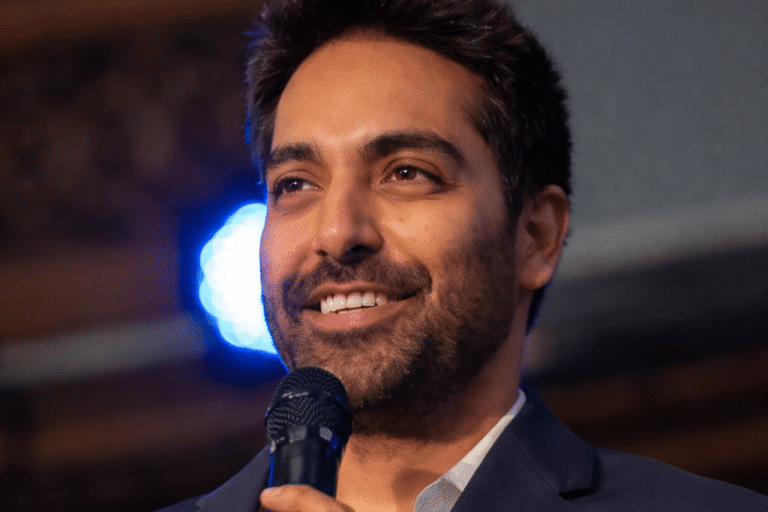
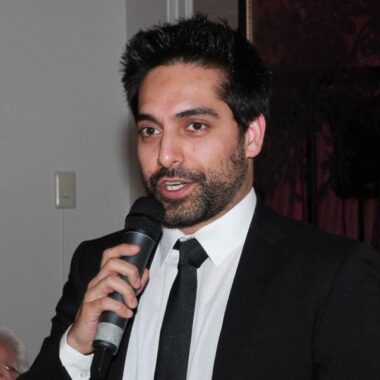
When Mahyar Tousi left Iran at age 14 in 2003, he had no idea that he would one day become one of YouTube’s most prominent Middle East news streamers, with more than 1.5 million subscribers. In an interview with Unpacked, conducted before the current attack on Iran, Tousi said he first built an audience through his support of Brexit before a new wave of viewers found his channel through his coverage of the October 7 attacks.
As the situation in Iran intensified, even more people turned to him as a trusted source of commentary, particularly as he argued that Ayatollah Ali Khamenei would be removed as Supreme Leader one way or another.
“People in Iran are very pro-Israel and pro-America,” Tousi told Unpacked. “They say Israel has the right to defend itself, and they are fine with the IDF hitting government sites. They know they can’t really win this with just an uprising.”
Tousi said he hoped the regime could fall without the need for American or other foreign boots on the ground, though he acknowledged that the situation remained deeply complicated.
Nearly a million people turned to Tousi’s livestream as he became one of the first online broadcasters to report that Khamenei had been killed in the joint U.S.-Israeli aerial assaults of February 28.
The moment was striking not only because of the scale of the news, but because of who was delivering it: an Iranian exile who had spent years building an audience around anti-regime commentary was now narrating what many viewers saw as a historic turning point for Iran.
For Tousi, the announcement was not just another breaking-news update. It was personal, emotional, and tied to the cause that has defined much of his public life.
“Every single minute of my 37 years in this world was to fight for freedom,” Tousi told his audience, framing the moment as part of a much longer struggle against the Islamic Republic.
Blending humor and hope
Tousi blends sharp analysis of the Iranian regime with a dry, sometimes biting sense of humor, dismissing figures he sees as apologists for terrorists or obsessively anti-Israel, including Tucker Carlson and Candace Owens, as “nutters.”
But beneath the sarcasm is a serious conviction: he told Unpacked that he still believes the people of Iran will eventually be free, even if the path there is long and uncertain.
He has also been clear that bringing down the regime will not be easy. Time recently reported that two senior Iranian health officials said the death toll from the regime’s crackdown during the nationwide protests of January 8 and 9 could be as high as 30,000, though the magazine said it could not independently verify that figure.
Tousi has described the situation inside Iran as dire and has suggested that some form of help from the U.S., Israel, or both may ultimately be necessary. At the same time, much remains unclear, despite the military gains made by Washington and Jerusalem. A decisive factor, he argued, would be whether parts of the Iranian military defect, side with the people, or, at a minimum, refuse orders to fire on civilians.
Why Mahyar Tousi’s channel exists
Tousi said that in an ideal world, there would be no need for a channel like his. But in his view, the British Broadcasting Corporation, or BBC, created that need by repeatedly showing what he sees as an anti-Israel bias. That failure, he argued, left a vacuum for viewers who no longer trusted mainstream outlets and began searching for alternative sources of commentary and analysis.
“The BBC’s failure over the last five or ten years was the reason a channel like mine was created and grew,” Tousi said of Tousi TV. “My channel shouldn’t exist. There shouldn’t be any need for a channel like mine if you had a normal country with normal media that was credible. But they’re not doing their job, so people like me will have to do it. We saw for the first few months [after October 7] the BBC was refusing to call Hamas ‘terrorists.’”
When anti-Zionism becomes something else
Tousi said he understands why some people, hearing his first name, might assume he is Jewish, even though he is not. He added that some detractors mock his surname, which he sees as further evidence that the claim that hostility is only about anti-Zionism, and not antisemitism, often falls apart under scrutiny.
“One of the nicknames people who don’t like me use is ‘Jewci,’” Tousi said. “They’re using it as an insult. I’m not a Jew. But what if I was a Jew? It exposed the problem. Over the last year and a half, they’ve been saying, ‘No, the problem we have is just with the Israeli government.’ Then they said, ‘Just the Zionists.’ Now they say, ‘All the Jews.’ So the mask is slipping.”
He said that when he first became popular, some people joked that he must be part of Mossad. By now, however, he said most people know that is not the case and understand that he is a journalist.

October 7 and the widening front
Tousi said he was alarmed by how quickly the reaction to the Hamas attacks of October 7 spilled into open anti-Israel activism. In the hours and days after the massacre, he recalled seeing people waving Palestinian flags, dancing, and celebrating, while anti-Israel protests erupted before the Israeli military had even launched its response. To him, that was an early sign that the fallout would extend far beyond the battlefield.
“That was already a signal this was going to be a long battle,” Tousi said. “It was not going to be only about Israel, but about any Jew anywhere in the world and an attack on our Western values. I knew from that moment, unlike previous conflicts, this was going to expand everywhere else.”
He added that he is especially proud of his documentary about that day, “October 7: Beyond Survival.”
A fighter for ideas
When Tousi was 13 and still living in Tehran, he said his mother once ran to the British embassy while being chased by Iran’s morality police. Those officers, he noted, have broad power to harass, assault, or jail women they accuse of wearing their hijab improperly or dressing in a way they deem immodest. For Tousi, memories like that are part of what shaped his understanding of the regime from an early age.

Although many of his streams feature him at home, delivering breaking news and political analysis, Tousi also reports from the ground. He has covered anti-Israel protests, pro-Israel rallies, and domestic political issues across England. In the course of that work, he has been struck on camera while interviewing people at demonstrations and has received death threats. Still, he said he has no intention of stopping. Drawing on both his life in London and his Iranian roots, Tousi said he sees himself as someone committed to fighting for ideas.
“I think it’s kind of hard-wired when you’re born in a country like Iran,” Tousi said. “My dad tried to bring me up like a soldier, but I’m still very much cosmopolitan. I’m not a fighter. But I’m good at survival. I don’t really get scared. I’m not complacent when a threat is there. It can get tough at times.”
Tousi said that in a surreal world shaped by unimaginable terrorism and other acts of violence, it can be easy to feel overwhelmed or discouraged. One way he pushes back, he said, is through ridicule: mocking people who repeatedly spread falsehoods or rush to defend evil. For him, humor is not a distraction from the chaos but a way of coping with it, a defense mechanism that helps make the horror more bearable. Still, he said he uses it carefully, sprinkling it in only when the moment allows. He credits his instinct for sharp, funny commentary to both sides of his identity: his Persian roots and his British upbringing.
“I think Israelis are the same,” he said. “You have to have humor or it’s too sad.”
Qatar, politics, and transparency
Tousi has pointed out the contradictions he sees at the heart of Qatar’s regional role. The country hosts a major American air base, yet it has also housed Hamas leaders in luxury hotels while positioning itself as a mediator between Israel and Hamas. He has also pointed to reports of Qatari money flowing into American universities, arguing that Doha has spent years trying to shape how young people in the West understand Israel, power, and victimhood.
Tousi said he believes Qatar pursued similar influence campaigns in Britain and France even before, in his view, its messaging took deeper hold among America’s Gen Z. In that reading, Qatar’s role as a mediator between Israel and Hamas, or between Israel and Iran, is part of a double game: using its immense wealth and strategic value to maintain ties with multiple sides at once.
“Qatar is a puppet of the IRGC,” he said, referring to the Islamic Revolutionary Guard Corps.
Despite his popularity, Tousi said he has no interest in going into politics. He prefers his current role, which remains largely a one-man operation even as he expands into Tousi TV+. But viewers should not expect to see him making his case for Israel on “Piers Morgan Uncensored.”
“He has blocked me on Twitter for about four years,” Tousi said of Morgan. “I think I hurt his feelings.”
Tousi said he has tried to show that it is a mistake for aggressors to “poke the bear,” assume there will be no response, and then cry foul when that response comes. He believes people trust him not because he pretends to be neutral, but because he avoids sensationalism, reports facts carefully, and is upfront about where he stands, including his pro-Israel views and his conservative politics.
“You can’t be impartial when it comes to news in 2025,” Tousi said. “What you can do, and what you should do, is be objective. People prefer transparency. They know Fox News is right-leaning, and CNN is left-leaning. With newspapers, you can normally tell which are more liberal and which are more conservative. They can have their own opinions and still be objective. My channel is not impartial. People know my leanings. But when I report the facts, I do it in an objective way.”
A few reporting notes before publication: Reuters has reported that Khamenei was killed in joint U.S.-Israeli strikes on February 28. Reuters has also reported that Qatar was the largest disclosed source of foreign funding to U.S. colleges in 2025 at $1.1 billion, and that Al Udeid is the biggest U.S. base in the Middle East. Time has reported that senior Iranian health officials said as many as 30,000 people may have been killed in Iran’s January crackdown, though it noted that figure could not be independently verified.