
The Jewish calendar is full of anniversaries, but so is the regular calendar.
Every week marks the anniversary of events that helped shape Jewish history, whether that’s a Nobel Prize-winning discovery, a pivotal Supreme Court decision, the birth of an iconic artist, the founding of a community, or a moment that changed the course of the Jewish people.
Welcome to Unpacked’s latest series, “This Week in Jewish History.” Each week, we’ll take a look back at the stories worth remembering and why they still matter today.
Check out previous editions here.
The Night of the Murdered Poets (August 12, 1952)
During World War II, the Jewish Anti-Fascist Committee (JAC) was the crowning jewel of Soviet wartime fundraising and effective wartime propaganda.
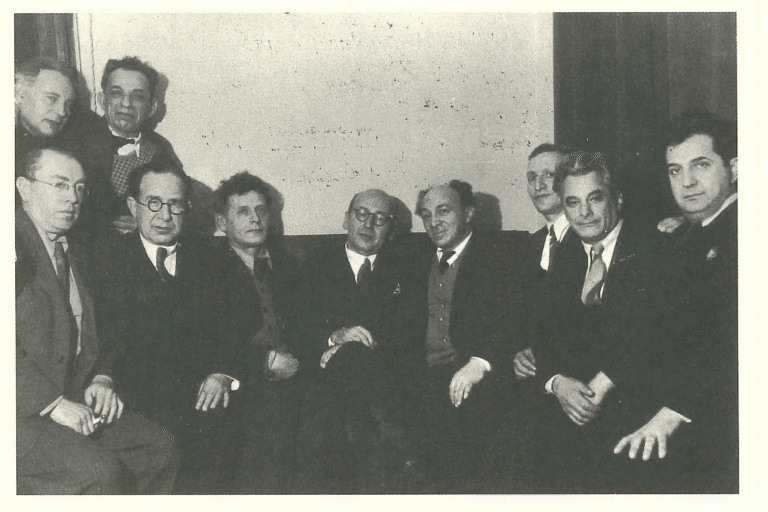
An ardently pro-Soviet, anti-Nazi group, JAC’s members traveled the world to raise money for the Soviet war effort. Established with the Soviet government’s support in 1942, the committee was made up of prominent Jewish writers, artists, scientists, and intellectuals united against Nazi Germany.
From Mexico to the United States and beyond, JAC, spearheaded by Yiddish actor and theater director Solomon Mikhoels and Yiddish poet Itsik Fefer, met with some of the planet’s most important Jews, asking for donations, supplies, and political support for the Soviet war effort.
In 1943, Mikhoels and Yiddish poet Itsik Fefer embarked on a high-profile international tour, traveling through the United States, Canada, Mexico, and Britain. Along the way, they met some of the world’s most prominent Jewish figures, including Chaim Weizmann, Rabbi Stephen Samuel Wise, and Marc Chagall. Their appearances attracted enormous crowds — including tens of thousands at a rally in New York — and raised over $33 million USD in financial and material support, which, in today’s currency, is equivalent to around $630 million USD.
In a righteous world, the JAC would’ve been celebrated for their efforts.
Instead, their success eventually helped seal their fate.
Toward the end of the war, shaken by the destruction of Jewish life in Eastern Europe, JAC members began documenting the Nazis’ antisemitic atrocities in Soviet-occupied territories. They attempted to rebuild Jewish life across Russia, which infuriated the Soviet regime, which declared that JAC was “intervening in matters in which it should not interfere.”

Thanks to their travels, JAC had formed relationships with Jewish leaders around the world. Together with American Jewish organizations, they had planned to publish “The Black Book of Soviet Jewry,” an extensive record of the Holocaust in occupied Soviet territories, in both English and Russian. An English version was published in 1946, but Soviet authorities suppressed the planned Russian-language edition, eventually destroying its printing plates.
To understand why Stalin turned against JAC, it’s important to note that Soviet wartime propaganda depicted Communists and Soviets as the primary victims of Nazi ideology, ignoring that the Nazis had specifically targeted Jews for total annihilation. Official propaganda emphasized the suffering and heroism of the Soviet people as a whole; the genocidal, rabid antisemitism that informed just about everything the Nazis did was left out of the picture almost entirely. So when JAC chose to highlight the Jewish experience of the Holocaust, the Soviets felt threatened as the committee challenged the state’s version of the war.
Additionally, JAC’s Western contacts increasingly became cause for suspicion as Stalin’s regime descended into postwar paranoia. Jews with ties to the West were branded “rootless cosmopolitans” and accused of harboring greater loyalty to the Jewish people than to the Soviet Union.
In 1948, Mikhoels, once the regime’s shining star, was murdered by the Soviet Ministry of State Security. Soviet agents staged it as a hit-and-run car accident. But the Soviets didn’t end there, dissolving the Jewish Anti-Fascist Committee and systematically eliminating its members one by one.
In August of 1952, this all came to a head with a tragic event known as the Night of the Murdered Poets.

On August 12, 13 Soviet Jews — including writers, intellectuals, scientists and former committee leaders — were executed in Moscow’s infamous Lubyanka Prison. These former JAC members had already been detained for three years and had suffered beatings, torture, and isolation, all without charge.
Then, in 1952, they were tried in secret on baseless charges of espionage, treason, and Jewish nationalism. Their long record of loyalty to the Soviet Union — including their anti-Zionist sentiments — offered no protection. Initially, the Soviet authorities had hoped to create a public spectacle, with show trials for all to see, but they had changed their minds after the accused retracted their confessions under torture, refusing to play along with the state’s script.
Despite its name, not all 13 victims were poets. Five were prominent Yiddish writers, including poets Peretz Markish, Leib Kvitko, David Hofshteyn and Itsik Fefer, as well as acclaimed novelist David Bergelson. Their murders came to symbolize Stalin’s broader campaign to destroy Soviet Jewish cultural life.
Following Mikhoels’ murder, Markish reportedly told a friend, “Hitler wanted to destroy us physically. Stalin wants to do it spiritually.”
Four years later, Markish and the other defendants were posthumously exonerated. But by then, many of the Soviet Union’s most influential Jewish voices had already been silenced.
Jewish history is a story of both tragedy and triumph. This week is no exception.
The Bialystok Ghetto Uprising (August 16, 1943)
It’s hard to imagine that a militarily doomed Holocaust-era revolt could be seen as a moment of Jewish triumph. But the Białystok Ghetto Uprising was never simply about defeating the Nazis. It was an attempt to save lives, resist dehumanization and deny the Nazis complete control over how the ghetto’s Jews would meet their fate.
The Bialystok Ghetto Uprising began much like the more famous Warsaw Ghetto Uprising did: with the news that the Nazis planned to liquidate all of the Jews living inside the Bialystok Ghetto. Before the war, Białystok had been home to roughly 50,000 Jews, who made up nearly half the city’s population. By August 1943, an estimated 30,000 to 40,000 Jews remained in the ghetto.
They already knew what deportation meant. During an earlier Aktion in February 1943, German forces had murdered approximately 2,000 Jews inside the ghetto and deported around 10,000 more to the Treblinka killing center. Members of the underground had staged a small act of armed resistance, but the Nazis temporarily halted the deportations after selecting thousands of Jewish laborers to remain behind.
The reprieve lasted only six months.
During the night of August 15–16, German police and SS units, supported by Ukrainian auxiliaries, surrounded the ghetto. Notices instructed residents to report for supposed resettlement in Lublin. In reality, the Nazis intended to liquidate the ghetto and deport its remaining population to killing centers and forced-labor camps.
The resistance was ready.

In the months before the liquidation, previously divided Zionist and Communist underground groups had united under the leadership of Mordechai Tenenbaum and Daniel Moszkowicz.
On the night of the ghetto’s liquidation, a group of 300 to 500 fighters known as the Anti-Fascist Military Organization, composed of former Zionist Jewish members of the Polish Army, began attacking the Nazis and their collaborators with whatever arms they had been able to acquire through the black market, clandestine ghetto manufacturing, and weapons smuggling operations. These included a single machine gun, rifles, a few dozen pistols, Molotov cocktails, and bottles filled with acid.
The fighters knew that, ultimately, the uprising had no chance of success. The Nazis were much more powerful. But they went ahead with it anyway, considering it a way to save their dignity after years and years of humiliation.


The fighters hoped to break through the ghetto fence near Smolna Street, opening an escape route into the surrounding forests for as many residents as possible.
On the morning of August 16, the underground launched its attack. Armed with little more than pistols and homemade explosives, the fighters confronted German forces equipped with machine guns, armored vehicles, tanks, and even aircraft.
The resistance failed to breach the German lines, but fighting continued across the ghetto for five days. On August 19, German forces discovered a bunker sheltering more than 70 underground members and killed nearly everyone inside.
To avoid capture, the commanders of the revolt took their own lives when they ran out of ammunition. However, another few hundred fighters managed to escape the ghetto and continue their partisan activities in the forest. Some became members of a Jewish partisan group called Kadimah, which was later incorporated into the broader Soviet partisan movement.

In the end, the Nazis went ahead with their plans, deporting the ghetto’s remaining 11,200 residents to Treblinka, Madjanek, and Auschwitz. Approximately 1,200 children were sent first to Theresienstadt under the false promise that they might be exchanged for German prisoners. Weeks later, they were deported to Auschwitz and murdered.
Though only nine German officers were wounded in the revolt, the Bialystok revolt is still considered the second largest Jewish uprising during the Holocaust, after the Warsaw Ghetto Uprising. By taking up arms, they attempted to create a path to survival — and asserted their humanity in the face of a regime determined to strip it away.