
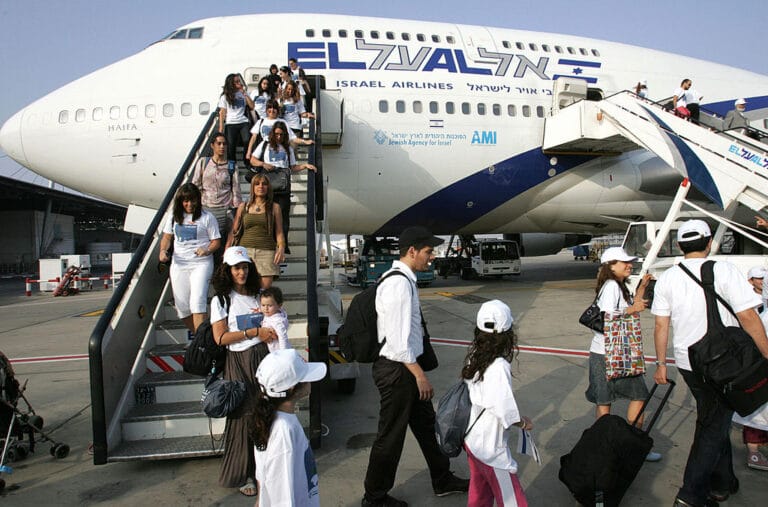
In Israel, even the most ordinary moments feel distinctive. Take, for example, an afternoon bus in Jerusalem. It’s packed to the brim, every seat filled, so passengers grip the metal railings and sway as the bus bumps along the city’s winding roads.
The air hums with a lively cacophony of overlapping conversations in Hebrew, Russian, French, Amharic, Arabic, Yiddish, and English, spoken in accents from every corner of the globe. Together, they form the living soundtrack of Jerusalem.
This bus ride is a microcosm of Israel’s culture: woven from the traditions, values, and practices of immigrants from around the world.
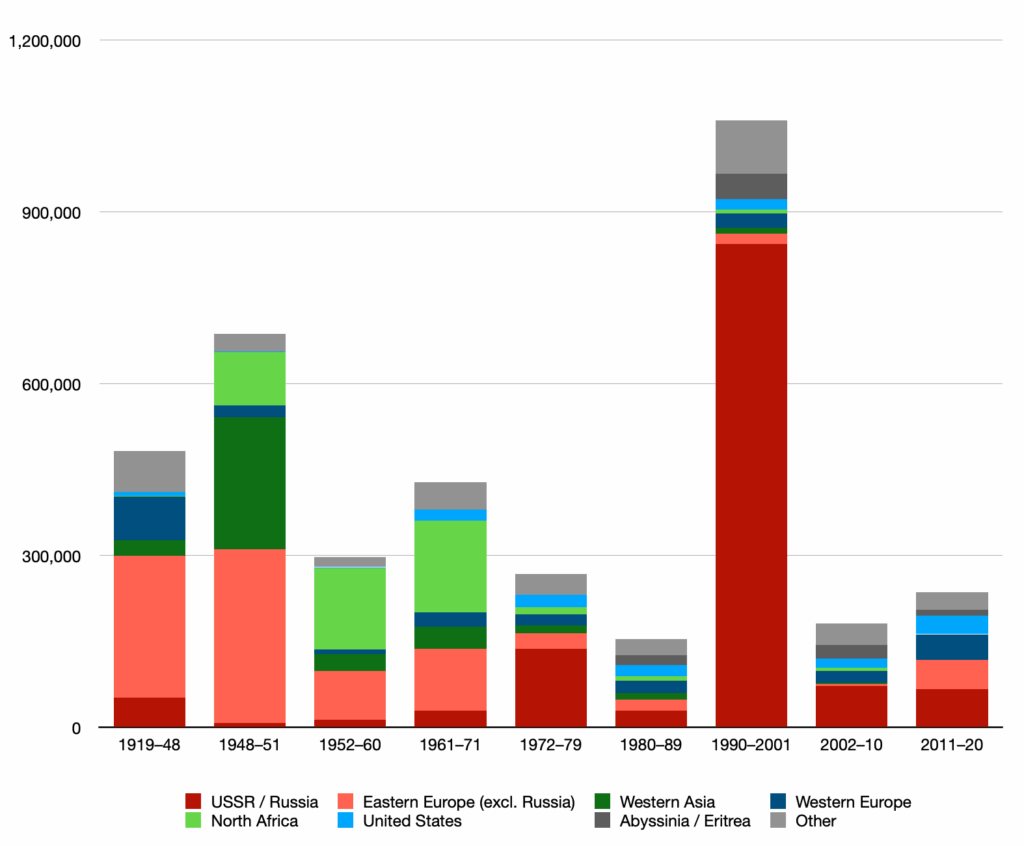
In recent discourse, Israel is dismissed as a product and perpetuator of white European colonialism. But a closer look at Israel’s complex history and vast demographics reveals something more complex: a nation built by Jews and non-Jews alike from the Middle East, North Africa, Europe, the Americas, and beyond.
This mix of languages, faces, and customs did not appear overnight. It is the result of centuries of migration — waves of people drawn to this small strip of land by faith, heritage, and the hope of a better life. From the first Zionist pioneers escaping persecution in Eastern Europe, to Jews fleeing the devastation of the Holocaust, to families expelled from Middle Eastern and North African countries in the mid-20th century, Israel’s population has been shaped by constant movement and resettlement. Understanding this layered immigration history is key to understanding Israel itself.
Jews in Israel date back thousands of years
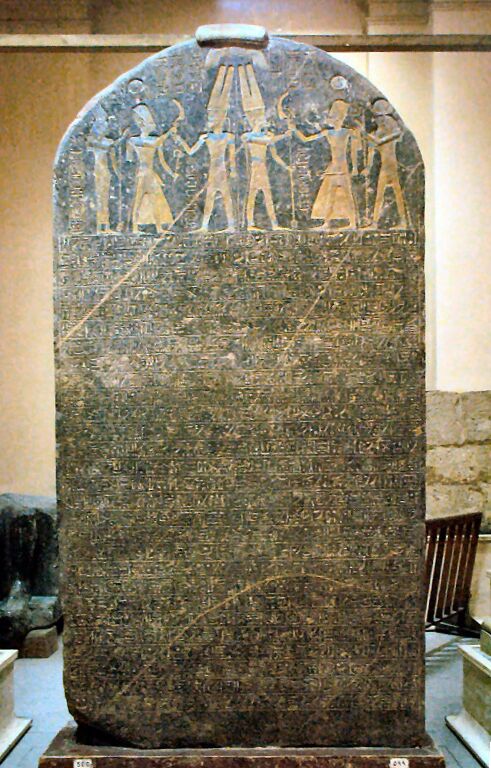
Long before modern immigration waves, the Jewish connection to the land traces back thousands of years. The earliest known reference comes from the Merneptah Stele, an inscribed stone dating to the late 13th century BCE, in which Pharaoh Merneptah mentions Israelites in the land of Canaan, the area we now call Israel.
Jewish presence in Canaan continued for centuries. However, after the destruction of the Second Temple in Jerusalem in 70 CE, the Jewish nation was banished, scattering the Jewish population across the Mediterranean, Europe, North Africa, and the Middle East.
For over 2,000 years, the Jewish people dreamed of returning to Israel, a yearning enshrined in liturgy, holidays, and daily ritual.
That hope began to take tangible form in the late 19th century. On July 6, 1882, for the first time in over two millennia, a small boat carrying just 14 Jewish immigrants arrived at the Jaffa Port. Over the next decade, the number of immigrants would grow to 35,000 Jews who ultimately journeyed to Ottoman-ruled Palestine in the immigration movement known as the “First Aliyah.” Aliyah, the Hebrew word for “going up,” refers to migration to Israel.

Why did the first immigrants decide to return after 2000 years of longing?
The reality for many immigrants of the First Aliyah was harsh: most did not leave their homelands by choice. Most were fleeing antisemitic persecution, expulsions, and shrinking opportunities as immigration quotas in other countries closed doors to Jewish communities. But, ultimately, the First Aliyah was not driven by necessity alone — it was also fueled by centuries of intense longing to return to the land of Israel.
Most immigrants of the First Aliyah came from Eastern Europe, but a small group arrived from Yemen. By the late 1800s, over five million Jews living in Tsarist Russia faced antisemitic violence and legislation. The pogroms, a Russian term for “demolish violently,” historically refer to the gruesome attacks instigated by local non-Jewish populations on their Jewish neighbors. Most prevalent in Russia in the late 1800s, pogroms devastatingly became commonplace in Western and Southern provinces of the Russian Empire.
In the decades that followed, these pressures in the Russian Empire intensified with more aggressive anti-Jewish legislation having been passed, such as the expulsion of Jews from Moscow. By 1906, more than 3,500 Jews emigrated from the Russian Empire to the land of Israel, becoming part of the influx of Jewish immigrants of the First Aliyah.

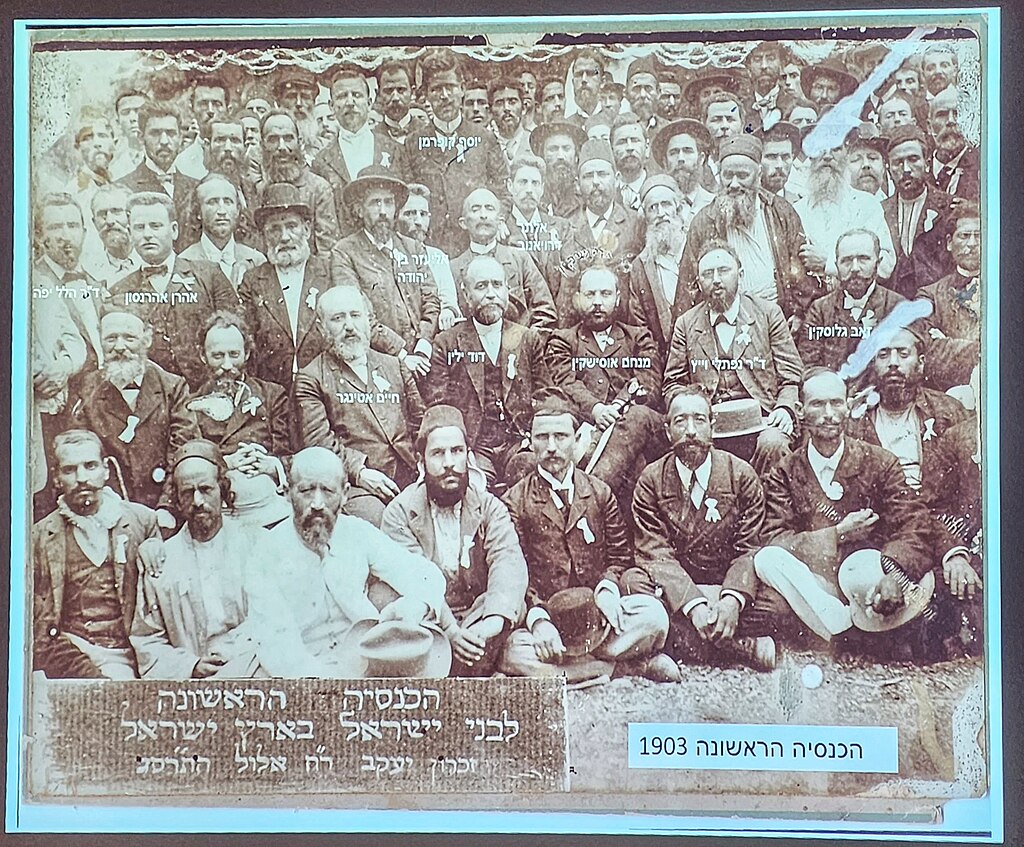
But the First Aliyah was not solely limited to Eastern Europe. A group of 3,000 Yemenite Jews emigrated to Israel as part of the First Aliyah, their motivations mostly based on Messianic beliefs.
Since the destruction of the Second Temple and the dispersion of the Jewish people from Israel, many Jews believed in the Messiah. While there were different interpretations among various groups of Jews, there was some uniformity in the Jewish beliefs in the Messiah, generally a belief in the ingathering of the exiles to the Third Temple in the Land of Israel. Thus, the news of land purchased by Baron Edmond de Rothschild and increased European immigration to Israel was interpreted as the beginning of the Messianic Redemption.
Together, this diverse group of chalutzim (early Zionist pioneers) from Europe and Yemen — who utilized their skills as farmers, laborers, tradespeople, and scholars — laid the earliest foundations of modern Jewish settlement in the land.


The Second Aliyah
Later, in 1904, there was a new wave of immigration to the land of Israel, motivated by the need for a Jewish safe haven. This mass migration, known as the “Second Aliyah,” included roughly 35,000 immigrants from across the globe. The majority of these immigrants came from Eastern Europe — particularly from areas within the Russian Empire where antisemitic violence and economic hardship were escalating — while a small portion arrived from Yemen.
Over the course of the Second Aliyah, specifically between 1911 and 1912, Yemenite Jews were brought over to Israel as part of an unprecedented, organized immigration operation. Shmuel Yavne’eli, a leader of the growing Jewish settlement movement, traveled to Yemen to persuade Yemenite Jews to move to Israel. This plan, the first of its kind in the history of Zionism, aimed to help the oppressed Jewish community and address the pressing need for agricultural labor in the farming colonies (Moshavot) in Israel. Since Imam Yahya’s reign had begun in 1904, antisemitic rules intensified. For example, he prohibited Jews from emigrating to the Land of Israel, and Yemenite Jews were considered dhimmis, second-class citizens.


Ultimately, Yavne’eli’s initiative brought 2,000 Yemenite Jewish immigrants to Israel. About half of the Yemenite immigrants from the Second Aliyah settled in cities, while the other half worked in the moshavot. Despite the Second Aliyah giving Yemenite Jews freedom from Yemen’s oppressive regime, the Yemenite immigrants continued to face the hardships of the cultural barriers, like language and Jewish traditions, that existed between themselves and the Jews living in Israel at the time. There was often strife and social division between the different ethnic communities in Israel at the time. Ashkenazi Jews, who had immigrated from Eastern Europe, often dominated the early Zionist infrastructure and had a Eurocentric view, looking down on their Yemenite neighbors.
The Second Aliyah continued until 1914, but declined when World War I broke out, slowing immigration. However, the flow of people to the land never truly ceased. By 1919, the establishment of the British Mandate over Palestine, the publishing of the Balfour Declaration in 1917 supporting a Jewish homeland, and the worsening political and social situations across Europe sparked another wave of Jewish immigrants to Israel. Roughly 35,000 Jews arrived at the time, primarily from Poland and Russia, and smaller groups who emigrated from Lithuania and Romania.

Immigration amid World War II tensions
A decade later, immigration surged again as the threat of Nazism grew. In the years leading up to World War II, over 250,000 European Jews made the journey. Between 1933 and 1936 alone, as Hitler consolidated power in Germany and antisemitic laws spread, over 160,000 immigrants arrived in British Mandate Palestine, seeking safety and a future free from persecution.
As antisemitism intensified worldwide, particularly in Europe with the enactment of the Nazi Nuremberg laws, the number of Jewish refugees seeking asylum drastically increased in the years leading up to World War II. Consequently, United States President Franklin D. Roosevelt called for an international conference to address the rapidly accelerating Jewish refugee crisis.
From July 6 to 15, 1938, 32 nations gathered for the Évian Conference in Évian-les-Bains, France. The meeting resulted in the creation of the Intergovernmental Committee of Refugees (IGCR), tasked with facilitating the resettlement of Jews living in Nazi-controlled areas.


However, the IGCR proved ineffective. Member states failed to commit significant resources or open their borders, leaving the vast majority of Europe’s Jews trapped under Nazi oppression.
To make matters worse, in 1939, the British Parliament, the governing body of British Mandate Palestine, passed the White Paper, a law that placed severe quotas on Jewish immigration. As per the White Paper, only 15,000 Jews each year were permitted to enter Mandate Palestine for the next five years, with any future immigration subject to Arab approval. This policy remained in effect throughout World War II, slamming shut one of the last potential safe havens for Jews fleeing the Holocaust.


Immigration after Israel’s founding
After World War II, the founding of the State of Israel and the enactment of the Law of Return triggered an unprecedented wave of immigration. The Law of Return was passed by the Knesset in 1950 and aimed to grant every Jew the right to immigrate to Israel and gain automatic citizenship. Between 1948 and 1952, approximately 600,000 refugees arrived in Israel. Many of these immigrants were Holocaust survivors who had been abandoned by the international community during World War II and now sought a permanent home.
While many Jews escaping the Holocaust had finally been given a home, they also faced obstacles in integrating into Israeli society. While Holocaust survivors were offered refuge in Israel, they were also socially pressured to suppress their traumatic past and adopt the new identity of the emerging state.

Moreover, the post-war world was filled with spreading antisemitism, far beyond the borders of Europe. The United Nations’ ratification of the 1947 Partition of the Mandate of Palestine ignited a surge in antisemitism in many Arab countries.
Arab Muslim mobs led riots against the Jewish community in Yemen. Mobs looted Jewish stores, burned Jewish-owned businesses, schools, homes, and synagogues.
In response to the increasing danger in Yemen, in 1949, Operation Magic Carpet brought roughly 50,000 Yemenite Jews to Israel, a near-total Exodus of the Yemenite Jewish community to Israel.
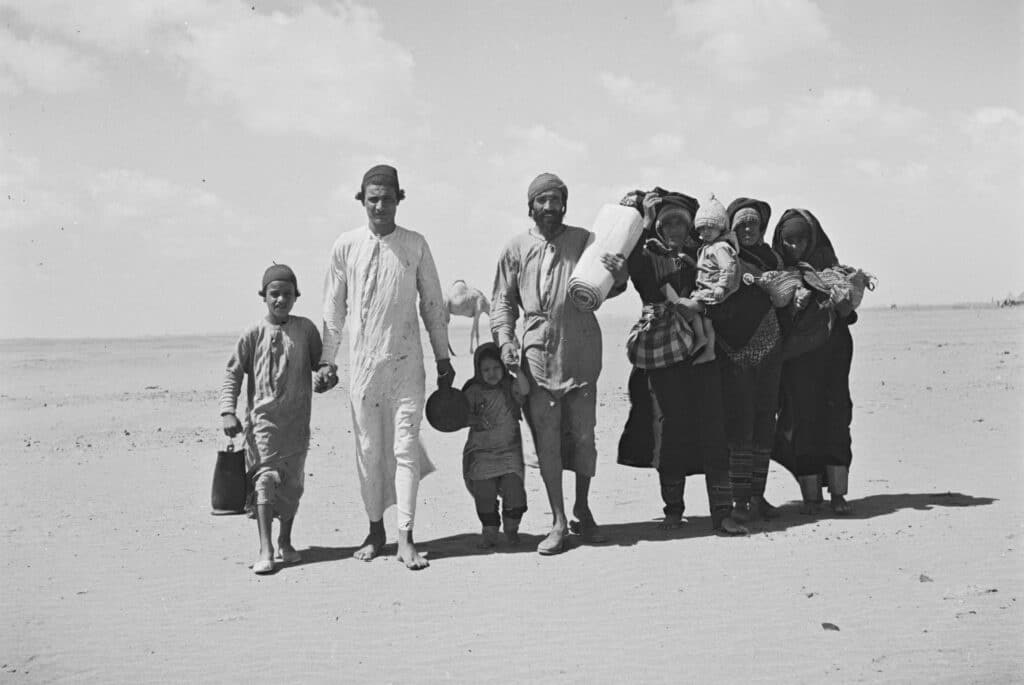


At the same time, between 1948 and 1972, approximately 600,000 Mizrahi Jews from across the Arab and Muslim world — including Iraq, Egypt, Morocco, Libya — resettled in Israel. Many had been stripped of their property and citizenship in their countries of origin.
Rescue missions continued for decades. In 1984, during the Ethiopian civil war and famine, Operation Moses secretly airlifted 8,000 Jews from refugee camps in Sudan to Israel. This mission was a result of Israel’s Chief Rabbis’ recognition of Beta Israel, Ethiopia’s Jewish community, as Jews, which gave them eligibility for rescue under the Law of Return.


Soon after, in 1991, Operation Solomon brought 14,000 Ethiopian Jews from Ethiopia to Israel. In under 36 hours, Israel completed one of the largest and fastest airlifts in history to continue the evacuation of the remaining Ethiopian Jews after a regime change in Ethiopia that further threatened their safety.
Meanwhile, between 1990 and 1999, over 800,000 Jews from the former Soviet Union immigrated to Israel, many fleeing economic collapse and renewed antisemitism in the post-Cold War era.
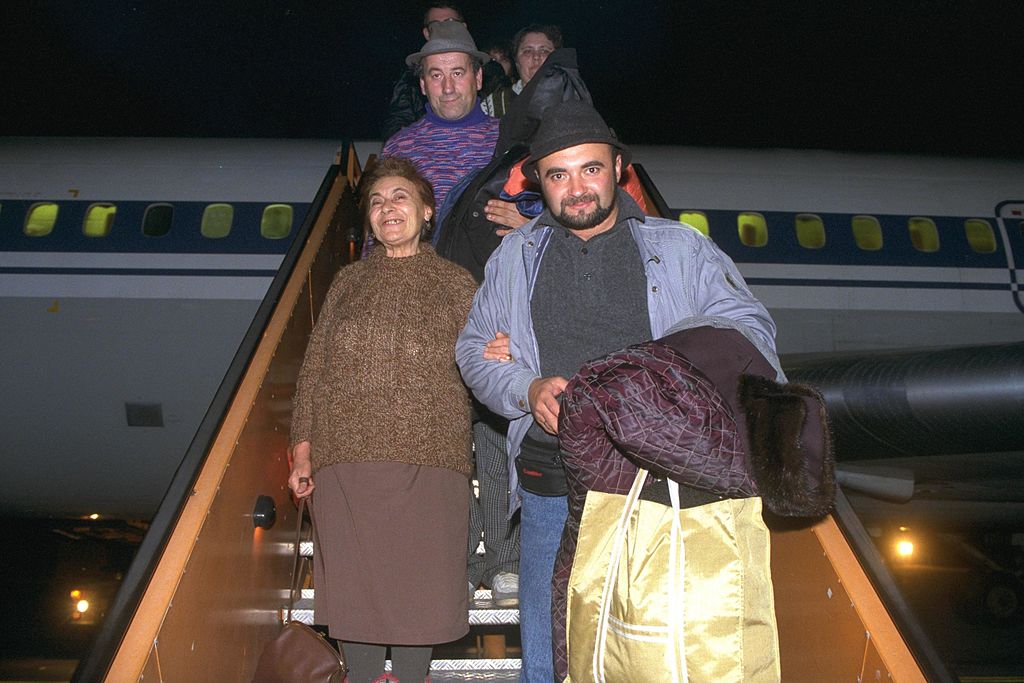
Overall, while countless Jews were saved from the struggles of antisemitism and prosecution in their countries of origin, immigration was not a simple feat.
Many of the immigrants from Yemen and Middle Eastern and North African countries were placed in refugee camps with harsh living conditions. According to author Daniel Gordis, “these camps created a groundswell of resentment that would foster for decades.” The intolerable living conditions for Jews of color were especially poignant when compared to the adequate living conditions given to the European immigrants from Poland and Hungary.
In addition to unequal living conditions, from 1949 to 1954, more than 1,000 Yemenite babies disappeared. At the time of immigration, many of the Yemenite children were brought from the transit camps to a “babies’ house” where their mothers would come to nurse them. And, if the children became sick, they were taken to the hospital, where they often disappeared under the ruse that they had died.
Today, state commissions concluded that while there were some cases of stolen children adopted by Ashkenazi parents, the majority of these children died of diseases and malnutrition.
Similar to the Mizrahi Jewish immigrants, Ethiopian Jews have faced challenges while living in Israeli society. Ethiopian immigrants are more likely to be impoverished, attend lower-funded schools, and have fewer opportunities for success. These immigrants also faced blatant racism, such as the Israeli national blood bank regularly disposing of blood donated by Ethiopian Israelis due to fear of HIV.
Soon after, Israel’s esteemed Sephardi Chief Rabbi Yitzhak Yosef, the son of the late Rabbi Ovadia Yosef, condemned this behavior, saying, “There is no excuse for issuing such instructions other than pure gizanut, pure racism.” Similarly, Israel’s president at the time, Ruvi Rivlin, called it a serious injustice.
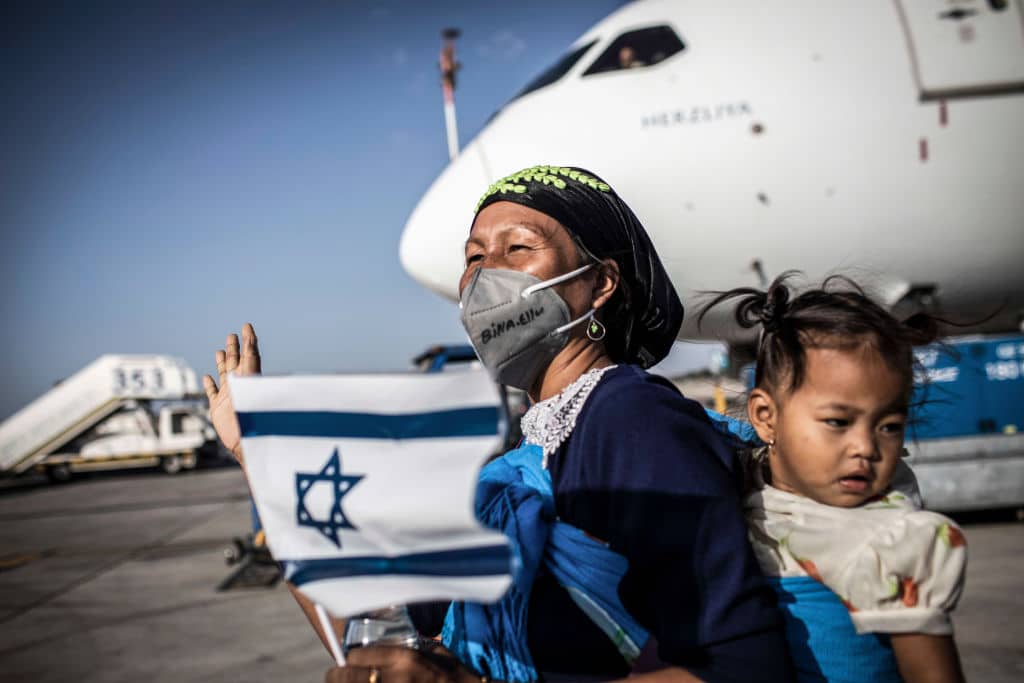
Though the process was often painful, the place of Mizrahi and Ethiopian Jews in Israeli society has grown much stronger over time. Today, Mizrahi and Ethiopian Israelis are top commanders in the military, university professors, and members of Knesset. Even so, discrimination has not fully disappeared.
Today, a bus ride in Jerusalem embodies this unique, Jewish story. Every language, accent, and face carries a history of exile, longing, and return. From the deserts of Yemen to the streets of Moscow, from the concentration camps in Europe to the highlands of Ethiopia, each passenger is a living testament to Israel’s role as the one place where Jews — no matter their origin — can find a home in Israel.
