

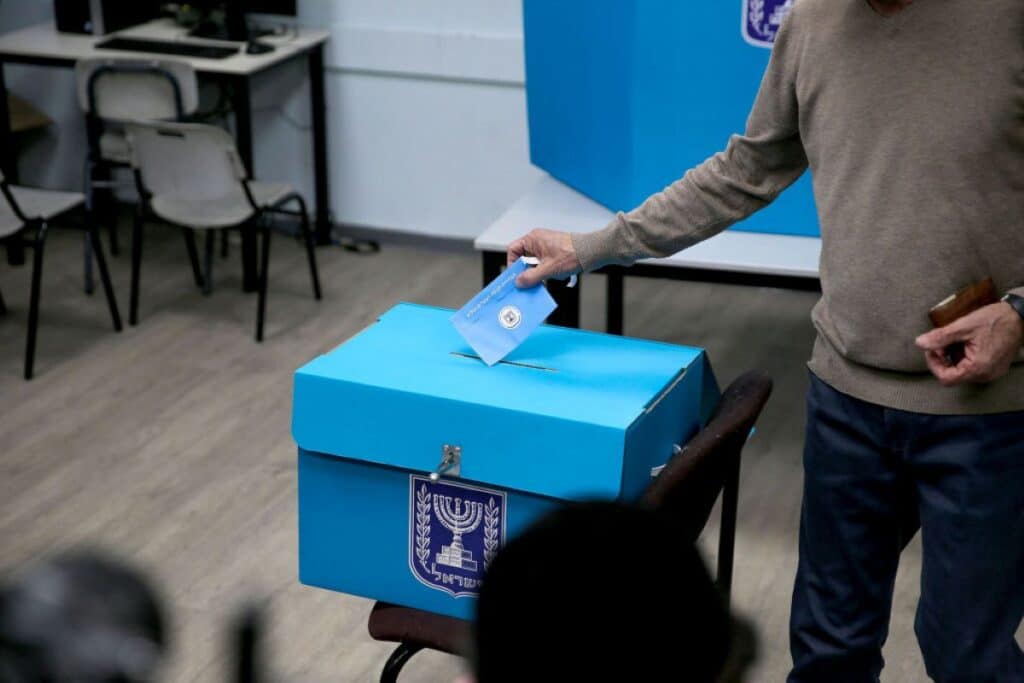
The Knesset took the first step toward calling early elections on Wednesday, approving an initial vote on a bill that would bring forward parliamentary elections by a month or two.
The bill will now need to pass three more votes to receive final approval and officially bring about early elections. One hundred and ten members of Knesset voted in favor of the bill and none voted against it or abstained. Ten members of Knesset were not present in the plenum for the vote, including Prime Minister Benjamin Netanyahu.
Elections for the next Knesset were scheduled for Oct. 27, 2026, the end of the four-year term of the current Knesset. Even if the decision to dissolve the Knesset receives final approval, the elections can’t be moved much earlier than that.
The law requires that the elections be held at the earliest 90 days after the bill to dissolve the Knesset is approved, meaning the earliest possible date would be mid-to-late August. The exact date will be determined during discussions on the bill, with Israeli media reports indicating the likely decision will be either early or late September, as the Jewish High Holidays are taking place during mid-September this year.
Wait, the government in Israel can collapse?
In Israel, the government can collapse before it completes its four-year term, sparking early elections, a feature of its parliamentary system and the way coalitions work.
Israeli governments are really unstable. The last time a government completed its entire four-year term was in 1988. The current government and the governments during the 13th, 18th, and 20th Knessets got close, nearly completing a four-year term but collapsing just a couple of months early.
There are a bunch of different ways governments can collapse in Israel, more than in almost any other country.
For one, the prime minister can, in coordination with the president, decide to dissolve the government and spark early elections. The Knesset can try to appoint another leader to form a new government to avoid elections, but if it fails to do so within a certain time period, elections are called.
If, after elections, the Knesset fails to form a government coalition within a specific timeframe, the country automatically goes back to elections.
Elections are also automatically called if the government fails to pass a state budget within a specific period after it takes office.
The Knesset can also hold a vote of no confidence in the government. For such a vote to pass, the MKs supporting the vote have to propose an alternative government coalition to replace the current one, including a new prime minister.
The Knesset can also pass a law to dissolve itself and call early elections. The law must pass through four votes and include the date of new elections, traditionally within five months from then. This is the method currently being used.
How did we get here?’
While the opposition has been calling for elections since the war began, the coalition has so far rejected such demands outright. Since the coalition holds the majority in the Knesset (68 out of 120 seats), it was able to prevent any attempts to vote on early elections. At least until now.
What changed was that the parties representing Haredim – ultra-Orthodox Jews – decided to support the vote for early elections this past week. There are two Haredi parties in the Knesset: United Torah Judaism, which represents Haredim from Ashkenazi communities, and Shas, which represents Sephardi Haredim from Mizrachi communities.

UTJ holds seven seats in the Knesset, while Shas holds 11 seats. Together, they were able to remove the coalition’s majority and pass the vote.
Why did they switch sides now?
It all centers around the draft to the IDF.
The Haredi draft exemption
In Israel, all citizens are legally required to register for the draft at the age of 18, though not all are ultimately drafted into the military.
Exemptions are granted for various reasons, including to married women and mothers, individuals with specific medical conditions, women who observe Shabbat and keep kosher, and Arab Israelis, among others.
Despite not fitting into one of the standard exemption categories, Haredi yeshiva students typically receive a “deferral” from military service, allowing them to avoid the draft by declaring that “Torah study is his work” and demonstrating full-time study in a yeshiva.
This arrangement, which has been in place since the state’s founding, was initially agreed upon by Israel’s first prime minister, David Ben-Gurion, to exempt a few hundred students.
Since then, however, the number of Haredi youth who use the arrangement has surged to tens of thousands, leading to increased criticism from other Jewish citizens who are required to serve.
Already in 1998, the High Court of Justice (part of Israel’s Supreme Court) ruled that the exemption was too large and needed to be regulated to ensure some Haredim were drafted.
A commission known as the Tal Committee got to work on a new law to make the arrangement more equitable. In 2002, a law was passed providing a deferment of service to full-time yeshiva students. Once they reach 22 years old, these students would need to decide whether to join the army for a little over a year or do a year of national service (volunteer work in the emergency services or charitable or educational organizations). The idea was that the law would eventually lead to increased recruitment among Haredim.
However, after several years, the state realized that the law wasn’t actually increasing enlistment. In light of the failure, in 2012, the High Court of Justice ruled that the law had failed to serve its purpose and violated the right to equality.
Since then, the issue has jumped between the government and the courts. Many governments since have relied on the Haredi parties as coalition members, making it nearly impossible for them to pass legislation on the issue that the courts would approve.
The Haredi parties have refused to consider any law that would lead to widespread enlistment among Haredi young men, so the laws passed have largely just extended the existing exemption without any changes. The parties have said that they oppose enlisting any Haredi young men due to concerns that interactions with other Israelis during their military service would cause them to leave the ultra-Orthodox way of life. They have also presented the issue as a threat to full-time Torah study, although they’ve also rejected proposals to only draft young men who don’t spend their days in yeshivas.
This isn’t the first time a government’s stability has been threatened by the draft issue.
In 2018, debates surrounding the law contributed to the dissolution of the 20th Knesset, leading to a series of successive elections and short-lived governments.
Since then, discussion of the issue somewhat abated until the start of Netanyahu’s current government.
As Netanyahu’s new government was being formed, the right-wing Likud Party signed agreements with Haredi parties to pass a law exempting yeshiva students from the draft.
The issue was temporarily sidelined due to the Oct. 7 attacks and the war in Gaza, but resurfaced in February 2024 when Israel’s Defense Ministry proposed laws to increase IDF service length due to manpower shortages. The IDF says it needs 10,000 more soldiers than it has, including about 6,000 combat soldiers.
The announcement sparked outrage and renewed the conversation about requiring Haredim to draft, as opponents argued that the manpower shortage could easily be dealt with by requiring Haredim to share the load.
Then, last March, the High Court of Justice ruled that the state couldn’t wait any longer and needed to start drafting Haredim.
The previous law regulating the exemption for Haredim expired in June 2023, technically requiring the IDF to begin drafting those currently exempt. However, the government approved a decision not to draft them while working on a new law.
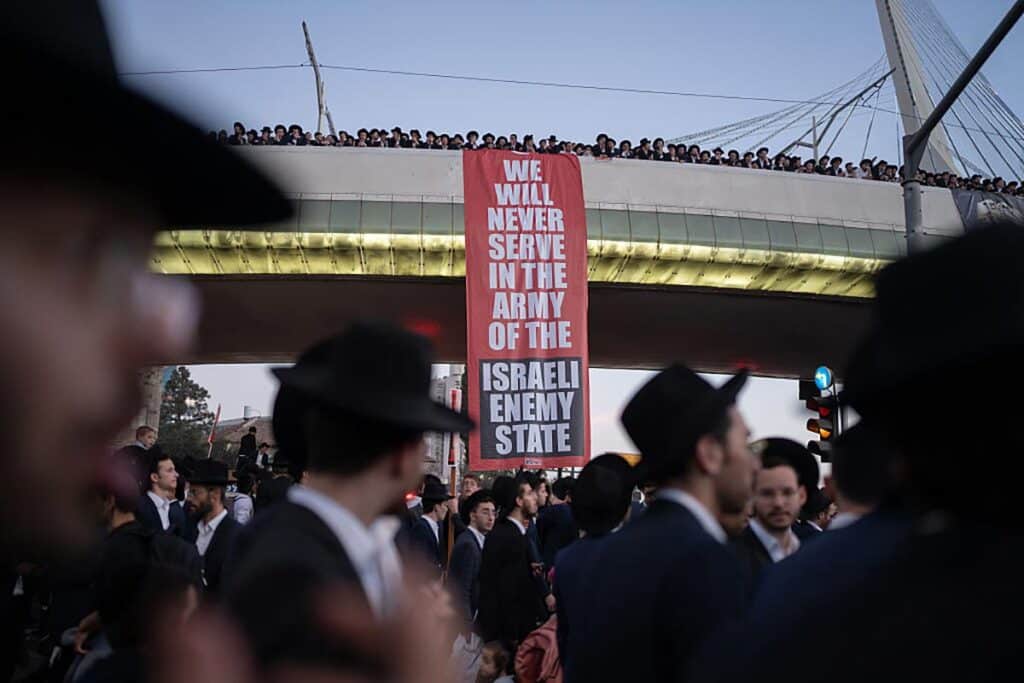
Efforts to reach an agreement on a new bill were unsuccessful, despite meetings between Prime Minister Netanyahu, government officials, and Haredi party leaders. Ultra-Orthodox leaders warned that any bill with significant recruitment quotas or financial sanctions could cause them to leave the government.
However, many members of both the opposition and the coalition have demanded that any new bill include such quotas and sanctions to ensure it can actually be enforced. The issue came to a head in June 2025, when the Haredi parties threatened to dissolve the Knesset if a bill to extend the exemption wasn’t approved. They later retreated from the threat, partially due to promises of a compromise from the government and due to warnings about how this would affect the Iran war, which erupted shortly afterward.
Since last June, the government has attempted to promote a bill concerning military conscription that the Haredi parties had approved, but failed to secure sufficient support among members of the ruling coalition. Critics of the bill, both within the opposition and the coalition, argued that the proposal included too many loopholes, such as lax enforcement policies and irrelevant sanctions, which could be used to effectively continue the current policy of broad draft exemptions for all Haredim while eliminating the sanctions draft dodgers are currently facing.
Last week, Rabbi Dov Lando, the senior spiritual leader of the Degel HaTorah faction within the United Torah Judaism party, instructed the faction to push for early elections due to the continued failure of the current government to approve an extension of the draft exemption for Haredim.
“We no longer have any trust in Netanyahu,” Lando said. “From this point forward, we will do only what is best for Haredi Judaism and the yeshiva world. We must act to dissolve the Knesset as soon as possible.”
The other faction of United Torah Judaism, Agudat Israel, and the Sephardi Shas Party, announced that they would support the decision to advance early elections. In light of the decision, both the opposition and the coalition presented bills to dissolve the Knesset. The bill by the coalition was approved on Wednesday, while the opposition’s bills were rejected.
On Sunday, Netanyahu announced that he would attempt to promote the conscription law that the Haredim had approved despite the apparent lack of support from members of the coalition, a move some Israeli analysts interpreted as an attempt to avoid early elections. A discussion on the bill was held in the Foreign Affairs and Defense Committee on Wednesday, shortly before the initial vote to dissolve the Knesset. At least two more discussions need to be held on the conscription bill before it can be brought to the plenum for the two final votes needed to make it law.
Recent polls have indicated that the Knesset will still be split about equally as it is now. That means that the Haredim will likely need to sit with the parties they’re already with, or they’ll be left in the opposition, while the current opposition, which is pro-draft, either forms a government on its own or joins with parts of the current coalition.
How the current government or any future one could forcibly conscript the tens of thousands of Haredim who would need to be drafted also remains unclear. Some Haredi leaders are warning that young men would prefer jail over enlistment, and previous attempts at limited enlistments have led to protests and riots.