
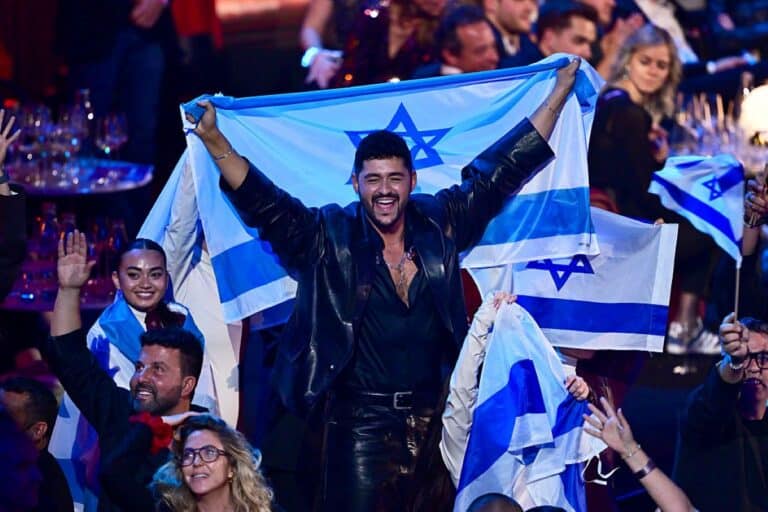
Israel’s Noam Bettan finished in second place in the Eurovision Song Contest final on Saturday night, with his hit “Michelle,” performing excellently despite an international campaign aimed at booting Israel from the contest.
The tension was palpable as Israel took the lead during the public vote, holding first place until the last minute, when Bulgaria’s DARA scored 312 points, bringing her total to a whopping 516 points when added to the jury vote.
During Bettan’s performance, audience members raised a Palestinian flag next to members of the Israeli delegation. However, the audience in general received him well, with loud cheers and little to no booing. During the announcement of the results, more vocal boos were heard after Israel took the lead, although much of the crowd countered with cheers and chants of “Israel! Israel!”
גמר האירוויזיון: בזמן הביצוע של נועם בתן, דגל פלסטין הונף בצמוד לחברי המשלחת הישראלית@AmitHarari2 pic.twitter.com/Q0Fcmwddxv
— כאן חדשות (@kann_news) May 16, 2026
Shortly before the final, Israel was ranked fifth in the betting tables. Finland ranked as the most likely to win, followed by Australia, Greece, and Bulgaria.
The contest has two sections of votes, which are added together: one from each participating country’s judges panel and one from the public. Israel was awarded 123 points from the judges, ranking eighth before the public vote was tallied. Bettan then shot up to first place with 220 points from the public vote, more than any country in the competition, up until DARA took the lead.
In the judges’ vote section, each participating country can award a special prize of 12 points (commonly referred to as the French term “douze points”) to one competitor of its choosing. Regional and international politics often affect that decision. Israel only received douze points from Poland this year. Last year, Israel only received douze points from Azerbaijan.
Israel’s successful history in Eurovision
Israel has competed at Eurovision almost every year since 1973, when singer Ilanit personally lobbied the national broadcaster to enter after discovering Israel was eligible.
Israel’s first entry came just a year after the Munich Olympics massacre. Security was so tight that audience members were warned not to stand up during the show. Israel finished fourth in its first outing with the song “Ey Sham” and quickly found its footing, scoring back-to-back wins in 1978 and 1979, with the 1979 winner “Hallelujah” topping charts across Europe.
Israel has often been a trailblazer in the contest. In 1998, trans singer Dana International became a global icon when her song “Diva” won Eurovision, in what commentators still describe as a watershed moment for LGBTQ representation. In 2009, Arab Israeli Mira Awad performed alongside Jewish Israeli Achinoam Nini, with their song “There Must Be Another Way” weaving together Hebrew, Arabic, and English lyrics in a pointed statement of coexistence delivered right after the first Gaza War.
Israel’s participation has never been without friction. Arab, Muslim, and Soviet-aligned states periodically boycotted the contest or refused to broadcast Israel’s songs. Jordanian television cut the feed when Israel won in 1978 and announced Belgium as the winner instead. Turkey sat out the contest in 1979, after Arab states put extreme pressure on it not to take part because the contest was taking place in Jerusalem, even threatening to cut off its petrol supplies. However, until recently, Israel was generally well-received by the other participating countries.
Boycotts, protests, and controversy
The first large-scale controversy occurred in 2018, after Netta won Eurovision with her hit, “Toy,” and the contest returned to Israel for the first time in many years. Dozens of artists, former Eurovision participants, politicians, and activists called for a boycott of the competition in light of Israel hosting the event, and the 2019 contest was marked by protests by pro-Palestinian activists in Israel.
The controversy around Israel skyrocketed after October 7. Boycott petitions signed by participants, politicians, singers, and activists, and protests demanding Israel’s removal marked both the 2024 and 2025 contests. The 2025 final was disrupted when activists rushed the stage during Israel’s performance and sprayed a guard with paint.
Despite the boycott campaigns, Israel’s representative in the 2024 contests, Eden Golan, still performed well, finishing second place in the public televote. In 2025, Israel was even more successful, with Yuval Raphael finishing second overall in the contest, earning the highest public vote total of any act that year, suggesting that the protests, despite their size, did not reflect broader public sentiment.
Israel’s success sparked controversy, with critics accusing Israel of “buying votes” due to an ad campaign that encouraged social media users to support Raphael.
Despite increased calls for Israel to be booted from the event, the European Broadcasting Union decided that Israel would be allowed to participate in this year’s contest. However, certain changes were made to the voting and advertising rules in light of the criticism of Israel’s 2025 ad campaign.
In response to the decision to keep Israel in, Iceland, Ireland, the Netherlands, Spain, and Slovenia announced that they would be boycotting the event. Switzerland’s Nemo, who won the contest in 2024, and Irish 1994 Eurovision winner Charlie McGettigan returned their trophies and called for Israel to be banned. Germany and France, meanwhile, emphasized their support for keeping Israel in the competition.
Ahead of the 2026 contest, the Austrian broadcaster, ORF, announced that it would not ban Palestinian flags from the audience or drown out booing during Israel’s performance. The show’s executive producer, Michael Kroen, stated that ORF “will not sugarcoat anything or avoid showing what is happening, because our task is to show things as they are.”