
Most Jewish Americans who travel on heritage trips tend to focus on visiting Israel or Eastern Europe. But what if you didn’t have to cross an ocean to explore the richness of different Jewish diasporic traditions?
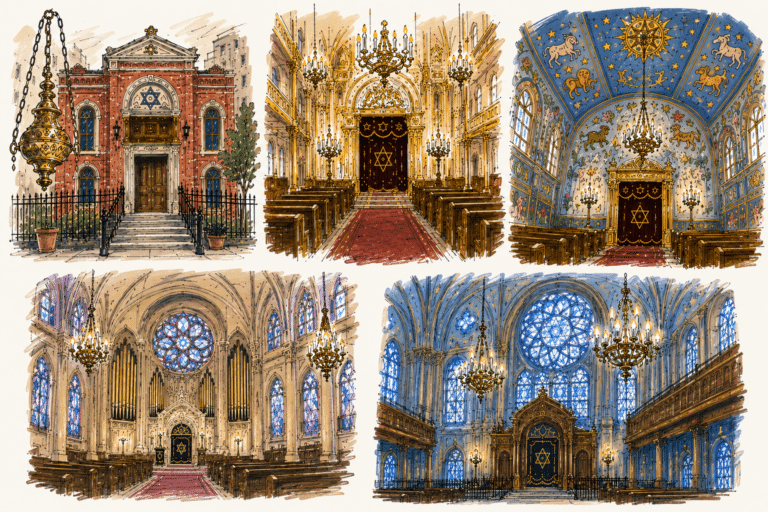
New York City is home to the largest Jewish population in the United States, a living mosaic of languages, customs, histories, and religious practices shaped by communities from around the world. Wanting to immerse myself in just one corner of that cultural treasure trove, I set out to visit five synagogues over the course of three days, each offering a window into different versions of Jewish life.
From distinct liturgical traditions to unique architectural styles and communal histories, each synagogue felt like stepping into another time and place. If you’re looking to transport yourself through geography, history, and rituals, think about visiting these five synagogues.
Kehila Kedosha Janina Synagogue
When walking through the Lower East Side, you might keep your eyes peeled for large, looming buildings that once served as busy synagogues for the massive Jewish population that shaped this corner of New York City. But if you only look up to the skyline, you might miss one of the most interesting synagogues in the U.S.

Tucked between apartment buildings and sitting significantly lower than the structures around it, designed to fit narrowly within the dense urban fabric of the Lower East Side, Kehila Kedosha Janina Synagogue is the only Greek Jewish Romaniote synagogue in the Western Hemisphere.
The synagogue was built in 1927 by Greek-speaking Romaniote Jews from Ioannina, Greece. Romaniote Jews are considered the oldest Jewish community in the European diaspora, with a presence in Greece stretching back more than 2,300 years. Distinct from Sephardic or Ashkenazic Jewish traditions, Romaniote Jews developed their own liturgy, customs, melodies, and communal practices over centuries of relative geographic isolation.
Those traditions are visible from the moment you step inside. The bimah sits in the center of the sanctuary rather than at the front, and the benches face one another so there is a more communal, intimate atmosphere, instead of forward-facing benches in rows. When the ark opened, I noticed that the Torah scrolls are stored in tikkim, rigid cylindrical cases made from wood or metal, that are never removed when the Torah is read, a tradition common in many Mediterranean and Middle Eastern Jewish communities.
Read more: The ultimate Jewish guide to Manhattan, NYC: What to see, eat & do
In addition to the typical Ner Tamid, ornate memorial lights in traditional Greek styles hang before the ark, donated in memory of loved ones. Perhaps most unique to Romaniote Jews, the synagogue displays Alephs: rare, hand-painted birth and circumcision certificates created to protect a newborn and his mother for the first 40 days after birth.
The still-active synagogue also functions as a museum, preserving artifacts and traditions from a Jewish world nearly destroyed during the Holocaust. To help support that work, Kehila Kedosha Janina hosts an annual Greek Jewish Festival each spring featuring live music, traditional food, and activities for children.

As I peered over the women’s section and into the men’s section in the sanctuary below, I felt like I had stepped into a version of Jewish life shaped by a completely different geography than my own, but one I still instantly recognized.
Congregation Shearith Israel
From the outside, Shearith Israel doesn’t really stand out. In fact, I walked past it the first time without even realizing I had arrived. But the moment I opened the front doors and stepped inside, it was as though I had been whisked away to a grand palace in a faraway land.
The sanctuary, glowing in gold, is the centerpiece of the building. Compared to it, the surrounding rooms feel almost secondary. And yet, beneath the grandeur, the synagogue still carried the feeling of a lived-in Jewish home. Congregants own seats that have been passed down in their families through generations, and many store their personal items beneath them, so they have a permanent presence in the synagogue.


Founded in 1654 by Jews of Spanish and Portuguese descent, Shearith Israel is the oldest Jewish congregation in the U.S. Although the community has long included both Sephardic and Ashkenazi members, its services follow the traditions of Spanish and Portuguese Jewry.
Inside the sanctuary, there is a large stretch of space between the bimah and the ark. Covered in maroon carpeting, the area feels almost ceremonial, elevating its status the way we think of the red carpet. This space is considered so holy that no one is allowed to walk across it during services. That holiness is felt all around; the pure gold is a symbol of prestige.
Bialystoker Synagogue
I didn’t think this type of synagogue existed in the U.S., ever, let alone still functioned as an active congregation.
Only a few months earlier, I had returned from a trip visiting shtetl towns in Poland. In places like Bobowa, I encountered the synagogue style of Jewish lore: sanctuaries covered in beautifully hand-painted walls, with colorful zodiac signs, animals, and elaborate decorative patterns stretching across the space. It was breathtaking. Until that trip, I had never seen anything like it outside of history books.

Flash forward a few months, and I’m standing on the Lower East Side outside the Bialystoker Synagogue, an unassuming wooden brick building with a tiny Jewish star on top. From the street, it resembles an oversized townhouse more than a synagogue.
But then you unlock the entrance door, climb up the stairs, and are greeted by a completely changed sight: a stunning sanctuary where your eyes migrate upwards to the painted blue-sky ceiling dotted with white clouds surrounded by paintings of animals and astrological signs. The sanctuary feels startlingly out of place in New York, as though a fragment of Eastern European Jewish life had somehow been folded into the middle of Manhattan and preserved intact.
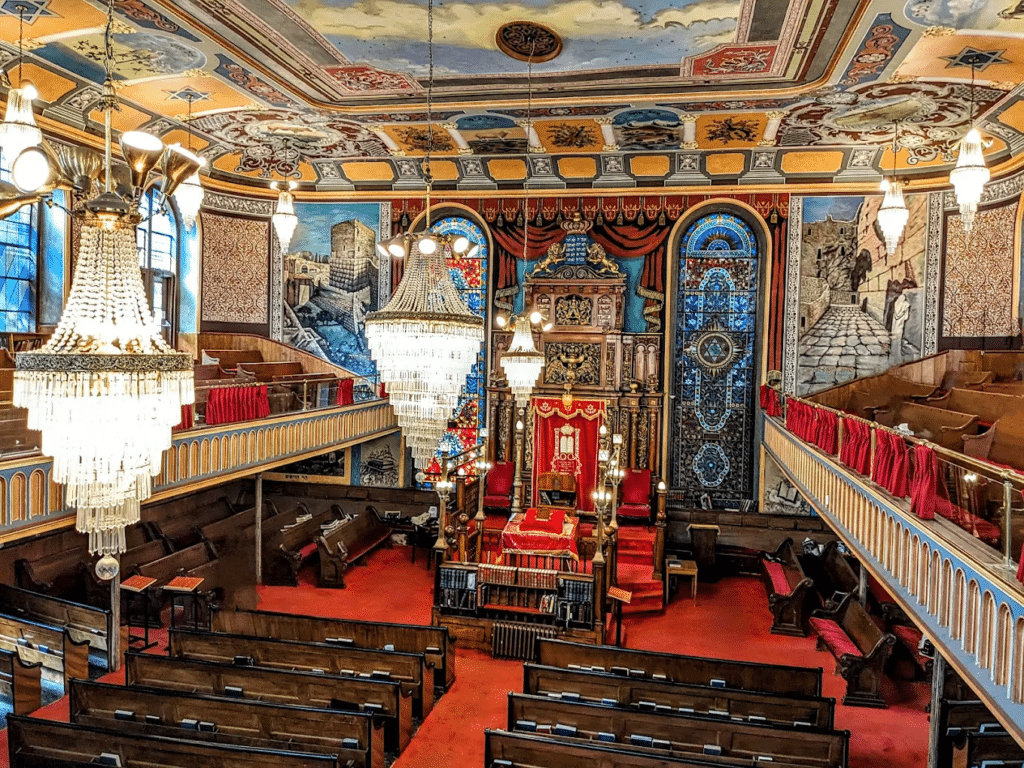
The still active Orthodox synagogue feels like something out of a history book, less like a recreated aesthetic and more like a transplanted memory. It was designed by immigrants from Bialystok, Poland, to replicate a synagogue from their town, an architectural attempt to carry home across an ocean. Built in 1824, the structure itself is among the oldest surviving buildings in New York City. Inside, nearly everything is wood, including the ark, giving the sanctuary an intimacy and warmth rarely found in modern synagogue architecture.
There are hundreds of synagogues with paintings like this in Poland and Ukraine, but the Bialystoker Synagogue is one of only two in New York City that still preserves this style of painted Eastern European Jewish artistry.
Temple Emanu-El
Welcome to one of the largest Jewish houses of worship in the world.
Read more: From the bimah to Instagram — 14 women rabbis shaping Jewish life right now

The sheer scale of Temple Emanu-El is difficult to grasp until you stand in front of it yourself. The synagogue stretches across a significant portion of an entire city block. Inside, the sanctuary fits 2,500 people.
And yet, despite its size, it is the light that defines the sanctuary.
More than 60 stained-glass windows line the space and draw you in. The colors echo off of each other, creating a beautiful harmony of Jewish symbols, the light bringing positivity into the sanctuary.


Founded in 1845, Temple Emanu-El is the oldest Reform Jewish congregation in New York City and has long been associated with the rise of American Reform Judaism. This synagogue is renowned for its grand architecture.
What surprised me most, however, was how intimate the sanctuary still felt. Given its enormous size and soaring ceilings, I expected something more cathedral-like and distant. Part of the intimacy comes from the sanctuary’s design. Uniquely, every single seat in the sanctuary is a good seat: it is a column-free sanctuary with an unobstructed view of the bimah.
Eldridge Street Synagogue
Nestled in between old tenement buildings and weathered storefronts sits one of the first grand synagogues built by Eastern European Orthodox Jews in the U.S. From the outside, the building blends into the layered texture of the Lower East Side. But the moment when you walk inside, you can’t help but marvel in awe at the contrast of where you just were versus the detailed chandeliers and stunning light blue stained glass inside.


Unlike the other synagogues I visited during my three-day trip, the Eldridge Street Synagogue no longer functions as an active congregation and now solely operates as a museum. That absence changes the atmosphere of the space. During my visit, the sanctuary was quiet except for the voice of my tour guide echoing gently through the cavernous room. It isn’t hard to envision why this Moorish-Romanesque architecture seems like it brings Jewish continuity over from Europe, where the architectural style is common.
Yet, traces of that life still linger everywhere. The museum felt like a preserved version of a Jewish home that once held a community and still resonates with it.
As I stood in each one of the five synagogues I visited on this trip, I found myself picturing the generations of people who had once walked through their doors, or still do today. I might not be Romaniote, Sephardic, Orthodox, Reform, or descended from immigrants from Bialystok, but each of these buildings was built around a common purpose: to gather Jews together in prayer, tradition, and community. That shared purpose makes even the most unfamiliar synagogue feel recognizable.
This Jewish American Heritage Month, consider exploring the diverse Jewish diasporic traditions that exist not only around the world, but right here in the U.S. It’s remarkable that you can sit in Manhattan and take part in traditions that originated in places like Greece, Poland, or Spain, without ever having been there yourself. These synagogues are living reminders that Jewish life has never existed in only one form. Let this be a starting point for discovering other synagogues and traditions that add to the Jewish mosaic and help ensure we find a home wherever we are in the world.