
Celebrated Irish fiction author Sally Rooney seems to be having a taste of her own medicine.
Five years ago, Rooney famously announced that she would not sell Hebrew translation rights for her books to Israeli publishing houses, citing her opposition to Israel’s occupation of the West Bank. The Jewish community widely condemned the move, with critics arguing that private Israeli publishers have no control over the decisions or policies of the Israeli government. Many also viewed the decision to withhold translations from her Hebrew-speaking readers on account of their national leadership as a blatant double standard, especially given that Rooney had no apparent issue translating her books through Chinese state-affiliated publishing systems.
Regardless, pro-Palestinian activists and anti-Zionist circles widely celebrated her stance. Since the October 7 massacre, Rooney emerged as one of Israel’s fiercest critics in the literary world. A year after the attack, she signed a letter calling for a mass boycott of the Israeli publishing industry, with the exception of Israelis who had openly denounced the “genocide in Gaza.” “We cannot in good conscience engage with Israeli institutions without interrogating their relationship to apartheid and displacement,” the letter stated.
Read more: Book publishing is only looking for the ‘right kind’ of Jew
The message was clear: Sally Rooney? Not exactly a fan of Israel or of engagement with Israelis.
But a few days ago, the left-wing, anti-Zionist, Israeli-owned publication +972 Magazine announced that it will be publishing Rooney’s latest novel, “Intermezzo,” in Hebrew, in what it is describing as a “BDS-compliant” arrangement.

To be fair, the announcement didn’t come completely out of left field. Back in 2021, Rooney herself had said that she would be “pleased and proud” to have her book translated into Hebrew, provided it was done in a way consistent with the principles of the Boycott, Divestment and Sanctions movement.
Still, many observers remained skeptical. After all, the BDS movement promotes anti-normalization policies that oppose virtually all engagement with Israeli institutions and, in some cases, Israelis themselves. It also demands that Israeli-owned and Israeli-led companies and organizations denounce Israeli “settler-colonialism,” though what constitutes settler-colonialism from a BDS viewpoint remains intentionally vague.
Does the term refer specifically to Israeli settlement construction in the West Bank? Or does it apply to the entire State of Israel itself, the product of so-called Israeli settler-colonialism? And, if so, is it reasonable to expect Israelis to publicly advocate for the dismantling of their home country? Do we ever ask the same of citizens of other nations embroiled in prolonged or bloody conflicts?

It’s true that, in theory, someone doesn’t have to be an Israeli citizen to translate a novel into Hebrew. In practice, however, the vast majority of fluent Hebrew speakers, let alone professional translators, are Israeli.
According to +972 Magazine, its translation of “Intermezzo,” carried out in collaboration with its Hebrew-language sister news site Local Call, and the independent Israeli publishing house November Books, satisfies the BDSmovement’s three basic demands: support for ending Israeli occupation of the territories captured in 1967, support for full civil equality for Palestinian citizens of Israel, and support for the implementation of the Palestinian “right of return.” Critics of the final demand argue that such a policy would effectively end Israel’s existence as a Jewish and democratic state by fundamentally transforming the country’s demographic makeup.
That’s all well and good. But rather than celebrating Rooney’s partnership with three “BDS-compliant” Israeli companies, many pro-Palestinian activists quickly turned on their former literary hero, accusing her of betraying the cause. The backlash was swift, intense, and at times openly antisemitic.
Palestinian American writer Susan Abulhawa argued that November Books could never be BDS compliant, because it “pay[s] taxes to the zionist [sic] colony,” suggesting that any Israeli business is inherently illegitimate regardless of its political views.
Meanwhile, Palestinian writer Mohammed el-Kurd, author of “Perfect Victims,” chastised Rooney for “creating loopholes to bypass sanctions.”
The criticism extended far beyond Palestinian activists themselves. Writers, academics, journalists, influencers, and online commentators joined the chorus of condemnation, often interjecting with sprinkles of good, old-fashioned antisemitism.
“Sally Rooney’s work was promised to them 3,000 years ago in the Bible,” said journalist Heidi N. Moore, invoking the increasingly common caricature that Jewish ties to Israel are rooted solely in religious fanaticism or myth rather than history, culture, and national identity.
“Whether you like it or not, history is history and facts are facts. The Hebrew language is an invented language,” a pro-Palestine influencer argued, with an ironic disregard for both history and facts.
As I watched the anti-Israel mob turn on Rooney, I couldn’t help but wonder: what did she think was going to happen?
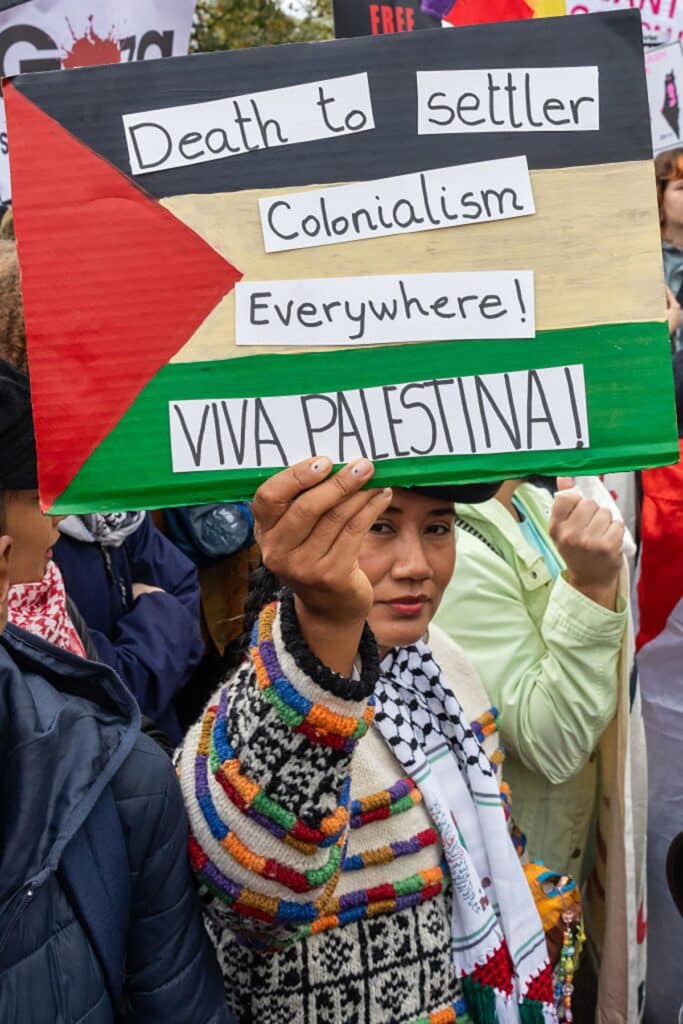
Whatever the BDS movement’s stated goals or intentions may be, in practice, it has often expanded far beyond opposition to Israeli government policy and into the shunning and marginalization of nearly anything perceived as just the slightest bit Jewish. From BDS Boston’s infamous Mapping Project, which identified a wide range of Jewish institutions, including summer camps, disability organizations, synagogues, and nonprofits as part of interconnected systems of alleged oppression to the vile January 2024 pro-Palestinian display outside of the Memorial Sloan Kettering Cancer Center in New York City, which charged the hospital — and its pediatric cancer patients — with complicity in genocide. The protest focused in part on the fact that the hospital once received a $400 million donation from a billionaire who condemned the Hamas attack on October 7, as well as its collaborative oncology research with the Rambam Hospital in Haifa.
When the face of your movement verbally assaults American children with cancer, it’s safe to say that the motivation is probably no longer about human rights.
To Sally Rooney, I say this: they say we Jews are the canary in the coal mine of social movements and political cultures, and for a good reason. Hostility that begins with Jews rarely ends with Jews. Movements that organize not around dialogue but around shunning and exclusion, ideological litmus tests, and public shaming tend to keep narrowing the circle of who qualifies as morally acceptable.
Eventually, even those who once believed they were safely inside the circle discover how fragile that protection really was.