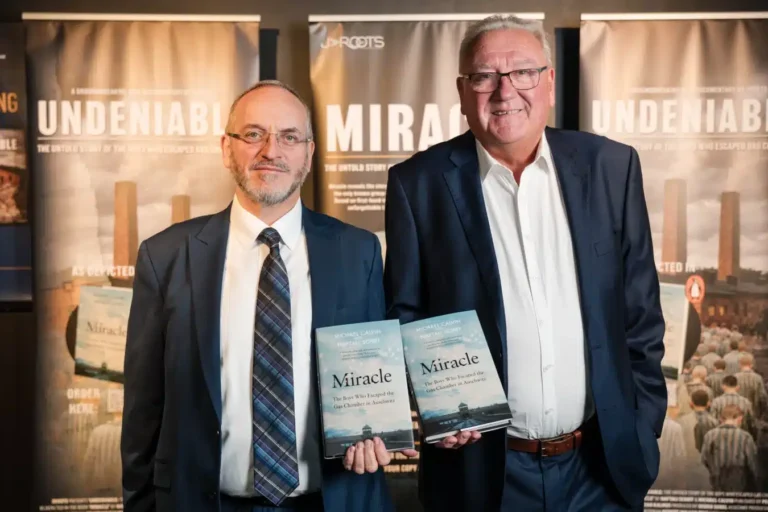
More than two decades before Rabbi Naftali Schiff wrote his latest book, “Miracle: The Boys Who Escaped The Gas Chamber in Auschwitz,” he had set out to discover sparks of Jewish life in the darkest graveyards of Jewish history.
As founder of JRoots, an organization that specializes in Jewish heritage journeys, Schiff has spent years traveling the world, often visiting places with more Jewish history than living, breathing Jews.
Naturally, among these destinations was Poland, and, more specifically, the infamous Nazi death camp at Auschwitz-Birkenau.
Over the years, Rabbi Schiff has had the tremendous honor and privilege of getting to know countless Holocaust survivors. Among them were six men who shared with him a remarkable story.

In the summer of 1944, over the course of just under three months, the Nazi SS and Hungarian police deported approximately 440,000 Hungarian Jews to Auschwitz, nearly half of the total Hungarian Jewish population at the time. Historians estimate that roughly 80% of deportees were sent directly to the gas chambers immediately upon arrival.


That was supposed to be the fate of these six young Jews and 45 others.
On Simchat Torah, the same Jewish holiday that would, 79 years later, coincide with the October 7 massacre in Israel, the teenagers were marched into the gas chambers at Auschwitz. The Nazis marked their names as “gestorben,” or dead.
But then, as they looked at death in the face, something remarkable happened: they were instructed to get out.
Against the odds, all 51 survived.
Those events form the basis of “Miracle: The Boys Who Escaped The Gas Chamber in Auschwitz,” which has already become a bestseller in the United Kingdom and was published in the United States on June 9.
Alongside the book is an upcoming documentary, “Undeniable,” which recounts the same story and includes powerful testimony from forensic architect Professor Robert Jan van Pelt, the renowned Holocaust scholar who served as a key expert witness in Deborah Lipstadt’s successful legal battle against Holocaust denier David Irving.
I recently sat down with Rabbi Schiff to discuss the book, the documentary, and the lessons he believes this remarkable story offers at a time of renewed polarization, rising antisemitism, and ongoing debates about memory, history, and truth.
This interview has been lightly edited and condensed for clarity.
Can you tell our readers a little bit more about yourself and the work that you do?
I’m a rabbi, but not a congregational rabbi. I passionately believe in the Jewish people and in our mission to bring goodness into the world and be the best we can be, not from a place of “supremacy,” but from a place of responsibility.
We’re living in crazy times, where there’s an obfuscation of reality between fake news and everything feeling virtual, invented, or fake. The Holocaust is something that is so real that it’s actually an opportunity to connect people with something that is real, and from that, to try to get in touch with one’s own authenticity, meaning, and purpose.
I run a group of organizations called Jewish Futures. One of the organizations is called JRoots, which organizes trips for Jews of all backgrounds and all ages to places that tell the Jewish story. There are many places like that, and we’ve probably been to most places in the world on our wanderings, from pillar to post. Tragically, one of the saddest places is Poland.
JRoots has taken 30,000 people over the last 20 years to Poland. Through my trips to Poland, I met many Holocaust survivors, and I realized that their stories are so compelling and so authentic and so real that they can be a way to bring people into touch with the reality of evil and of how to steer it back on its course.

Jewish people were subjected to mass destruction, but at the same time, when one touches the extremities of life, one also comes into touch with tremendous goodness. So, apart from JRoots, I set out about 25 years ago to interview survivors and bring their stories, personalities and legacy to future generations.
This book, “Miracle,” which has an accompanying documentary called “Undeniable,” is really one of the most remarkable Holocaust stories I’ve ever come across.
What is “Miracle” all about?
It’s all about the reality of hundreds of Hungarian Jewish teenage boys being led to the gas chambers, ordered to strip naked, and pushed inside on Simchat Torah. Obviously, over the last few years, that day has become even more poignant because of October 7.
This was Simchat Torah 1944. Hungarian Jewry was the last large Jewish population in Europe to be deported to Auschwitz. Over a period of just a few months, more than 400,000 Hungarian Jews were murdered. Those who survived the journey arrived at Birkenau and faced selection by Josef Mengele. The vast majority were sent directly to the gas chambers.
In a macabre twist, Mengele often carried out selections on the Jewish holidays of Rosh Hashanah, Yom Kippur, and Simchat Torah. Who knows how the mind of such a monster worked, but those dates carried a particular cruelty.
Then, at the very last moment, something extraordinary happened. There was a commotion and another selection from within the gas chamber itself. Fifty boys were chosen to live. It appears that decision was made not by Mengele but by Johann Schwarzhuber, the commandant responsible for that section of Birkenau. The boys were told to get dressed and were sent back to the barracks.
At a time of Holocaust denial and rising antisemitism, I think this story is especially important because it opens a window into the reality of what happened. In the documentary in particular, we’ve brought forward evidence that many people haven’t seen before about the reality of the gas chambers.
It’s a tremendous story of humanity and values. On the one hand, it’s a story about evil. On the other, it’s a story about faith, resilience, optimism, and persistence. That’s what makes it so powerful.
How did you originally come across this story?
I first came across the story through the Holocaust scholar Esther Farbstein in Jerusalem. She knew the story, but she’d never actually met any of the people involved. Having met six of them myself, I had the great privilege of bringing the story to life.
It’s already a bestseller in England and Canada, it’s been translated into 10 languages, and it’s being published this week by Harper Horizon.
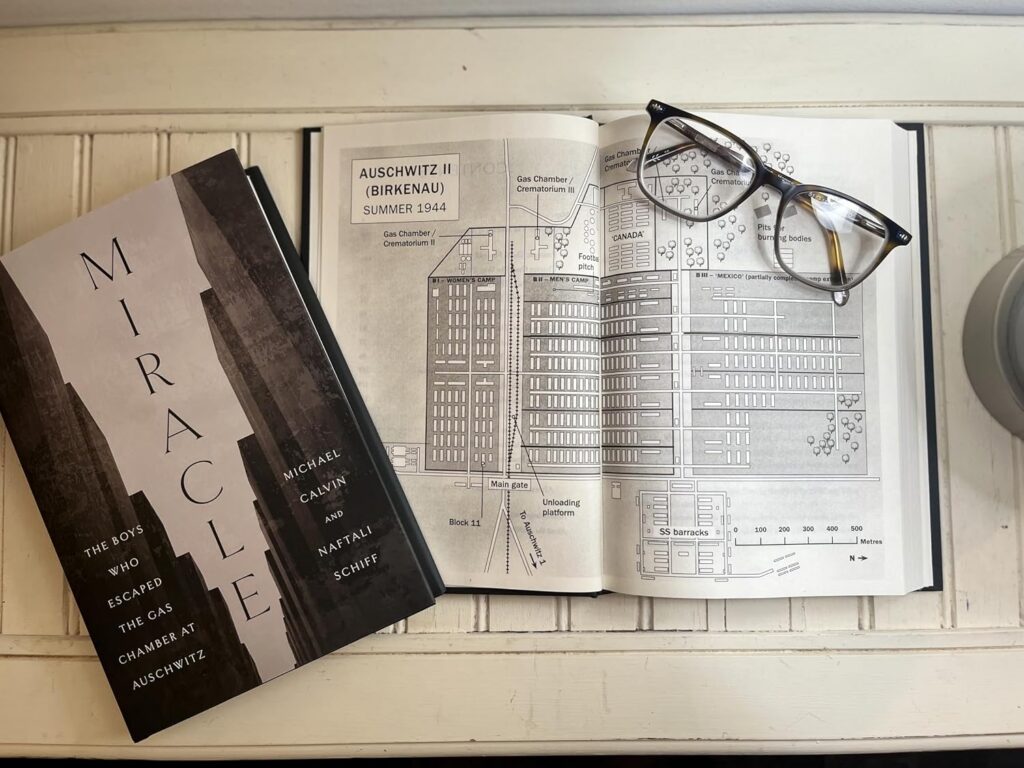
Despite the tragedy of Auschwitz, there’s something extraordinary about this story. You can’t call it a silver lining, because that would be the wrong phrase, but there is something miraculous about the survival.
I’ll tell you something else. I wasn’t happy with the title “Miracle.” Calling a book about Auschwitz “Miracle” didn’t sit well with me. I didn’t win that argument with my co-author or the publishers. They won.
But when the book came out in England, and there was all this interest in it, against the backdrop of everything that’s going on in the world at the moment, something dawned on me. The survival of the Jewish people is miraculous. The fact that we’re Jewish and living in this world is miraculous. Nations come, nations go, and it’s not like everybody loves us. The fact that we’re still here, there’s something miraculous about that. So the title is actually quite appropriate.
In a sense, we’re all survivors, and we’re here for a purpose. The irrationality of antisemitism is just so bizarre, and it’s rearing its ugly head again. There’s something going on, and to me that something is a sense of responsibility. We’re here to do good, to make the world a better place, and make it shine. There are forces of evil and people who don’t want that.
Tell me a little bit about your relationship with your co-author, Michael Calvin.
He’s a great author. My literary agent found him and introduced us. This is the second book that we’ve collaborated on. It’s really fantastic and heartwarming that he is a religious Catholic, and I’m a rabbi. He’s tremendously sensitive to the story.
He’s a great author. My literary agent found him and introduced us, and this is the second book we’ve collaborated on.
What’s really fantastic, and quite heartwarming, is that he’s a religious Catholic and I’m a rabbi. He’s been tremendously sensitive to the story and to its meaning.
The story itself is bigger than all of us. It’s a Jewish story, of course, but in 2026, with everything that’s going on in the world, it’s also a story about humanity.
Related post: How did a Jew escape from Auschwitz?
As Jews, we grow up with the famous quote: “All it takes for evil to triumph is for good people to do nothing.” We’re living in a time when you and I are challenged to do something. If we’re part of the story of Jewish survival, then we have a responsibility to be good and to make good happen.
That’s something Mike and I really connect on.
Why was it important to you to have a documentary alongside the book?
Seeing is believing.
The book is a bestseller, but it would be interesting to analyze the age of the readership. I would hope that people who read the book will want to see the film, and that people who see the film will want to read the book.
There’s something very powerful about looking into the eyes of these survivors and seeing the evidence we bring forward about the reality of the Holocaust, the reality of Auschwitz, and the reality of the gas chambers.
But there’s another important message here, especially for today’s world. Just because you get knocked down and go through a hard time doesn’t mean you’re finished. You can get up and keep going.
These are six stories about people who were beaten to a pulp. They were starving. They were emaciated. They lost their families. There was no hope. And yet they got up, they rebuilt their lives, and they kept going.
You started talking to survivors 25 years ago. Why are you bringing this story to light right now?
The specific answer is October 7, because October 7 fell on Simchat Torah, and this story also took place on Simchat Torah.
October 7 really blew open the myth of “Never Again.” I’ll say something that may be a little controversial: we’ve become obsessed with remembering and with building monuments to the Holocaust. Enormous amounts of money and effort have gone into Holocaust museums, and those institutions are important. But the Jewish people have to do more than build museums.
We have to build schools. We have to build camps, not concentration camps, but places where Jewish children can connect to one another, connect to their heritage, and live Jewish life to the fullest.
The world is getting darker, and our job is to make it lighter.