
In countless films, parents are forced into the role of superheroes, fighting against impossible odds to bring their kidnapped children home. In real life, tragically, some children never return.
At the end of August 1955, 14-year-old Emmett Till was kidnapped, tortured, and murdered. His mother, Mamie Till-Mobley, insisted on an open casket. She wanted the world to see what had been done to her son. In doing so, she forced a confrontation with a brutality many had been able to ignore.
At the end of August 2024, Hersh Goldberg-Polin, 23, was shot and killed by Hamas terrorists in a tunnel in Rafah after being abducted from a shelter on October 7 and held hostage for 328 days. Jewish law forbids open-casket funerals, and in Israel, the dead are typically buried wrapped in simple linen shrouds. Yet Rachel Goldberg-Polin’s memoir, “When We See You Again,” serves a similar purpose: it reveals not only what was done to her son, but who he was.

“When We See You Again” is a memoir of the 328 days Hersh was held hostage by Hamas after being abducted on October 7. Part diary, part testimony, part record of waiting, the book traces the daily reality of uncertainty — fragments of information, rumors, fleeting hope — alongside the global campaign she and her husband launched to bring him home.
But it is not only a record of events. The book moves between past and present, weaving together Hersh’s childhood, personality, and inner life with the unfolding nightmare of his captivity. In doing so, Goldberg-Polin resists allowing her son to be reduced to a headline. Instead, she reconstructs him in full — as a reader, a friend, a son — even as the world came to know him primarily as a hostage.
This is not only the story of Hersh, whose left forearm was blown off by a grenade after he fled the Nova music festival and hid with others in a cramped shelter. It is also the story of a mother’s psychological whiplash — the rise and collapse of hope, over and over again — and the unbearable uncertainty of waiting.
Goldberg-Polin’s grief is not abstract. It is vivid, immediate, and often difficult to read.
In interviews, including a searing appearance on” 60 Minutes” with Anderson Cooper, she describes the agony of knowing her son was alive but suffering.
“To know that your child is being tortured, tormented, starved, abused — that he’s maimed — is an excruciating form of suffering,” she said. “And then…when they came to tell us that Hersh had been executed, I realized those days had been the good part. Because he was alive.”
That inversion — that captivity became, in retrospect, a form of hope — captures the emotional whiplash at the heart of her story.
A timeline measured in dread
The book moves between memory and chronology. At its core is a timeline measured in dread.
At 8:11 a.m. on October 7, Hersh texted his mother: “I love you. I’m sorry.”
For hours, his parents believed he was dead.
Then came the videos. Proof of life, filtered through propaganda. Relief tangled with horror. He was alive — and in the hands of Hamas.
What follows is not a single emotional arc but a relentless loop: fear, hope, exhaustion, and the physical toll of waiting. Goldberg-Polin writes of sleepless nights, dependence on medication, and even episodes of acute physical pain. And still, she and her husband traveled the world, meeting diplomats, pleading publicly, refusing to let their son disappear into silence.
The pain, she writes, had “no intermission with Junior Mints.”
Who Hersh was
Amid the brutality, Goldberg-Polin insists on something else: Hersh’s life, not just his death.
He was left-handed, vegetarian, and a devoted fan of Hapoel Jerusalem soccer. He was soft-spoken but magnetic — the kind of person who quietly drew others in. As a teenager, he once captivated a crowd at a mall with his encyclopedic knowledge of American presidents.
Even in captivity, that presence endured.
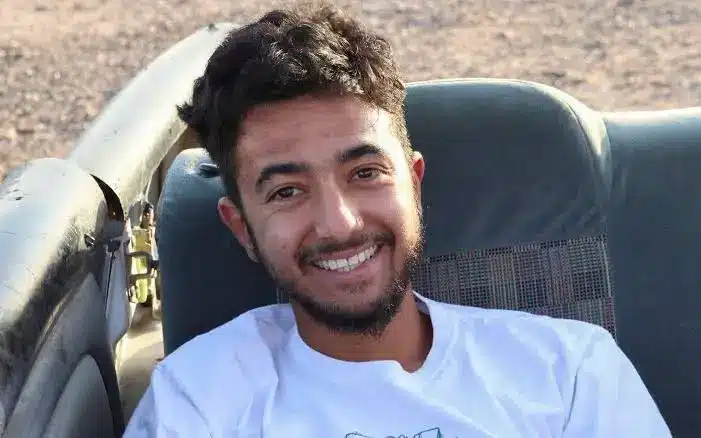
He persuaded his captors to allow him a book — the young adult fantasy novel “Shadow and Bone” by Jewish author Leigh Bardugo — which he shared with other hostages. To his mother, that act carried meaning: giving the book away suggested he believed he would survive.
Others saw it too. Freed hostage Eli Sharabi later described Hersh as a source of strength, someone who remained positive despite his injury. He often repeated a line from Viktor Frankl’s “Man’s Search for Meaning”: “He who has a why can bear any how.”
Listen to Unpacked’s interview with Eli Sharabi here.
At some point, he even heard his mother’s voice on a news broadcast. He knew she was fighting for him.
The unsettling foreshadowing
After his death, Goldberg-Polin discovered something she could not explain.
In a journal entry from 2015, written when Hersh was just 15, he described life as a series of tunnels — passages into the unknown, entered without knowing when or how one would emerge.
The word “tunnel” appears again and again.
Reading it years later, after he was held and killed in an actual tunnel, feels almost unbearable. Not prophetic, exactly, but haunting in its resonance.
Refusing the easy narrative
Goldberg-Polin became one of the most visible voices advocating for the hostages, meeting world leaders and speaking on global stages. She could have directed her anger outward: toward governments, institutions, or the international community.

Instead, she resists that instinct.
“I don’t like to be a blamer,” she writes, even as she acknowledges the scale of failure. The statement is less absolution than exhaustion — a refusal to simplify something that feels, to her, impossibly vast.
In the book’s afterword, her husband, Jon Polin, writes directly to their son. The message is both devastating and disciplined: grief will last forever, but it cannot be allowed to consume what remains of their lives.
Redefining strength
Goldberg-Polin returns, at one point, to the image of Superman — specifically Christopher Reeve, who was paralyzed in an accident yet continued to live with purpose.
The metaphor is imperfect, but intentional.
“Though I too am broken, my costume says otherwise,” she writes.
Strength, in this telling, is not triumph. It is adaptation. It is learning how to move through a world that has permanently changed shape.
The others in the shelter
The book also widens its lens to include others caught in the same moment.

Hersh’s friend, Aner Shapira, is believed to have thrown multiple grenades back out of a shelter after Hamas militants hurled them inside — buying precious seconds for those around him before he was killed.
It is one of many stories that expands the narrative, shifting it from a single tragedy to a collective one.
Hope, against reason
Perhaps the most difficult question the book raises is how — after everything — hope survives.
Goldberg-Polin does not offer a neat answer. Instead, she describes hope as something internal, almost mechanical: a force that must be generated, not found.
“The engine of love,” she writes, “can entirely fuel and propel us.”
Throughout Hersh’s captivity, that love became action — advocacy, travel, interviews, endurance. Even now, it remains.
In the aftermath, there are endless counterfactuals. If he had stayed home. If he had been taken elsewhere. If October 7 had never happened.
But when other hostages were eventually released, Goldberg-Polin did not say it should have been her son.
She said she was happy for them.
It is a small sentence.
It holds everything.