
There are few things more nerve-racking than babysitting your psychiatrist’s grandchildren while grappling with OCD and teetering on the edge of a breakdown. That’s the premise of “Fantasy Life,” Mathew Shear’s new film about a man doing just that, with a heavy side of Jewish anxiety, guilt, and emotional unraveling. Featuring iconic actors like Judd Hirsch, Bob Balaban, and Holland Taylor, “Fantasy Life” often feels less like a conventional film than a three-act play, unfolding in emotional beats.
“Fantasy Life” begins in the fall, a time of new beginnings and, fittingly, Rosh Hashanah and the High Holidays. Shear plays Sam, a young man who has just been fired from his job at a law firm and suffers a panic attack in a bookstore. Shaken, he visits his longtime psychiatrist, Fred (Judd Hirsch), and tries to explain what he describes as “internalized antisemitism.” Sam’s OCD manifests through intrusive thoughts: whenever he sees a visibly Jewish person, slurs begin ricocheting through his head. It’s one of the most revealing moments in the film, showcasing how much Sam is struggling, not just with his OCD but with his inability to connect with anyone, as he is riddled with shame and isolation. He is so consumed by embarrassment and self-loathing that even speaking those thoughts aloud to Fred becomes its own kind of ordeal.
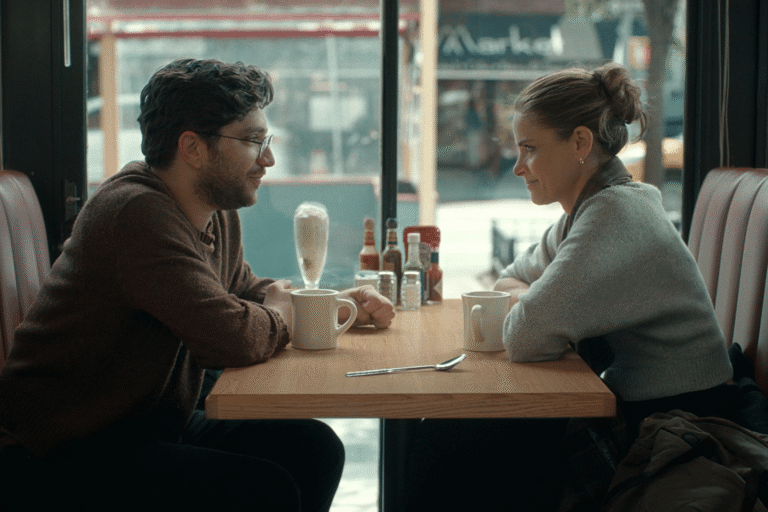
As Sam is leaving, Fred’s wife, Helen (Andrea Martin), asks whether he can babysit their grandchildren because they are suddenly unable to do so that evening. That request sets the story in motion. Sam soon finds himself taking care of the three girls through the spring. His anxious energy is easily matched by that of the girls’ mother, Dianne Cohen (Amanda Peet), a fading actress who seems perpetually on the verge of collapse. As her husband David (Alessandro Nivola) heads off to tour with his band, Dianne is barely holding on, let alone managing her children. Sam gradually becomes far more than a babysitter, or “manny,” as David jokingly calls him. He becomes Dianne’s emotional support system, accompanying her to movies, spending time with her outside the house, and slipping into a role that blurs the boundaries between employee, confidant, and surrogate partner.

But when spring gives way to summer, Sam starts to find his mental state getting worse. While picking up the girls from camp in Martha’s Vineyard, he suffers another panic attack and admits he is in love with Dianne. Her father, Lenny (Bob Balaban), is not amused and wants Sam gone, fearing that his instability could put the children at risk. Later, when Dianne tries to comfort him, the two share a kiss, which ends awkwardly with her pulling away and rejecting him. When David returns, he is furious over Dianne’s relationship with Sam and accuses her of sleeping with him. In a moment of anger and desperation, she lies and says yes. David then ends up drunkenly crashing his car, injuring himself. He spends the fall at his parents’ apartment recovering, unable to tour.
Where “Fantasy Life” loses its audience is in its pacing and editing. Too much is left for viewers to piece together between fall and spring, between the chaos of Sam’s first babysitting gig with the girls and the deepening of his connection with Dianne. Most of the important action happens offscreen; Sam’s panic attack on the mountain and David’s car crash are left for the audience to figure out, with information retold after the event, leading viewers to decide for themselves how serious or even how fatal each event was before the film fully clarifies it. By skipping over the winter altogether, the film also makes it difficult to understand just how deep Sam’s relationship with Dianne is. Their bond is clearly meant to feel intimate and consequential, but too much of its development happens in narrative blank space. The film might as well have been called “Private Life,” given how little we know about most of the characters.

What is clear is the film’s Jewish and mental health themes. Through Shabbat dinners and family gatherings, “Fantasy Life” captures a particular kind of chaos and overstimulation that both Dianne and Sam seem unable to escape. Sam’s neurotic and anxious temperament feels recognizable, echoing a familiar archetype of the Jewish man who is just trying to get through and find a way forward. Dianne, too, is defined by her own neuroses. Still, toward the end of the film, she reveals to her psychiatrist (Holland Taylor) that she believes she does not have a right to be sad, acknowledging her privileged disposition in life.
By the film’s conclusion, both Dianne and Sam seem less transformed than tentatively redirected. When the two meet for the last time, they are both seeking a way forward. Sam has finally found a girlfriend, while Dianne lets her husband move home. The journey ends, but it does not feel fully complete. The film seems to suggest that for people like Sam and Dianne, healing is not a revelation or a breakthrough so much as a matter of continuing to try. Whether that effort will actually lead to happiness remains unresolved. That, perhaps, is a question for another movie.