
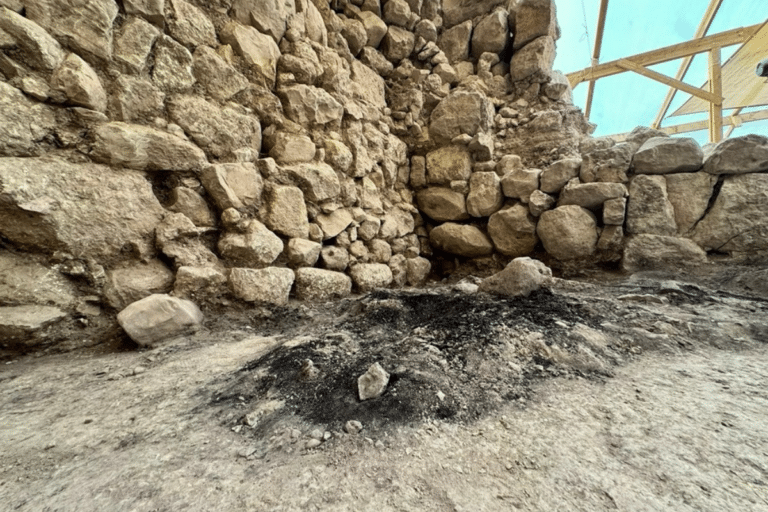
Burnt ancient wooden beams from the end of the First Temple period were recently discovered in the City of David in Jerusalem, a rare find that appears to preserve evidence of the destruction of Jerusalem in 586 BCE.
The First Temple (or Beit Hamikdash, meaning “the House of the Sanctuary”) was built by King Solomon in Jerusalem in the 10th century BCE. It served as the central sanctuary of the ancient Israelites and the only place where they were permitted to offer sacrifices to God, as it was believed to be where God’s divine presence dwelt on Earth. The Temple also housed the Ark of the Covenant in the Holy of Holies, a chamber accessible only by the High Priest once a year. It stood for centuries, until the Babylonians destroyed it in 586 BCE.
The new finding
The beams recently discovered in the City of David were made of sycamore and a conifer, and were coated in plaster, which likely helped preserve them. Archaeologists at the dig theorized that the plaster melted off the walls of the structure onto the wood as the building burned during the destruction of Jerusalem.
Excavation Director Efrat Bocher explained that “The beams appear to have served as the roof of an inner courtyard in a building from the First Temple period. During the destruction, they collapsed onto the floor. We believe that the plaster cladding of the building’s walls, melted by the fire, covered the charred wooden beams, and ultimately enabled their exceptional preservation.”
“We are just before Tisha B’Av,” Bocher added. “This discovery makes you feel that you are witnessing the very moment of destruction, the moment when it all happened. It’s deeply moving.”
Researchers were especially excited because they could see many growth rings on the beam made of coniferous wood. This could help them narrow down the dating of the wood and other findings at the site through carbon dating from a range of hundreds of years to as specific as a range of ten years.
“It is very rare in Israel to find wood with such a large number of growth rings,” said Dr. Johanna Regev of the Israel Antiquities Authority and Weizmann Institute of Science, who is studying the find. “Here, in the City of David, we found beams with many rings, offering significant research potential – with more growth rings enabling higher dating resolution.”
The archaeologists also discovered that during the period when the Persians ruled the area and the Jews returned after the first exile, the returning residents built around the site and blocked off this area, preserving the destruction as it was.
“Creating a space of memorial is a basic human need, especially after a traumatic event. The residents consciously chose to leave the destruction as evidence of the destruction, and rebuilt next to it instead of removing it,” explained the directors of the excavation, Dr. Yiftah Shalev of the Israel Antiquities Authority and Prof. Yuval Gadot of Tel Aviv University.

The mystery these findings could help solve
While such findings are rare, these aren’t the first beams found at this dig site. The site appears to have been home to a large building that was burnt down by the Babylonians in 586 BCE. Evidence archaeologists have found indicates that the building was likely constructed in several stages, but they’re unsure exactly when construction began. Regev explained to Haaretz that the building may date back to as far as the 10th century BCE, around the time King David would have ruled the city, but it may also be that the builders simply reused older materials they found when building the structure at a later point.
Archaeologists are also unsure about what the building was used for. On the one hand, the building was organized like a residential structure, with rooms situated around a courtyard, and contained precious items such as ivory. On the other hand, archaeologists have also found seal stamps at the site, indicating that the building was used for administrative purposes. Because of the mixed findings, the archaeologists working at the site believe it was likely an administrative building where people also lived.
Despite the lack of clarity about when it was built and what it was used for, archaeologists are much more certain about when it was destroyed. Luxurious items that wouldn’t have been left behind in a normal situation were found in the layer from when the building collapsed. Arrowheads used during the Babylonian invasion, which couldn’t have been from another period, were also found among the debris.
The first charred wooden beams, found to be from sycamore and carob trees, were discovered in the building’s southern part in the early 2020s, and researchers determined they were likely cut from the trees around 680 BCE based on radiocarbon dating and analysis of the wood’s growth rings. These beams are believed to have supported a massive floor of polished plaster.
How did all of this end in flames? The story begins centuries before Jerusalem burned.
The First Temple period
The Tanakh (the Jewish Bible) relates that after the Exodus from Egypt and 40 years of wandering in the desert, the Israelites reached the land of Canaan and conquered parts of it under Joshua (Yehoshua), Moses’ (Moshe) assistant.
The Israelites were then led by a series of judges for a couple of hundred years, though the exact length is heavily debated by biblical and academic scholars alike. Eventually, the first Israelite kingdom was founded under King Saul. Saul was succeeded by King David around 1000 BCE, and then by David’s son Solomon, who built the First Temple in Jerusalem. After Solomon, the kingdom split in two: Israel in the north, with its capital at Samaria, and Judah in the south, with its capital in Jerusalem.
Israel fell to the Assyrians in about 720 BCE. Judah, though, narrowly held on. After launching a siege of Jerusalem, the Assyrians suddenly packed up and went home without actually conquering the city. The Biblical story says God sent an angel to kill the Assyrian soldiers, forcing them to flee, and the Assyrian records say simply that Judah agreed to pay a large tribute. The southern kingdom survived another 134 years before falling to the Babylonians in 586 BCE.
The Tanakh records the destruction by the Babylonians in 2 Kings (Chapters 24-25), the Book of Jeremiah (39 and 52), Chronicles II (36), and the Book of Lamentations. The fall was a process that took place over a period of about 18 years.

According to the account, the process began with King Jehoiakim of Judah, who served as a vassal of King Nebuchadnezzar of Babylon for three years before rebelling. Judah was then raided by Chaldean, Aramean, Moabite, and Ammonite forces, bringing the kingdom to the brink of destruction. Jehoiakim was taken captive and died soon afterward, and his son Jehoiachin took the throne. The Tanakh records that both kings did evil in the eyes of God.
A few months later, Nebuchadnezzar marched on Jerusalem and placed it under siege. Jehoiachin and the rest of the city’s elite surrendered and were carried off to Babylon, along with treasures from the Temple and the royal palace.
Nebuchadnezzar installed Jehoiachin’s uncle, Zedekiah, as the new king. But Zedekiah rebelled too, and like those before him, displeased God. This time, Nebuchadnezzar showed no restraint. According to 2 Kings (Chapter 25), he besieged Jerusalem for roughly a year and a half, during which the city was gripped by severe famine and waves of disease. Once the Babylonians breached the walls, Zedekiah fled, but he was caught and blinded, his sons killed in front of him. Nebuchadnezzar then burned down the Temple, the royal palace, and every significant house in the city, and exiled all but the poorest residents, who were left behind to work the land.
Babylonian records of the fall are relatively slim. Only the first stage, the capture of Jehoiachin, survives. It states simply that Nebuchadnezzar “besieged the city of Judah (Jerusalem) and on the second day of the month of Adar he seized the city and captured the king (Jehoiachin). He appointed there a king of his own choice (Zedekiah), received its heavy tribute and sent to Babylon.” The section of the Babylonian Chronicle covering the years of the destruction itself has not survived.
The Jewish people remained in exile for 70 years until Persia took over Babylon and allowed the Jews to return and to rebuild the Temple. This process also took a while and happened in several waves, with the construction of the Second Temple ending in 516 BCE.
The Second Temple remained in place for nearly 600 years until it was destroyed by the Romans in 70 CE, and the Jewish people were sent into a 2,000-year-long exile.
The loss of both Temples is mourned on a single day each year: Tisha B’Av.
What is Tisha B’Av?
Tisha B’Av is the ninth day of the Hebrew month of Av, and it commemorates some of the most horrific tragedies in Jewish history, including the destruction of the two Temples in Jerusalem.
The Talmud relates that day’s tragic character dates back to the Israelites’ journey through the desert, pointing to the Biblical story of the Twelve Spies who were sent to scout out the Land of Israel before the Israelites arrived. Upon their return, the spies described the land as fruitful but warned that its inhabitants were powerful and stronger than the Israelites. In response, the Israelites despaired that they would have no chance of conquering the land and wept for an entire night, telling Moses that they wanted to return to Egypt, where they had been slaves.
God expressed outrage at the Israelites’ lack of faith. In the Torah (Numbers 13-14), He threatens to destroy them and only relents after Moses prays on their behalf, but decrees that the Israelites will wander the desert until the entirety of that generation dies so that none of them enter the Land of Israel. The Talmud (Taanit 29a) adds to that story that God said to the people: “You wept needlessly that night, and I will therefore establish for you a weeping for future generations,” thus tying the future disasters of the day to this original sin.
Beyond the destruction of the Temples, Tisha B’Av also commemorates the fall of the city of Beitar and the crushing of the Bar Kokhba revolt, the plowing over of the Temple Mount by the Roman emperor Hadrian, and the expulsion of Jews from England in 1290 and from Spain in 1492. Major massacres of Jewish communities during the First Crusade are also tied to Tisha B’Av, as they took place during the summer. Additionally, Germany declared war on Russia on Tisha B’Av in 1914, setting off World War I, which many Jews tie to a period of devastating pogroms and displacement and which sowed the seeds for World War II and the Holocaust.
The Book of Zechariah (8:19) relates that in the times of the Messiah, Tisha B’Av and the other fasts commemorating disasters related to the destruction of the two Temples will become “occasions for joy and gladness, happy festivals for the House of Judah.”