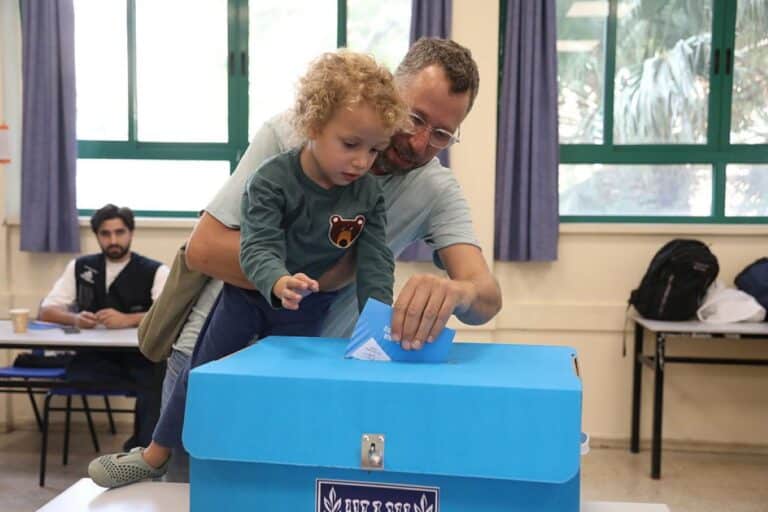
Neither Prime Minister Benjamin Netanyahu‘s bloc nor the parties seeking to replace him appear to have won a majority in Tuesday’s election, according to initial results. With about 90% of the vote counted as of Wednesday night, Netanyahu’s bloc currently holds about 53 of the Knesset’s 120 seats, while the anti-Netanyahu bloc holds about 48. Both blocs fall short of the 61 seats needed for a majority, raising the possibility that Israel could face another election if neither side can form a government.
Netanyahu’s Likud currently holds 27 seats, ahead of Gadi Eisenkot‘s Yashar, which currently has 21 seats. Naftali Bennett and Yair Lapid‘s B’Yachad have 12 seats, Avigdor Liberman‘s Yisrael Beytenu 7, and Yair Golan‘s Democrats 8.

Among Netanyahu’s allies, Itamar Ben Gvir‘s Otzma Yehudit has seats 7, United Torah Judaism has 6, Shas has 7, and Bezalel Smotrich‘s Religious Zionism-Zehut has 6.
Meanwhile, the Arab-majority Joint List has 12 seats and Ra’am has 7. The leading parties in both major blocs have rejected the idea of sitting with either party, although neither bloc has a path to a 61-seat majority without them. As of Wednesday afternoon, the Reservists-Economic Party was below the threshold, and Amcha Yisrael was below the threshold as well. The Reservists-Economic Party had not committed to either bloc, while Amcha Yisrael had committed to support Netanyahu but had been rejected by parties in his bloc.
Official results aren’t due until Nov. 4, though a clearer picture is expected to emerge as votes are counted in the coming days. There are still about 430-480,000 double envelope votes that need to be counted, although these aren’t expected to swing the results by more than a couple of seats, leaving a majority still out of reach for both major blocs.
Voter turnout was especially high in these elections, reaching 77.7% when polls closed, one of the highest turnouts in the past three decades. Turnout in Arab-Israeli communities was unusually high, averaging 80%, a 25% increase compared to the 2022 elections. High turnout matters beyond the headline number. The 3.25% threshold is calculated from all valid votes, so the more people vote, the more votes a party needs to enter the Knesset. Parties whose supporters turned out at lower rates than the rest of the country fell below the line even if they gained tens of thousands of votes.
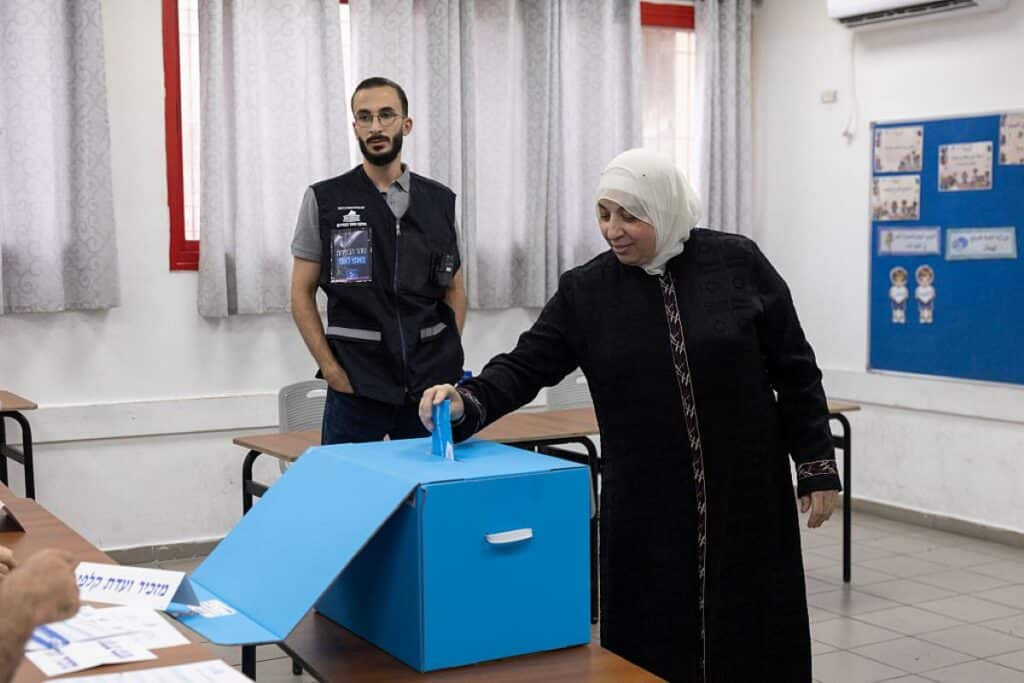
Once the results are official, President Isaac Herzog will consult with the elected parties and task a Knesset member with trying to form a government. The leader of the largest party does not automatically become prime minister: The question is who can bring together enough support to govern.
Why it matters
In Israel, election day is just the first step in the process of forming a new government that can take weeks or even months. Because no party has ever won a majority on its own, parties have to work together to form a coalition.
Without a majority, a government can’t function reliably, as the opposition could form a majority and shoot down legislation at any time.
In Israel, this is even more pressing because the government must approve a national budget every year. If the government fails to do so by the legal deadline, the Knesset automatically dissolves, and early elections are held. That means that if the government doesn’t have enough support to pass the budget, it’s more or less doomed from the start.
There is technically another option: a minority government with external support. In this scenario, the coalition holds fewer than 61 seats but receives guarantees from parties outside the coalition that they will either support or abstain on critical votes.
While this option has been used before, it has always resulted from parties leaving the coalition mid-term, not from an agreement reached right after elections. In September 1993, for example, Shas left Prime Minister Yitzhak Rabin’s second government, but it survived despite holding only 56 seats thanks to external support from Arab parties.
All of this shapes the options facing Israel’s parties.
If the official count confirms a deadlock, party leaders will need to decide whether to honor their campaign promises not to work with certain rivals. Breaking the deadlock would mean that at least one party would have to reverse a public commitment, or that a bloc would find a way to form a minority government.
Ra’am’s 7 seats would be one of the clearest paths to 61 for the anti-Netanyahu bloc, although they wouldn’t be enough on their own. However, Eisenkot, Bennett, and Liberman have ruled out a government that depends on an Arab party, even if it is from outside the coalition.
Even with Ra’am, the anti-Netanyahu bloc would still need another party to join them, or, at the very least, to provide support from outside the government. Liberman has also rejected the option of forming a minority government.
Earlier this month, Eisenkot raised the possibility that if his bloc did not secure a majority, he would try to form a minority government to ensure Netanyahu did not remain caretaker prime minister, even if the government collapsed shortly after its formation. But that would leave him with the challenge of finding parties willing to allow such a government to take office and help it survive key votes, as he’s said that he would not rely on the Arab or Haredi parties to do so.
Netanyahu’s options may be even more limited. Almost all the parties outside his bloc have committed to not sitting with him, and he has promised not to sit with Ra’am, the Joint List, or the Democrats.
One option that would require both blocs to renege on some of their promises would be a broad unity government built by the Likud, Yashar, and B’Yachad. Together they hold 59 seats, meaning they could form a government if even one smaller party joined them.
Such unity governments have been formed in the past, including in May 2020, when Benny Gantz and Netanyahu formed a government amid the COVID-19 crisis, despite prior commitments not to sit with one another. The two agreed to a rotation in which Netanyahu would serve as prime minister for 18 months, after which Gantz would replace him until the end of the term. However, this government collapsed after it failed to pass a budget amid instability and internal disputes. Gantz never became prime minister under the agreement.
President Isaac Herzog has said he will do everything he can to prevent another election. The outgoing Knesset was the first to last a full four-year term since 1988. Only seven of Israel’s 25 Knessets, including the outgoing one, have lasted a full four years, without calling early elections.
Israel faced a particularly severe political crisis in the years before the last government took office, during which it held five elections between 2019 and 2022, three of them within 11 months.
What happens next
The count isn’t over on election night. The first numbers were exit polls from Israeli news channels, released as polls close at 10 p.m. They’re projections based on voter surveys conducted at a selection of polling stations across the country, not officially counted ballots.
The real ballots are counted by hand. While most votes are counted overnight, many votes by soldiers, diplomats, hospital patients, special polling stations, and other exceptional cases are collected in double envelopes and must be counted separately and verified to ensure no one votes twice. This year there was an unusually high number of such votes, about 650,000.
The entire process takes several days before the final results are published, but the count is updated in real time on the Central Elections Committee’s website, and the networks update their projections accordingly. The Central Elections Committee must publish the official final results by Nov. 4. The chart at the top of this page will be updated as the official counts and projections are updated.
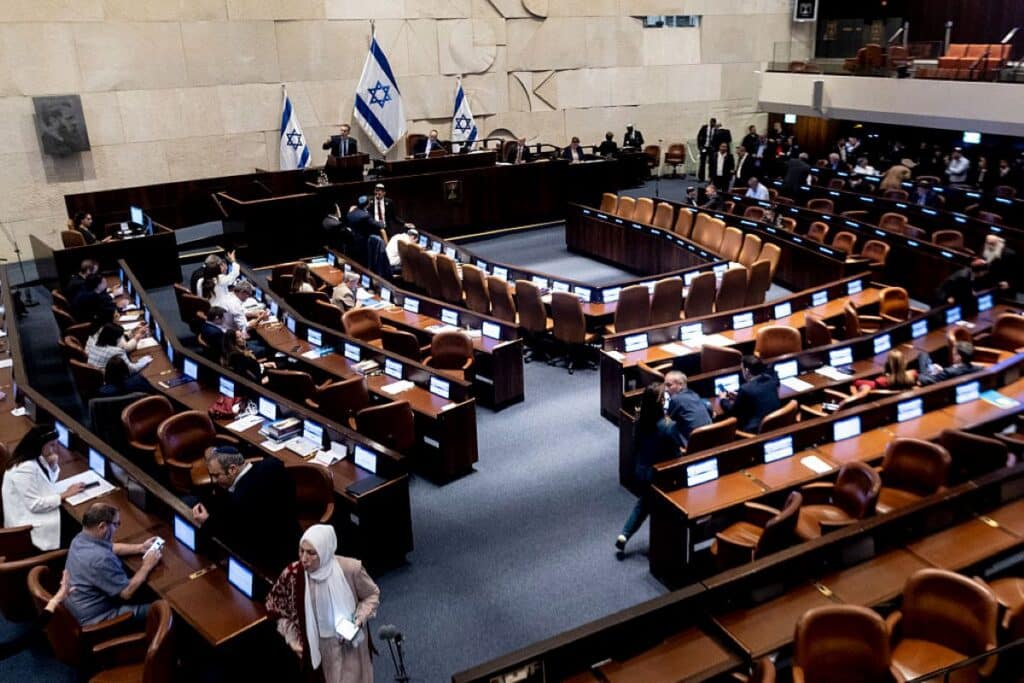
Choosing a prime minister. Once the official results are received, Herzog meets the representatives of every party that won seats. Each can recommend an MK for prime minister, or recommend no one.
Within seven days of receiving the official results, Herzog hands the mandate to the lawmaker he thinks has the best chance of forming a government. That person doesn’t have to be the leader of the largest party.
For example, in 2009, Netanyahu received the mandate even though his party won one fewer seat than the rival Kadima party. This was because he received more recommendations than Tzipi Livni, the head of Kadima. In September 2019, this happened again: Netanyahu won one fewer seat than Gantz’s Blue and White party but received one more recommendation. The deciding factor was the Joint List, which recommended Gantz but, at the request of three of its MKs from the Balad party, asked President Reuven Rivlin not to count them. In 2020, the reverse happened, when Gantz got three fewer seats than Netanyahu but received three more recommendations.
The coalition talks. The chosen lawmaker has 28 days to build a coalition. Herzog can extend that period by up to 14 more days. Partners negotiate over ministries, policy, and budgets, and sign coalition agreements before the government takes office.
If they succeed. The proposed government needs to win a confidence vote. It doesn’t require 61 votes in favor, just a regular majority. That means abstentions can allow a government to take office with fewer than 61 active supporters. Once it passes, the prime minister and ministers are sworn in.
If they fail. Herzog has three days to either give another lawmaker 28 days to form a government or tell the Knesset speaker that he sees no possibility of forming one. The second lawmaker cannot receive an extension.
If the second attempt fails — or Herzog decides not to appoint a second candidate — the Knesset gets one last shot. Within 21 days, 61 lawmakers can ask Herzog in writing to give the mandate to a specific lawmaker, who must agree to accept it. That lawmaker then has 14 days to form a government.
If no one succeeds, the Knesset dissolves automatically and Israel holds new elections about three months later. The Knesset can also vote to dissolve itself sooner, as it did in May 2019, and set an election date up to five months away. Netanyahu and his outgoing government remain in a caretaker capacity until a new government is sworn in.
The calendar if every deadline runs out
| Step | Legal window | Latest date |
| Official results | Within 8 days of the vote | Nov. 4 |
| Knesset sworn in | 14 days after the vote | ~Nov. 10 |
| First mandate assigned | Within 7 days of results | ~Nov. 11 |
| First attempt ends | 28 days + up to 14 | ~Dec. 23 |
| Second attempt ends | 3 days to assign + 28 days | ~Jan. 23, 2027 |
| Knesset attempt ends | 21 days to petition + 14 days | ~Feb. 27, 2027 |
| New election | Between about 90 days and five months of dissolution | ~July 2027 |