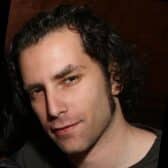

For more than 15 years, Jewish musician Mikey Pauker has performed at concerts, festivals, and synagogues across North America. Known for blending folk, reggae, Hebrew prayer, and chant music, he has built a following through songs rooted in Jewish spirituality, connection, and community. TIME magazine previously named him one of the “10 rising stars of New Jewish Music.”
But he never expected that one day he would need to contact the FBI because of antisemitic harassment.
Several years ago, Pauker was performing at a show in Oregon when another artist on the bill began asking him unusual questions after learning he was Jewish.
“She found out I was Jewish,” Pauker, 40, told Unpacked. “She said circumcision was genital mutilation and that I shouldn’t support it. I explained that it was a common practice in other religions as well, but I was happy to move on from the topic. We didn’t even know each other very well.”
According to Pauker, the interactions did not end there. He said the woman continued sending him hostile messages, and after the October 7 Hamas attacks, her online attacks intensified.

“She started calling me ‘Zionist scum’ online and pressured concert organizers to cancel my shows,” he said. “She falsely claimed I performed ‘genocide music.’”
In one instance, Pauker said the situation became serious enough that he had to take additional security precautions.
“She threatened to show up with protesters, so I had to call the FBI and arrange extra security,” he said.
While Pauker says he has lost performance opportunities since October 7, he also says demand for his music has grown within Jewish communities looking for artists willing to speak openly about Jewish identity and Zionism.
The experience would become part of a much larger turning point in his life. As he navigated rising antisemitism, professional challenges, and growing hostility toward Zionist Jews, Pauker found himself moving toward a calling he had considered for years: becoming a rabbi and cantor.
How October 7 changed Mikey Pauker’s path
Long before the current wave of antisemitism, Pauker said he encountered anti-Israel sentiment as a student at San Francisco State University.
“Back in 2007, there was already an oppressor-versus-oppressed mentality where Israel and Jews were cast as oppressors,” he said. “But you didn’t hear the word ‘Zionism’ nearly as much as you do today.”

He believes that changed dramatically after October 7.
“We saw the strategic misuse of the word ‘Zionist,’” Pauker said. “For me, Zionism simply means the right of the Jewish people to self-determination in their ancestral homeland.”
The aftermath of October 7 affected him both professionally and personally. While he had spent years considering a future in Jewish leadership, seeing people deny or minimize the Hamas attacks convinced him it was time to stop postponing that dream.
“After October 7, the whole world changed for me,” Pauker said. “I had thought about becoming a rabbi or cantor before, but suddenly the calling became very loud. I realized I couldn’t keep putting it off.”
Read more: From the bimah to Instagram — 14 women rabbis shaping Jewish life right now
In many ways, Pauker’s move toward the rabbinate reflects work he was already doing through music. His performances frequently draw from Jewish prayer, biblical texts, and communal singing traditions, blurring the line between concert and spiritual gathering.
Today, Pauker is studying at the Academy for Jewish Religion, a pluralistic seminary founded in 1956 that ordains rabbis and cantors from a variety of Jewish backgrounds.
Pauker said he was drawn to the school’s welcoming attitude toward Zionist students at a time when many Jewish spaces have become divided over Israel.
“The academic rigor is incredible,” he said. “And I love being in an environment where Jewish connection to Israel is understood and respected.”
For Pauker, pursuing ordination is not a departure from music. Instead, he sees it as a natural extension of the work he has already been doing for years through song, prayer, and community-building.
Taking the fight to court
Pauker’s experiences also led him into a legal battle over what he sees as discrimination against Zionist Jews.
The dispute centers on a Hanukkah concert scheduled for December 2024 at Harbin Hot Springs, a Northern California retreat center where Pauker had performed before the war. After online activists objected to his support for Israel, the venue canceled the event, citing safety concerns. Pauker later filed a federal lawsuit alleging discrimination.
Pauker described the Harbin cancellation as a tipping point after years of threats, cancellations, and hostility related to his Jewish identity and support for Israel.
“For me, Zionism is both religious and political,” Pauker said. “The word Zion is in the Torah and throughout our prayers. We face Jerusalem when we pray, and at Passover we say, ‘Next year in Jerusalem.’”
Pauker is working with the National Jewish Advocacy Center, arguing that Zionist Jews are increasingly being excluded from cultural and professional spaces.

His attorney, Matthew Maimen, believes the case has implications beyond a single canceled concert.
“This is an important case, not just because it squarely targets antisemitism in the form of anti-Zionism,” Maimen told Unpacked. “The court acknowledged that, at this stage, it must accept that Zionism can be a sincerely held Jewish religious belief. We believe businesses cannot avoid liability simply by pointing to pressure from customers.”
A lower court dismissed the case, a ruling Pauker and his legal team are now appealing.
Pauker is not the only Jewish performer who has faced controversy over Israel-related issues. Jewish artists, including Matisyahu and Kosha Dillz, have also encountered canceled performances and organized campaigns against their work since October 7.
Mikey Pauker’s message for Jewish students
Having experienced attempts to cancel his own performances, Pauker said he understands why some young Jews feel pressure to stay quiet about their Jewish identity or distance themselves from Israel.
“We’re living in a strange moment where it’s become fashionable in some circles to blame Israel or Jews for everything, even things completely unrelated to them,” he said.
He is particularly concerned about younger Jews navigating social media and college campuses.
“My advice is to be proud of who you are,” Pauker said. “A lot of people thought this would blow over, but now they realize it’s impossible to sit on the sidelines. There are influencers and public figures who stay silent because they’re afraid of losing followers. That pressure is real.”
At the same time, he says he has been encouraged by the growing number of Jewish creators speaking openly about their identity online.
Music, nature, and Psalm 96
Even as he pursues rabbinical ordination, Pauker has no plans to leave music behind.
His latest song, “Ya’aloz Sadai,” draws from Psalm 96 and translates to “Let the fields be jubilant.” The Hebrew and English composition celebrates nature, gratitude, and renewal.
“I’ve always felt deeply connected to the natural world,” he said.
Pauker, who sings and plays guitar, has built a following through an eclectic style that blends folk, reggae, prayer, and chant music. His songs include fan favorites such as “Hinei Mah Tov,” “Mountain Medicine,” and “Rise.”
He is also the founder of Beautiful Way Records and, as a voting member of the Recording Academy, advocates for the creation of a Jewish music category at the Grammy Awards.
Hoping for peace
As he balances music, rabbinical studies, and public advocacy, Pauker says his ultimate goal remains simple.
“My deepest desire is to pray with people and help create spaces where Jews can explore Torah, spirituality, and community,” he said.
He hopes for peace in Israel, throughout the Middle East, and around the world.
“Every person should have the right to celebrate their identity with joy,” Pauker said. “History shows that there have always been people who tried to take that away from the Jewish people, and history also shows that those efforts ultimately failed.”
For Pauker, becoming a rabbi is not a departure from the work he has done as a musician. Rather, he sees it as the next chapter of the same mission.
The stage may look different than it once did, but the goal remains the same: helping people find meaning, connection, and hope in difficult times.
Despite the challenges of recent years, Pauker remains optimistic.
“It’s easy to look at the chaos of the world and become negative,” he said. “But there is still humor, family, friendship, beauty, and goodness. It’s important to focus on the things within our control and remember that even alongside darkness, there is still light.”