
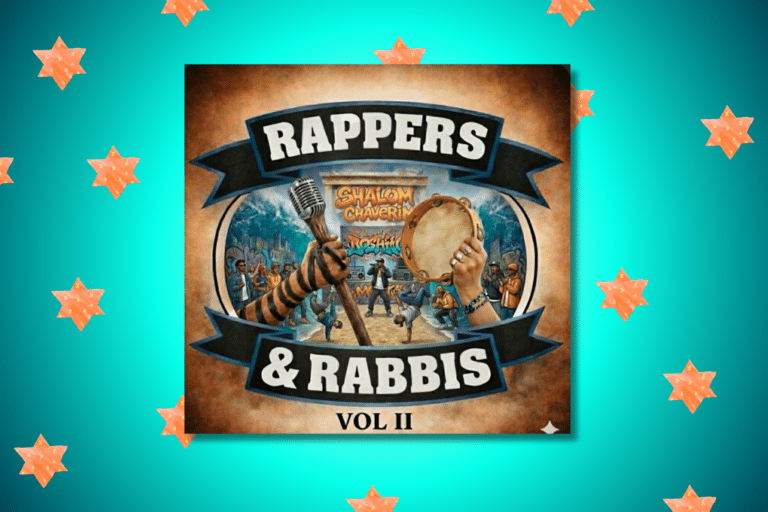
In a rehearsal space where ancient Hebrew prayers collide with boom-bap beats and Talmudic debate flows like a freestyle cipher, the nonprofit Rappers & Rabbis is trying to answer an unlikely question: What happens when Jewish tradition meets hip-hop culture not as a gimmick, but as a shared language? Founded by educator and performer Matt Bar, the collective remixes prayers, texts, and rituals through rap, arguing that both Judaism and hip-hop are built on rhythm, interpretation, memory, and the sacred power of words.
Rappers & Rabbis is not trying to make Judaism “cool.” Instead, the nonprofit collective is making the case that Jewish tradition and hip-hop culture have always spoken a surprisingly similar language.
For Bar, the project is not novelty or parody, but part of a much older Jewish tradition of adaptation and reinterpretation.
“Our work strengthens Jewish identity, deepens spiritual engagement, and ensures that this inherited storehouse of wisdom is not lost to assimilation but re-expressed for the present moment,” Bar told Unpacked. “Rappers & Rabbis exists because Judaism has always survived by re-voicing its past and hip-hop is one of the most powerful languages we have for doing that now.”

Founded officially in 2019 alongside Rabbi Adam Mayer and hip-hop artist Ali Richardson, Rappers & Rabbis grew out of Bar’s earlier project, Bible Raps, which he launched in 2007 through the business incubator Present Tense. Over more than a decade of teaching Judaism through hip-hop and performing himself, Bar said he began to realize there was a connection that could be explored deeper.
Read more: Hasidic rapper Moshe Reuven is making history
“I kept encountering the same truth: the overlap between Hip-Hop culture and rabbinic Judaism wasn’t superficial — it was structural,” Bar said.
“Both cultures treat words as sacred,” he added. “Judaism understands the universe as being created through speech. Hip-hop treats language as binding and powerful. Word is bond.”
Why hip-hop and Judaism parallel each other
That connection, he argues, extends beyond lyrical dexterity. Hip-hop sampling, where artists remix and reinterpret earlier recordings into something new, mirrors the layered conversations of the Talmud, where generations of rabbis debate inherited texts across centuries. Both traditions, Bar said, preserve culture through reinterpretation.
Bar often points to moments of historical rupture as another parallel between the two worlds. After the destruction of the Second Temple in 70 CE, Judaism transformed from a religion centered around sacrifice and other physical rituals into one centered around prayer, study, and portability. Hip-hop, meanwhile, emerged in the Bronx during the 1970s after arts programs were cut across New York City, forcing young artists to create music with turntables, records, and improvised technology. In both cases, creativity emerged from limitation.
“Holding both worlds at once made something click,” Bar said, reflecting on his years studying at the Pardes Institute of Jewish Studies while simultaneously performing in a rap group called Renaissance. “The parallels between hip-hop and rabbinic Judaism weren’t metaphorical. They were foundational.”

Bar grew up in Iowa City, Iowa, where it would seem unlikely to grow up to combine Hip-Hop and Judaism as a life’s work. Like many American Jewish teenagers, especially those who grew up in an “ultra-Reform” environment like Bar, he assumed his bar mitzvah would mark the end of his synagogue life. But a Birthright trip to Israel shifted his relationship to Judaism entirely.
“I discovered that Judaism isn’t only a religion of belief,” Bar said. “It’s a culture of study, argument, interpretation, and lived wisdom.”
As a philosophy major in college, Bar said he found himself increasingly drawn to Judaism’s emphasis on practical and ethical questions rather than abstract certainty.
“While much of Western philosophy chased absolute truths and hit a wall in the twentieth century, Judaism asked a different question: How should we live?” he said. “That question felt like home.”
Read more: How rapper Kosha Dillz is embracing Jewish identity through hip-hop and ‘Bald Hashana’
For Bar, hip-hop became another pathway into that same conversation.
“Rap compresses meaning into dense, rapid-fire language in a way that feels much closer to Jewish prayer and study than most contemporary music,” he said. “To an untrained ear, the Amidah can sound almost percussive. The closest sonic equivalent I’ve ever found is double-time rap.”
Reimagining prayer through performance
Today, Rappers & Rabbis brings together rabbis, Jewish educators, and hip-hop artists to create performances and recordings that blend Jewish liturgy with rap production and spoken-word performance. Their work ranges from reimagined prayers like “Adon Olam” to holiday-themed tracks such as “Sukkah MCs.”

But Bar says the group’s larger goal is not simply musical experimentation. It is to make Jewish prayer feel emotionally accessible, participatory, and alive.
“At the most immediate level, we want people to enjoy Jewish prayer,” Bar said. “Prayer should feel meaningful, embodied, and even joyful, not something people endure from a distance.”
For Jewish audiences, he hopes the performances offer a fresh way into ancient traditions. For audiences rooted in hip-hop culture, he hopes they reveal Judaism as a living oral tradition shaped by rhythm, memory, debate, and moral struggle rather than something rigid or inaccessible.
Hip-Hop slang alone tells the story, word up, word is bond, word to your mother. Judaism calls Jews “the People of the Book,” and imagines a G-d who creates the universe through speech—“Let there be light.”
Hip-Hop didn’t pull me away from Judaism, it gave me a new way into it. It strengthened my connection to self, community and lineage.Looking back, Rappers & Rabbis feels less like an invention and more like a convergence—the natural meeting point of the music, culture, learning and questions that have been with me since the beginning,” Bar explained in detail.
Identity, culture, and belonging
But Matt says that in retrospect, “the throughline was always there. I was drawn to Hip-Hop and Black culture from a young age, long before I had language for why. Only recently did I learn that my father—a white Jewish kid from New Jersey, attended an almost entirely Black school until high school, just alongside his brother. That revelation helped me understand that my attraction to Hip-Hop wasn’t a detour from my story, it was part of it.”
Israel is where Matt fell in love not only with the country but with Jewish learning itself.
Bar also sees the project as part of a broader effort to expand the soundscape of contemporary Jewish music.
“Much of synagogue music has become narrowly Ashkenormative, both musically and aesthetically,” he said. “Without rejecting those traditions, we aim to widen the frame, to reintroduce rhythm, improvisation, call-and-response, and participatory energy that have always existed within Jewish life.”
Ultimately, Bar believes Judaism is resilient enough to evolve without losing its core identity.
“We want people to leave feeling that Judaism is not fragile or in need of protection,” he said, “but durable, flexible, and strong enough to be remixed.”
A new album and a larger vision
Rappers & Rabbis released its new album, “Rappers & Rabbis Volume 2,” on May 15. The group will celebrate the launch with a performance at the Philadelphia Jewish Music Festival on May 17, headlined by Matisyahu. The album features reimagined versions of Jewish prayers alongside original tracks inspired by Jewish ritual and holiday life, including songs like “Adon Olam” and “Sukkah MCs.”

The album also prominently features Rabbi Dvir Cahana, whom Bar describes as “undoubtedly the best rapping rabbi alive,” adding that he hopes the record marks “the beginning of a long career in the Jewish music scene for him.”
But for Bar, the music itself is only part of the larger project. The deeper goal, he said, is to create a spiritually serious space where younger Jews can encounter Judaism not as something frozen in the past, but as a living culture capable of evolving alongside the present moment.
“The motivation was simple but urgent,” Bar said. “To create a serious, creative, and spiritually grounded space where Jewish tradition and hip-hop could speak to one another as equals, and where younger Jews could encounter Judaism as a living, expressive, and relevant tradition.”
Read more: Jewish music star Nissim Black reflects on his journey to Judaism and the power of faith
Bar believes hip-hop is uniquely positioned to do that because it has become one of the defining cultural languages of contemporary America, especially for younger generations navigating questions of identity, history, and belonging.
“Hip-hop is not just a genre of music,” he said. “It’s a dominant cultural language, one that values authenticity, storytelling, social critique, and communal expression.”
For audiences attending a Rappers & Rabbis performance, Bar hopes the experience changes the emotional texture of Jewish prayer itself. Success, he said, can be as simple as someone leaving feeling more connected to prayer than when they arrived. But he also hopes audiences walk away hearing both Judaism and hip-hop differently: not as opposing worlds, but as traditions built around rhythm, interpretation, argument, and memory.
“For Jewish participants, that often means encountering their own tradition with fresh ears,” Bar said, “hearing ancient words, texts, and rituals reframed in a way that highlights their urgency, poetry, and relevance.”
Ultimately, Bar sees Rappers & Rabbis as part of a much longer Jewish story: one where tradition survives not by staying perfectly still, but by continually finding new voices through which to speak.
“If audiences come away feeling more connected to their own voice, more curious about others, and more confident that Jewish tradition can meet the present moment without losing its soul,” he said, “then we’ve done our job.”
