
As flames lit the sky above the Warsaw Ghetto and gunfire cracked through the streets, 700 Jewish fighters emerged from hidden bunkers and safehouses to face the Nazi machine sent to destroy them. They were starving, barely armed, and knew that they wouldn’t survive. But for nearly a month, they held off the SS with smuggled pistols and homemade grenades, launching the largest Jewish uprising of the Holocaust.
This wasn’t just resistance. It was a bold, coordinated act of rebellion — the culmination of months of planning, organizing, and defiance by youth movements who refused to go like sheep to the slaughter. It was an uprising so fierce it disrupted Nazi plans, rattled their confidence, and inspired Jews across Europe to fight back.
The Architecture of Oppression
The Nazis had never been shy about their aims — to systematically remove Jews from European society — but they didn’t start with extermination camps. Nazi violence began with race laws that excluded Jews from certain professions or places. It continued with ghettos: sealed-off urban prisons surrounded by walls and guarded checkpoints.
The ghettos served two purposes: to segregate Jews from society and crush the human spirit.
Over the course of the war, more than a thousand ghettos sprung up across Europe. To add insult to injury, Jews were often forced to build the walls that would contain them.
The biggest of these was the Warsaw Ghetto. Ringed by barbed wire and a 10-foot wall, it packed over 450,000 people — nearly a third of Warsaw’s population — into an area smaller than New York’s Central Park. On November 15, 1940, the Nazis sealed the ghetto. No one was supposed to go in or out.

Life unraveled slowly, as entire families squeezed into single rooms. Running water was rare, and disease spread like wildfire. Nazi food quotas allowed for little more than a bowl of watery soup a day. Smuggling was often the only way to stay alive — but not everyone made it. Over 80,000 lives were lost to starvation, illness, and the merciless conditions.
Dignity as Resistance
Nevertheless, the Jews of the Warsaw Ghetto fought to preserve their dignity and to sanctify life, even as the Grim Reaper breathed down their necks.
They built secret schools and libraries, gathered for underground prayer, and even created a hidden archive to document Nazi atrocities. This was the ultimate act of resistance: imagining a future they would not live to see. Even if they didn’t survive, they would not be forgotten. One day, the world would know what they had endured.

Musicians formed a theater and an orchestra, performing songs the regime had banned. The Nazis tried to destroy their culture, their dignity, their humanity, but the Jews of the ghetto held on. Every poem, every song, and every whispered prayer was an act of quiet resistance.
Inside the ghetto, youth movements began to organize. They supported one another, smuggled in food and medicine, and slowly began laying the groundwork for armed resistance.
The Truth About “Resettlement”
After a year and a half of misery, the Jews of the Warsaw Ghetto were told they would soon be “resettled” to camps in the east. The Nazis promised better food and improved living conditions. Many Jews were so desperate, so hungry, and so weakened that they reported for the deportations. Wherever they were going, it couldn’t be any worse than the Warsaw Ghetto.
Some Jews suspected the truth, though. This wasn’t a “relocation.” It was the end of the line.
Panic swept the ghetto. The head of the Jewish council — appointed by the Nazis to carry out their orders — took his own life rather than hand over the daily quota of 6,000 Jews. The youth movements scrambled to decide what to do. Many older leaders still clung to hope that the rumors weren’t true, but the youth saw it clearly: this was a one-way ticket to their demise.
It was time to mount a resistance — with or without the grown-ups.
Building the Resistance
At first, resistance was merely a concept — an ideal to live up to, not a concrete plan. Without weapons, there wasn’t much they could do to fend off the Nazis or stop the deportations.
Nevertheless, the ghetto’s youth were determined. Two resistance groups were formed: the Jewish Fighting Organization (ZOB) and the Jewish Military Union (ZZW). The ZOB was mostly made up of teens and young adults with no battlefield experience or military training. Meanwhile, the ZZW, led by the right-wing Zionist group Betar, included former officers of the Polish Army — Jewish veterans who had served their country loyally and now found themselves imprisoned behind the ghetto’s walls.
In the harrowing months that followed, the Nazis deported more than 265,000 Jews from the ghetto to Treblinka. Another 35,000 were sent to forced labor camps. At first, many young Jews hesitated to join the resistance, afraid that their families would pay the price. But as more and more Jews were carted away, it became piercingly obvious that Jews were paying a price just for existing. They had nothing to lose because the Nazis would take everything anyway, so their fear hardened into resolve.
The ghetto brought together Jews from across the political and religious spectrum. People who disagreed mightily on just about everything. What did a Zionist have in common with a Bundist? What did a Communist have in common with a religious person?
In the fall of 1942, ideological purity had become a luxury no one could afford. Nothing unites a fractured people like desperation. The ghetto’s various political groups put aside their differences and focused on the only thing that mattered: fighting the Nazis.
By that point, the ghetto had shrunk significantly. Hundreds of thousands had already been deported, and the remaining 50-60,000 Jews toiled in the ghetto’s workshops.
The ZOB had managed to make contact with the Polish Underground, exposing the truth about the conditions inside the ghetto, and negotiating for weapons. Meanwhile, others risked their lives to sneak out of the ghetto and sabotage the Nazis, setting fire to supply stores and smuggling others to safety.
They dedicated themselves to resistance and fought to ensure no one could get in their way, not even fellow Jews.
Yakub Lejkin was one such example. He was a deputy chief of the Ghetto Police Force, with a reputation for cruelty and callousness. His job wasn’t to keep the Jews safe. It was, in part, to coordinate deportations. To the ZOB, he was a collaborator, no better than the Nazis, and that made him a fair target.
In October 1942, he was assassinated in broad daylight, a warning to collaborators everywhere.
He wasn’t the only one. Anyone who made the Nazis’ job even a little easier would get the same treatment. Soon, the ZOB had transformed itself from a small group of mismatched idealists into a formidable militia.
The January revolt
When the head of the SS arrived in the Warsaw Ghetto in January 1943, the resistance was ready. They understood what this meant: another wave of deportations was coming.
Within hours, the ZOB flooded the ghetto with flyers declaring what many still didn’t want to believe: deportation was the end. Resettlement was a euphemism for extermination.
“Jewish Masses! The hour is drawing near. You must be prepared to offer resistance and not let yourselves be slaughtered like sheep,” read the flyers.
Anyone unable to fight was urged to hide. The goal was to avoid being sent to the camps.
When the SS returned four days later to begin the deportations, the ZOB made its move. Disguised as deportees, the fighters suddenly broke ranks, rushing the SS with smuggled pistols. Many of the young fighters did not survive this first clash, but in the confusion, some Jews managed to escape.
The Nazis were shocked. They hadn’t expected resistance, let alone this kind of ferocity. It took days for them to regain control. In retaliation, they rounded up 1,000 Jews, executed them in the main square, and deported another 5,000. But they were rattled, even pausing deportations for several months.
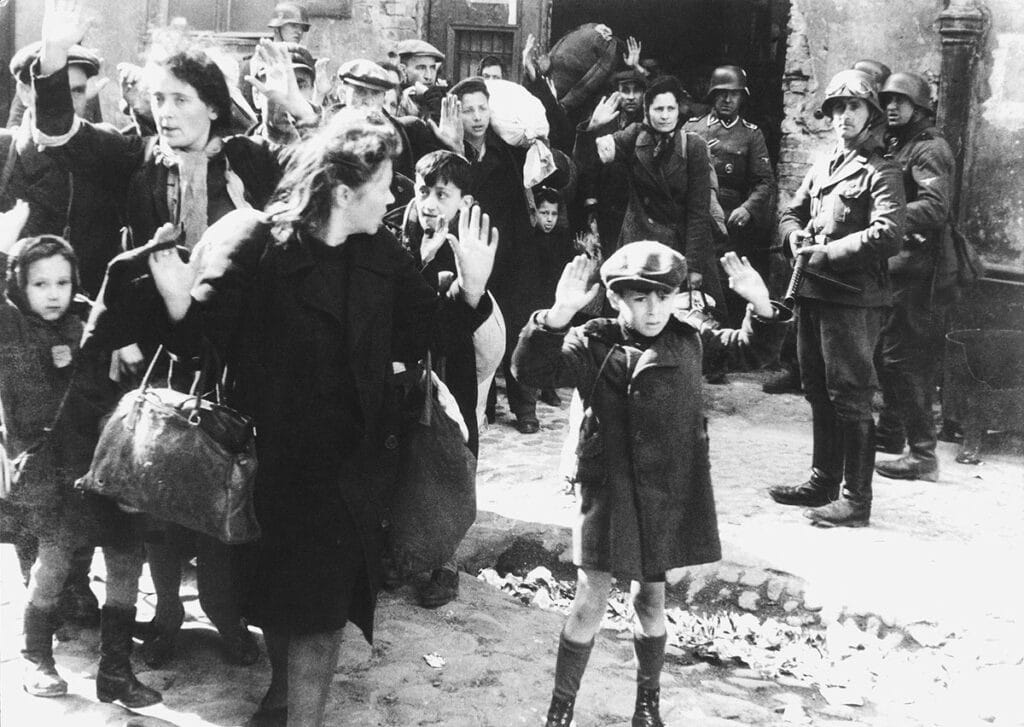
Despite their losses, this was a victory for the ghetto’s resistors. They delayed the Nazi machine and proved that resistance wasn’t only possible, it was effective.
The January revolt taught the ZOB three crucial lessons. First: the Nazi forces weren’t invincible — they retreated when met with resistance. Second: ambushes were far more effective than street fighting. Third — and most sobering — the rumors were true. The regime was preparing to liquidate the ghetto entirely.
The ZOB had managed to stave off this latest deportation, but they knew they would need to prepare for a much larger battle.
Roughly 55,000 Jews still remained in the ghetto. More and more began to join the resistance, understanding it was their only chance at survival. Thousands dug bunkers beneath buildings so they could hide when the Nazis returned.
The ZOB prepared for the inevitable showdown by building a central command bunker at Mila 18. Their leader, Mordechai Anielewicz, understood that this was most likely his last stand, and he was determined to give the Nazis hell until his very last breath.
The Uprising
On the Eve of Passover, April 19, 1943, at 3:00 AM, thousands of Nazis, backed by tanks and heavy artillery, stormed the Warsaw Ghetto. The streets were empty.
Fifteen minutes later, the silence was shattered. From rooftops, cellars, and hidden passageways, 700 Jewish fighters spring into action.
It was a motley crew, with some fighters as young as 13. Armed with pistols, grenades, Molotov cocktails, and crude explosives, they launched a fierce assault on the stunned Nazi troops with everything they had. As the fight erupted aboveground, thousands of ghetto residents remained hidden in makeshift bunkers, waiting and listening in the shadows.
The young fighters were vastly outnumbered and hopelessly outgunned. Nevertheless — against all odds — they pushed the German forces back. When the SS tried to reenter the ghetto, a mine planted by the ZOB detonated beneath them.
By that afternoon, the Nazis were so shaken that they begged for a temporary ceasefire. The resistance refused and struck again before vanishing into the shadows of their bunkers.
After that humiliation, Heinrich Himmler, the head of the SS, replaced the local command with SS Officer Jurgen Stroop. The fighting continued for five days, but still the Jewish fighters did not yield. Stroop decided to change tactics and ordered his troops to burn the ghetto to the ground, building by building. Simultaneously, the Nazis pumped poisonous gas into the sewers in an attempt to smoke out the fighters.
Flames roared as Jews leapt from burning buildings, while others crawled out of sewer grates, coughing and dazed. After 19 days of relentless battle, the SS closed in on the ZOB headquarters. Refusing to be captured, many of the ZOB leaders took their own lives inside the bunker.
Those who did not take their own lives fell victim to the gas that the Nazis pumped through the sewers. Anielewicz was among them.
Even still, the ZOB and the resistance continued to fight. It took another month for the Nazis to regain control of the ghetto. As a final show of victory, Stroop ordered the Great Synagogue of Warsaw blown up, and the entire ghetto leveled.

The human cost was staggering: 7,000 Jews lost their lives while resisting or hiding, and another 49,000 were deported to forced labor or extermination camps. Roughly 40 ZOB fighters managed to escape the burning ghetto. A handful of them even managed to survive and live long lives.
The Uprising’s Legacy
While the uprising ended in physical defeat, it was anything but a failure.
It was the largest, most sustained Jewish uprising against the Nazis in any ghetto or camp — led almost entirely by youth. A few hundred young Jews, with no formal training and makeshift weapons, held off one of the most ruthless military forces on Earth for nearly a month — outlasting the defenses of entire countries.
Their courage sparked further uprisings in Bialystok, among the Polish resistance, and sent a message across Europe: resistance was possible.
The Warsaw Ghetto Uprising is often remembered as a doomed final stand — a desperate act by those who knew they wouldn’t survive, but that narrative misses the point.
Their resistance was a coordinated, ideologically-driven rebellion by young people who believed that fighting back — no matter the outcome — was their duty. With their actions, they joined a long legacy of Jewish defiance — from ancient Masada to the modern fight for self-determination.
They left behind a legacy of courage, resistance, and the refusal to surrender dignity — even in the face of impossible odds.