
During some of the darkest days in world history, one man, Witold Pilecki, did the unthinkable: he voluntarily entered Auschwitz.
For two and a half years, he faced starvation, savage beatings, and the constant threat of his last breath: not as a victim, but as a spy.
Why would anyone willingly subject themselves to such inhumane treatment? His reason was simple yet extraordinary: to infiltrate the Nazis’ most notorious camp, uncover its secrets, and help destroy it from within.
By the time he became a spy, Pilecki had been resisting his entire life. He was born in exile in northern Russia to a Catholic family that was banished from their home in Poland after rising against the Russian regime.
He had never known an independent Poland, but by the time he was 17, Pilecki was already fighting for his homeland: first against the Germans during World War I, and then against the Bolsheviks in the Polish-Soviet War.
After all these adventures, Pilecki settled comfortably into middle age. He married a schoolteacher and raised two kids on the family farm. In his spare time, he painted and wrote poetry. It was the kind of peaceful life he’d only dreamed of during those long, cold nights of fighting. It should have lasted forever, but it didn’t.
In September of 1939, another regime threatened Witold’s beloved Poland. The Nazis, under the iron fist of Adolf Hitler, had been rattling their sabers for months, nibbling at the borders of neighboring countries. Austria and Czechoslovakia had already fallen.
Pilecki had no intention of letting the Third Reich swallow his country. When he was called to the front lines, he and his men fought the Nazis as hard as they could, but they were no match for Hitler’s army. In 26 days, the Polish Republic was gone. The Nazis carved up the territory crudely, annexing some parts and occupying others. For all intents and purposes, Poland was now a part of the Third Reich.
The Secret Polish Army
Pilecki and other members of the resistance decided to try to take it back. With other high-ranking soldiers who had refused to retreat, he formed an underground resistance movement called “The Secret Polish Army.” They weren’t the only ones to resist. Across the country, tens of thousands of Poles were determined to take back their homes. Eventually, they merged into a unified resistance movement with a military wing they called the Home Army. They vowed to overthrow the Nazi regime and restore Polish independence.
The Nazis had planned for such resistance. Almost as soon as they took Poland, they began commandeering its military infrastructure. Rumors began to spread about a large Nazi detention camp in southern Poland, built on the grounds of old Polish army barracks, where the SS was quietly disposing of anyone who stood in their way. This camp was Auschwitz, which would become the largest death camp where over one million Jews, political detainees, Roma and Sinti, and other groups targeted by the Nazis were killed.

Resistance members, anti-Nazi politicians, the intelligentsia, you name it. Dissidents were disappearing, and they weren’t coming back. The underground had to find out what was happening to them, so they needed a man on the inside.
But you don’t send just anyone to infiltrate a Nazi detention camp. You need someone special: someone smart and strategic, who could rally the resistance from inside the camp, without giving the whole game away. Someone who wouldn’t break, no matter what horrors he endured, and would live to tell the tale.
In short, they needed Pilecki. He was a trusted leader, a seasoned soldier, and a true Polish patriot. Just as his superiors had expected, he agreed to the mission right away, knowing he might never return.
Infiltrating Auschwitz
When the Gestapo raided the streets of Zoliborz in September 1940, Pilecki was ready for them. While others scrambled to hide, he surrendered, allowing the Gestapo to arrest him under the alias Tomasz Serafinski. Before he was hauled away, he whispered to his family, “Inform the right people that I am fulfilling the order.”
The plan was risky. There was no guarantee Pilecki would even get sent to Auschwitz, but he had to try. For two days, Pilecki suffered in confinement with nearly 2,000 other Polish political prisoners. Finally, he and his fellow prisoners were loaded onto a crowded train. The journey was harrowing, the air thick with the stench of sweat and vomit, with no room to sit or breathe.
As the train approached the cold metal gates of Auschwitz, SS officers shouted at the prisoners to line up. Immediately, the Nazis stripped Pilecki of his false name and his clothes, giving him a striped uniform and a new name: prisoner number 4859.
The officers demanded that Pilecki hold the number in his mouth until it could be sewn onto his uniform. When he refused, they beat him with a club, knocking out his teeth. Next, they sent him to get his head shaved and forced him into a shower with hundreds of other prisoners. The horrors had officially begun. Pilecki could already see how the Nazis had carefully planned every aspect of the camp to strip prisoners of their humanity and their hope. He refused to give them the satisfaction.
To survive, he focused on his three goals: organize all the resistance members in the camp to plan a revolt; raise prisoner morale by bringing news from the outside and, if possible, arrange better working conditions; and pass on information about what was going on in the camp.
The hope was that with enough information, the Resistance and the Allies would do something — not just to shut down the camp, but to bring down the Nazi machine itself.
Pilecki was well aware of what was at stake. His life, of course, but also the lives of every other prisoner. The Nazis had a particularly cruel way to suppress rebellions. If even one prisoner rebelled, every prisoner from the block would be punished, forced to stand for hours in the extreme cold or heat until they fainted from exhaustion.
If a prisoner escaped, the Nazis would shoot 10 prisoners at random as punishment. If a prisoner was caught trying to escape, the Nazis would force fellow inmates to hang them publicly. They’d then publicly hang those inmates for good measure. The whole system was designed to divide prisoners, keep them hopeless and terrified, and remind them that rebellion had a terrible price.
Pilecki knew all this, but he had come to Auschwitz with a mission, and he wasn’t going to abandon it, no matter what.
Organizing the Polish underground at Auschwitz
To start, he identified members of the Polish underground in the camp and encouraged them to recruit as heavily as possible. He wanted to seed the entire camp with the resistance, from the kitchens to the hospitals to the fields outside. Variety was crucial. The more resistance members placed throughout the camp, the more complete Pilecki’s intel became.
He split the prisoners into groups of five. To minimize risk, no group knew about the others. Soon, he had formed a network of over 500 prisoners secretly working against the Nazis. Pilecki used this extensive network to gather intel, which he sent back to the Home Army via a radio transmitter he and his fellow inmates had built from smuggled parts.
He did all of this while starving. Later, he’d describe the hunger as the most difficult trial of his life, but it was far from the only one he suffered. Along with his fellow inmates, Pilecki was forced to perform grueling, pointless tasks, such as pushing a wheelbarrow loaded with heavy rocks across the camp. At one point, he ended up in the camp’s lice-ridden hospital with a bad case of pneumonia and typhus. Somehow, he survived, even keeping up appearances with his fellow resistance members so as not to dampen their spirits.
The Nazis tried their best to keep the inmates busy with backbreaking work so they wouldn’t have the energy to conspire. However, Pilecki had injected a fresh energy into the camp. Between the pointless tasks and the forced labor, the resistance network was working. The Nazis began to suspect something was up.
In response, they put up a mailbox where inmates could rat each other out, like a gruesome parody of an office “suggestion box.” It might have worked if Pilecki and his men hadn’t immediately hacked it. They managed to destroy all incriminating information before it could ever reach the Nazis’ hands.
Pilecki’s reports to the Allies
In October 1940, reporting via radio became too risky, and Pilecki sent out his first dispatch with a released resistance member. The inmate delivered the message via a courier system operated by the Polish Resistance throughout Europe. It finally reached the Polish government, which was exiled in London, in the spring of 1941.
In the report, Pilecki included all sorts of vital details about the workings of the camp, which still mostly consisted of Polish political prisoners.
He detailed the grueling forced labor, the inhuman punishments, and the terrible abuses reserved for suspected rebels. No detail was too small or unimportant: from the camp’s layout to its daily schedule to the logistics of the transports.
He described the meager food rations that the Nazis meticulously calculated to keep prisoners alive for no longer than six weeks, his first clue about their ultimate intentions: No one was ever supposed to leave Auschwitz.
As time dragged on, Pilecki’s reports became more and more horrifying.
He described the Nazis’ first tests with Zyklon B gas, which they practiced on Soviet POWs. Within a few years, nearly a million Jews would be gassed the same way. He wrote about the agonizing, pointless medical “experiments” and forced sterilizations of Roma and Sinti prisoners, stories so gruesome they’re almost hard to believe. But they were all too real.
The Final Solution at Auschwitz
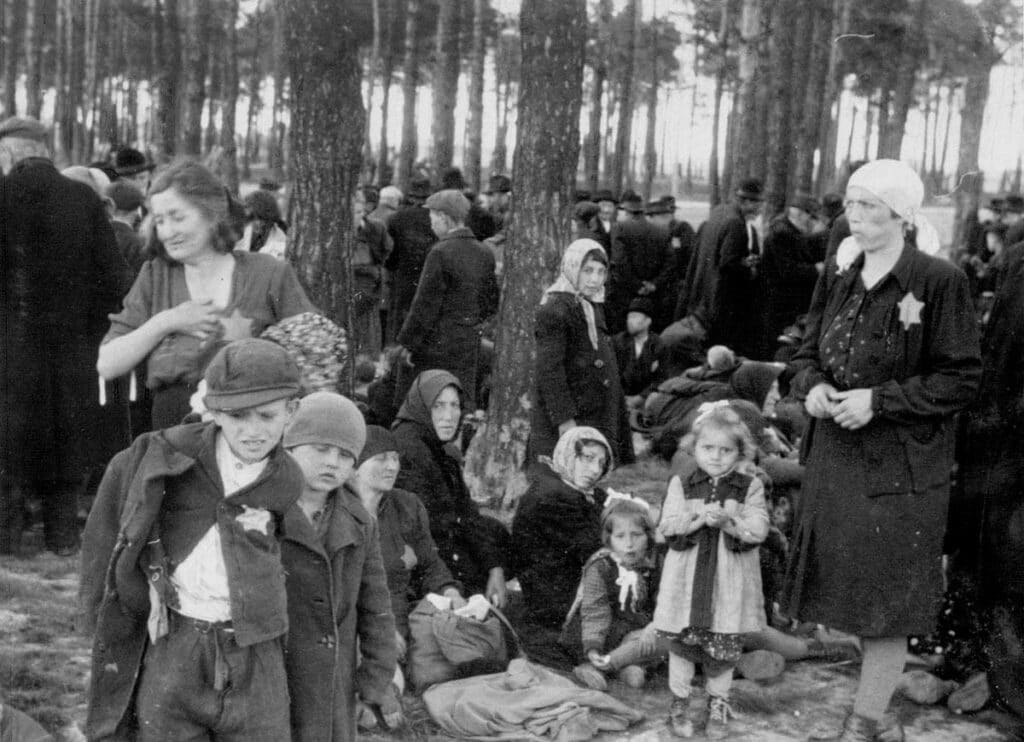
Then there was the Nazis’ plan to exterminate the Jewish people. After the Nazis devised their genocidal “Final Solution” in the winter of 1942, mass transports of Jews began arriving at Auschwitz. Most were gassed upon arrival, though some were worked to the grave first.
Pilecki revealed how victims were tricked into the gas chambers, thinking they were taking a shower, and then murdered, their bodies burned in the chimneys. He described the piles of clothes, children’s shoes, prayer books, baby carriages, and photographs, all left behind for the SS officers to paw through and steal.
Everything Pilecki saw confirmed what he had always suspected: the Allies needed to shut this place down.
In May 1942, Pilecki sent out a desperate plea to the underground command with two resistance members who had escaped: “You must inform them [about] the massive extermination of the Jews. Let the command know that children and elders from Slovakia were gassed and that young men and women are used for hard work, which in turn leads to chimneys. Our command must notify London so that the whole world saves the Jews from extinction. They have now started deporting Jews from Belgium and the Netherlands…Those people must be saved too.”
The Polish underground discussed potential plans: the British could target Auschwitz’s walls, or Polish paratroopers could fly in and liberate the camp. But resources were limited, and the underground feared that any attempt to liberate the camp was doomed to fail. Their scant weapons were no match for the SS’s robust equipment. The resistance network within the camp was defenseless and weak. Even if the underground could somehow liberate the camp, they worried that the prisoners would be too exhausted to escape.
Worst of all, the British officials who read Pilecki’s reports didn’t believe him. His reports of the gas chambers and crematorium were so gruesome that they had to be exaggerated, a sick story designed by the Polish government-in-exile to squeeze out more support from the Allies.
Pilecki grew more and more frustrated. He knew he had the necessary network to organize an uprising, take over the camp, and coordinate a mass escape. But his superiors in Warsaw refused to grant him permission to revolt, and he feared that disobeying them would cost more lives. The Nazis might even retaliate against the entire Polish nation.
For two and a half years, Pilecki had spied, endured, and survived. He had begged for the Allies, or the Polish government in exile, or the resistance, to do something, anything.
Pilecki’s escape
However, after nearly three years in hell, Pilecki realized that his pleas were useless. The Allies weren’t going to target the camp. The resistance was never going to approve a revolt. Meanwhile, the SS were catching and executing many members of the underground and transferring Poles to different camps to prevent them from conspiring. He had only narrowly evaded the most recent transports. He had done what he could. It was time to escape, and fast.
In April 1943, Pilecki got himself and two other prisoners assigned to the night shift of a bakery unit outside the camp. There, they wouldn’t have to worry about the electric barbed wires or concrete slabs built to prevent prisoners from escaping. When their guards weren’t watching, they snipped the wires of the alarm bells and unscrewed the bolts from the heavy metal door blocking them from the outside world. Then they made their break, traveling on foot for an entire week before reaching safety.
Report W
Eventually, Pilecki reached Warsaw, where he compiled his first extensive report, labeled “Report W.” While much of the report focused on the workings of the resistance network, he didn’t hold back on the nightmarish details that had been seared into his mind.
He wrote that arriving in Auschwitz was like entering another planet, with “such gruesome incidents that Dante’s description of hell would pale beside them.”
He noted that the Nazis were working, constantly, to make murder more efficient. They’d moved from firing squads to gassings to burning bodies in the crematorium after the stench of rot became too thick.
He recalled seeing a line of people stripped of their clothes and marched to the crematorium to be burned alive, so that the Nazis wouldn’t have to fiddle around with the gas chambers. So many people were being murdered that they had to build additional crematoriums.
He wrote about how the Nazis forced Jewish inmates to send falsely cheerful letters home, to convince other transports not to resist when they were brought to the camp.
He also detailed what Auschwitz had done to the human soul. The place was engineered to numb prisoners to horror. Inmates no longer recoiled from the bodies underfoot, or swinging from ropes, or stacked like firewood outside.
Amid this routine horror, people changed. They shed the niceties and social norms of life on the outside. Some turned to God, others lost all sense of morality, and you could never quite predict who would crumble into pieces and who would come out relatively whole.
“It has been known for quite some time,” he concluded, “that there is no hell like this [Auschwitz] anywhere else.”
Pilecki had been told, numerous times, that so-called “normal people” wouldn’t be able to wrap their heads around the horrors he had described. In his report, he urged these “normal people” to wake up, to believe, and to do something. He didn’t hold back when it came to the leaders of the resistance, either. The report made it clear how frustrated he was that he’d been denied the opportunity to organize a full-scale revolt.
But the report didn’t change anything. The underground still refused to encourage a rebellion or liberate Auschwitz, but Pilecki was still determined to fight. Pushing aside his frustrations, he continued to combat the Nazi regime in an effort to restore Polish independence.
Continuing the fight for Polish independence
When the Warsaw Uprising broke out in 1944, Pilecki joined the effort under a fake identity. He fought as a regular soldier until the resistance lost so many officers that he had to reveal his true status and take over command.
However, he was soon captured by the Nazis and thrown into a POW camp, where he languished until the Americans showed up in 1945. After liberation, Pilecki joined the Polish Armed Forces military intelligence division in Italy.
It was there that he wrote another 100-page report on his time in Auschwitz, later dubbed Witold’s Report. This one didn’t hold back, describing every horror in excruciating detail. The world needed to know.
Even still, Pilecki couldn’t rest. World War II was over. The Nazis were gone, but Poland still wasn’t free. Instead, it was a Soviet satellite – a pawn of greater powers. For the third time in his life, Pilecki went undercover, this time to gather intelligence on the Soviet government. His cover stories shifted, each one engineered to extract as much intel as possible.
Pilecki had survived Auschwitz, but his luck couldn’t hold out forever. In May 1947, he was caught, this time by the Polish Communist regime. He was no longer a young man, and the interrogations were harsh. Eventually, he “confessed” to a plot to assassinate members of the Polish police. Of course, there was no such plot, and the confession was coerced, but that didn’t matter to the regime.
After a rigged trial, Pilecki was found guilty and sentenced to death. On May 25, 1948, Pilecki was shot in the head in Warsaw’s Mokotów Prison. His remains were buried secretly. To this day, no one knows where they are.
For the next 40 years, the Communist regime tried to erase Pilecki from Polish history. No one was to speak of him or say his name. Even his wife didn’t know what had happened to him until she showed up at prison one day with a package, only to be informed he was no longer there. His children were told he was a traitor and an enemy of the state.
It was only when Communism collapsed that the world learned about his true heroism. Previously sealed archives were flung open. Poland – independent at last – posthumously exonerated and decorated the patriot who had dedicated his life to his country. In the year 2000, his surviving reports were finally published, ready for the world to read.
Even still, many people don’t know Pilecki’s name. Many have never even heard of the spy who entered Auschwitz, gathering intel years before the Allies even officially recognized the camp’s existence.
From all accounts, Pilecki was a true hero – the kind of person who gave others strength and raised their spirits, who put off escape so others could leave first, who worked tirelessly to tell the world what was happening at Auschwitz. He is a reminder that when the world seems made of darkness, it is possible to be the light.