








Schwab: Well, one thing that I’ll say as we’re diving into this story is definitely the Jewish star being tied to politics, to antisemitism, to oppression, to pain, to identity is not something that started in 2023. There is a long history of a lot of associations with this symbol and it being a point of pride and a point of shame.
MUSIC
Yael: From Unpacked, this is Jewish History Nerds, the podcast where we nerd out on awesome stories in Jewish history. I’m Yael Steiner.
Schwab: And I’m Jonathan Schwab.
Yael: And we’re here for season four. Schwab, it has been a while. What’s been going on with you?
Schwab: It has. One of the things I want to say is it has been a while since the end of season three, but something that I have enjoyed, even while we haven’t had the chance to be recording this podcast, is we had the chance to hang out recently a couple of times kind of related to the podcast.
Yael: Kind of related to the podcast? We saw an amazing movie together last Saturday night, Kidnapped, the abduction of Edgardo Mortara. Really, really depressing, but super interesting.
Schwab: And I’m also thinking about how we had a chance to visit a high school and talk to excited high school students who were in a history club about the making of this podcast, about the process of of learning history in different ways, which was really fun.
Yael: It was really awesome. It was a lot of fun to see that there is a new generation of history nerds on the rise that despite, you know, all the TikTok dances that they could be learning, they still want to learn cool things about Jewish history with old fogies like us, which was really fun. And, you know, we’re also getting to share a new perspective on ourselves with our listeners, so that you know we actually do enjoy each other’s company and we’re actually friends.
Schwab: Yeah, we do hang out other than when we’re recording the podcast.
Yael: But that being said, recording this podcast is one of my favorite things to do and I’m really glad that we’re back. And I have the distinct honor of being taught by you today for our first episode of season four. I’m assuming it’s going to be awesome, but why don’t you give me a little bit of a heads up?
Schwab: Yes. Yes. It is going to be awesome. But I think in the end, it adds so much to how we think about Jewish identity. And before we even get to the story, in case you didn’t already know, we’re doing things slightly different this season. We’re, of course, still taking turns, one of us is doing the research and teaching each other, but instead of focusing on a specific historical event or a specific person like we have in the past, this season we’re talking about symbols and objects.
Yael: Things. I love things. Things are awesome.
Schwab: Things. Yeah. And I thought a great place to start is what I think of as the symbol when we think about Judaism and Jewish identity.
Like if I said to you what or better yet, if you Google Jewish. and then click on images. I know because I just did this. It is the thing that is going to come up in 17 of the first 20 pictures.
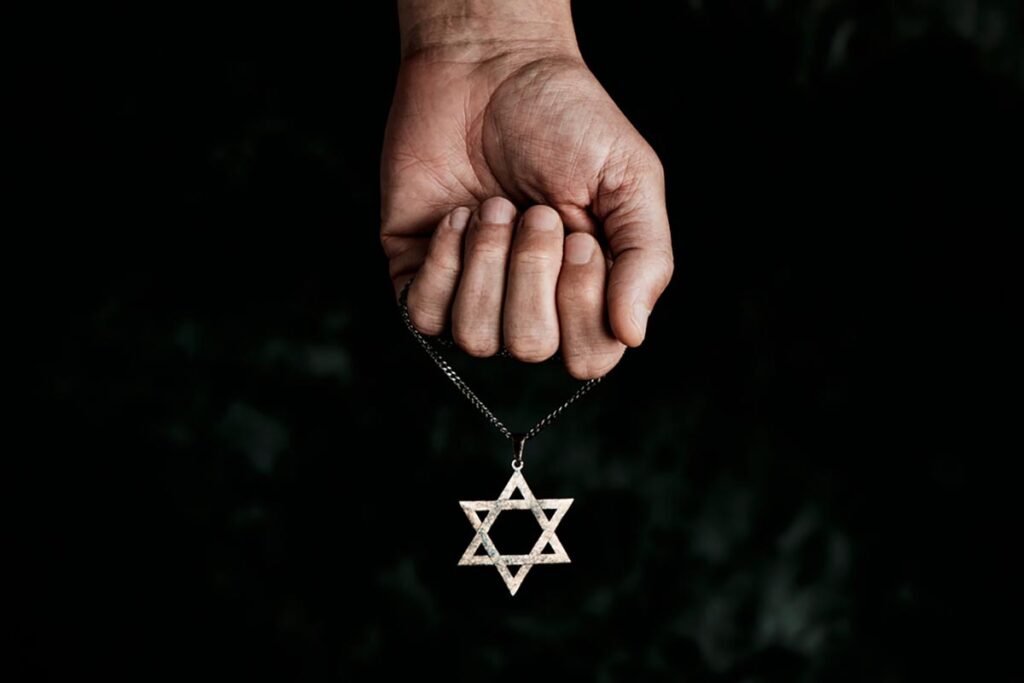
Yael: I’m gonna, you know, make reference to this little necklace that I’m wearing right now and go out on a limb and say it’s what I refer to as the Jewish star.
Schwab: Yes, yeah. And I think like two things already from what you said. One, like the idea of the fact that you’re wearing a necklace with it, with this symbol, which is very, very, very ubiquitous today. But also that slight hesitation. And then you said what I refer to as the Jewish star—
Yael: So just to clarify, we’re talking about the six-pointed star.
Schwab: The six pointed star and we’ll start, can I teach you something that I am pretty confident you do not know?
Yael: Sure, always.
Schwab: There is a fancy English word for this symbol.
Yael: It’s not a hexagon, it’s a… Hex-a-thedral?
Schwab: Ooh, you’re so close. It’s the hexagram.
Yael: Yeah, that makes sense. Because like the pentagram, that five-point star for the Wiccans or the…
Schwab: Right? Exactly like the pentagram, right? Yeah, hexagram. And I was like, man, this is the first thing I’m so excited to cover that it has, of course it does, a fancy English name that nobody who wears a necklace with this symbol on it would ever use.
Yael: Cool. So it’s the hexagram, it’s a six-pointed star. I refer to it as a Jewish star. I know that in Hebrew it’s often called a Magen David. Magin actually doesn’t mean star, Magen means shield. Often in English sometimes it’s called the Star of David.
Schwab: Mm-hmm. Yeah. So we’ll refer to it I don’t know by whatever we’re feeling like but we’re talking about the same thing and I think its names as we’ll see kind of plays into this story.
Yael: Okay, well tell me about this object that I proudly wear on my neck every day without knowing much about it.
Schwab: So it’s like we said, it’s the symbol for Judaism. If you Google search Jewish images, people wear it on jewelry. But it’s obviously inseparable from the symbolism of Israel because it is it’s the prominent symbol on the center of the flag of Israel. It’s the literal center.
Yael: Can I just say one tiny emotional thing? I started a new job recently and I was in the office last week and someone came to install some programs onto my computer and I noticed that he was inconspicuously somewhat under his collar wearing a Jewish star necklace. And I didn’t say anything to him about it, but it obviously immediately identified him to me as a Jew, as someone who also wears the Star of David necklace, immediately endeared him to me. So it’s definitely something that immediately resonates with me when I see it, probably more often than I notice. So I’m excited to learn about this.
Schwab: Yeah. Can I ask, did you, pre October 7th, did you wear a Star of David necklace?
Yael: I did, I did. Not actually for that long before October 7th. This particular Jewish star necklace that I’m wearing, I received it as a Bat Mitzvah gift.
Schwab: Mm-hmm. Mm-hmm.
Yael: And a little over 10 years ago, it was stolen from my parents’ house in a break-in. And I was really upset about it.
Schwab: Wow, stolen so soon after your bat mitzvah. 10 years ago, yeah.
Yael: So, so, just like a day later, just a day later. And I was really upset about it.And about two or three years ago, a cousin who I’m very close to, after hearing me complain a little bit about the loss of this necklace, bought me a new one, the exact same one that had been stolen, which was extremely kind, really lovely thing of her to do. And I have been wearing it again since then.
I probably would have started after October 7th if I hadn’t had this particular story. A lot of my friends have started wearing Jewish stars since October 7th, have started wearing other Jewish identifying jewelry. I think there’s been a lot of more conspicuous Jewish pride, at least where we live, where it is thankfully fairly safe to be openly Jewish. So yes, that is definitely something that’s come to the forefront.
Schwab: Yeah. But it’s also something that I think I pay much closer attention to than before. Like in your story, like of course you notice when somebody is wearing a necklace with a Jewish star on it.
Yael: Certainly, certainly. Yes, because unfortunately, it now feels as though being demonstrably Jewish means that you are demonstrably Zionist or demonstrably pro-Israel, which is obviously not always the case. So I think it’s because it’s a lot more politically charged than it once was. Whereas if I saw someone on the street five years ago wearing a Jewish star, I probably would have noticed, but I wouldn’t have thought, what does that mean about this person’s position on Israel and antisemitism and the safety of Jews in the world? Whereas since October 7th, it’s become a very clear indicator of that.
Schwab: Yeah, yeah. Well, one thing that I’ll say as we’re diving into this story is definitely the Jewish star being tied to politics, to antisemitism, to oppression, to pain, to identity is not something that started in 2023. There is a long history of a lot of associations with this symbol and it being a point of pride and a point of shame.
Like a way for people to target Jews and a way for Jews to be to demonstrate and be proud of their own identity.
Yael: So despite the fact that I’ve dragged us down this path, I’m assuming there is a lot more to this symbol than jewelry.
Schwab: Mm-hmm. Yeah. So let’s start with the most interesting part of the story of the Star of David or the Jewish star, which I think I wasn’t so shocked by this because I think it was like I sort of already knew this. But like, it doesn’t really have a natural meaning or symbolism to it, which is to say like, it’s a geometric symbol that is not in its origin really naturally tied to any sort of of Jews or Jewish history. It has come to be adopted. That gives it a tremendous amount of meaning. But like there isn’t anything like really deeply in what the symbol is that that connects it to Jewish history and its origin.
Yael: I certainly don’t recall ever seeing a reference to it in anything that I’ve learned from biblical history or even from Talmudic history. So where does it start?
Schwab: Mm-hmm. So we talked about at the beginning, you said immediately like the Hebrew name for it is Magen David and Magen doesn’t even mean star. It means shield, you know, and David is the biblical King David. like the shield of David, what does that have to do with the Jewish star? There’s this popular mythology story that this was a symbol that was literally on the shield of David that like David’s army, the Jewish army went to war with this symbol. There’s like zero historical archaeological textual basis for any of that.
There is a history that there is some sort of symbol that like this notion of a Magen David, that there was some sort of mystical perhaps like symbol that David used or that his son Shlomo or King Solomon also used, perhaps to control demons. That’s like a whole side story. But for most of Jewish history, it seems like a lot of the interpretations of what those symbols were involved very long, complicated names of God, much more popularly the menorah, which like definitely is like the opposite of just like a truly Jewish religious symbol that is rooted in a biblical origin that like four thousands of years Jews have clearly been expressing something through the use of the menorah using the menorah as a symbol for something. So like the star just does not have all of that history to it.
Yael: So where do we first see it?
Schwab: Yeah, it’s very, very old. And we see it in lots of places. And we don’t see it exclusively used by Jews. It’s a very pleasing geometric symbol. There’s a YouTuber whose videos I like to watch. he, I don’t know, sometimes talks about.
I think it’s called Vexillology, the study of flags. And he has a whole thing of like truly great flags can be recreated, I think his test is by like an eight-year-old doodling in class. And he’s very mixed on the American flag But the Israeli flag and more simply the Star of David is very easy for even young children to just draw because it’s, yeah.
Yael: Yeah, I mean, from a graphic design perspective, it’s one of those things where if you saw a graphic designer come up with it today, you’d be like, wow, this is perfect. This is Frank Lloyd Wright, you know, from a design perspective.
Schwab: Yeah, right? It’s a very pleasing geometric figure because it’s very simple to make with two triangles, but there’s a whole bunch of elements to it that creates six smaller triangles. There’s the center part. There’s the individual thing. It points in different directions. So it’s very easy to come up with tons of meaning that we can then ascribe to it. But the most basic theory of its origin is it’s just a very pleasing geometric symbol that was in pretty widespread usage.
Again, there’s plenty of really old Jewish artifacts from the sixth, seventh century BCE that have this symbol. But not exclusively, meaning alongside other symbols, and there are plenty of non-Jewish artifacts that also make use of this symbol, like going back–-
Yael: So it’s just kind of a decorative flourish that looks nice, like the same way you might see a fleur de lis or an asterisk or something that’s, you know, one of the top symbols in Microsoft Word that’s just something that people put on stationary because it looks nice underneath their name.
Schwab: Exactly. Yeah, yeah, very much so. There’s this ancient synagogue, I think it’s pronounced Capernaum that has like survived in pretty good shape. So we see a lot of the decorative materials in it. And we see this Star of David a bunch of times, but not exclusively. There’s a whole bunch of other, like exactly what you’re describing.
There’s also a motif of grapes and grapevines. As a decorative element, there’s also a pentagram a five-pointed star which which was also, you know commonly used alongside it and another geometrically pleasing symbol that you certainly would not see on any synagogues today But also has a long history of just as a geometric decorative symbol–
Yael: The swastika. Fascinating.
Schwab: Swastika, you know, which like, yeah, was not invented in the 20th century and was used in a lot of different traditions as just a pleasing, easy to draw shape.
Yael: So we know now, historically, the swastika has been imbued with a particularly heavy meaning since the 1920s, 1930s. Prior to then, it was used in a whole host of areas having nothing to do with Jews or antisemitism. So it seems like this hexagram was similarly used. When is its 1920s, 1930s moment? Like when does it switch over?
Schwab: Great question. As far as we can tell, the sort of like origin of it being, sort of exclusively associated with Jewish identity starts in 1354 in Prague and Emperor Charles IV of the Holy Roman Empire. He allows the Jewish community in Prague to have their own flag, which was an important marker of identity in the order it’s they have their own flag. as a special token of his grace, which I read and was just immediately like, wow, how, how gracious of you, Charles the fourth allow the Jews to make a flag.
Yael: Yeah, I’m assuming they weren’t living under the best conditions.
Schwab: Right, well, I guess this is the start of some improvement, you know? Like if they’re allowed to make their own flag, then that’s a symbol, but also a symbol of, if it could, it certainly could, well, it could also do the opposite, right? Like it could be like, okay, this is a symbol so that we can be sure that we keep the Jews separate in some way, but also recognize them as having something worthy of some sort of representation.
Yael: Mm-hmm, okay. Could lead to mixed dancing. Sure. Got it. Mm-hmm.
Schwab: And it does seem like they chose it for themselves, which also is important that the Jews are choosing this symbol for themselves. This isn’t being imposed on them. This isn’t saying, you know, Jews now now have to use this symbol, which does happen later in history as we’ll come to.
And the Jews make this flag. It’s funny because now I think it’s in my mind, it’s so strongly associated with certain colors, obviously from the Israeli flag or with gold because that’s the most common material you’d see of a like
Yael: Or yellow.
Schwab: Or yellow.
Yael: We’ll get there, yeah.
Schwab: Yeah, we will. We will get there. So this was a red flag with a star of yellow lines. We’re pretty sure not filled in, which is like, yeah, I don’t like a red flag with a yellow star of David is not something that you see nowadays.
Yael: Right. So it was just a decorative choice at that time.
Schwab: It was decorative, then because that was the flag of the Jews, began to, you know, it seems really take on this importance. There was possibly another, again, that was in the 1350s. There is another flag for Jews in the Kingdom of Hungary in 1476, and that flag had two pentagrams on it, but it does seem like after the 1350s, you start to see this more and more, and it takes on a clearer identity as this isn’t just, know, this, you know, in the opening page of this book, this is just like this printer’s symbol, but like this means Jewish in some way. And a later version of a flag, the 1627 version of this flag has the six Hebrew letters of Magen David arranged around the six triangles.
Gershom Shalom, who’s like the scholar on Jewish mysticism, he writes that like at some point in those years, this six-pointed star begins to converge with a lot of Kabbalistic ideas, or this idea of like this, a symbol or a seal or a shield of David. These two ideas begin to connect in some way. Gershom Shalom is pretty clear that the historical record shows there was a notion that David had some sort of symbol. This symbol became popular and that connection was made.
Yael: The two ideas merged. Got it.
Schwab: Yeah, those two ideas merged. There’s a great quote. I was like, Gershom Shalom, pretty clear and pretty harsh. He lists a bunch of different interpretations sort of of just of just like what the star means or some of these like older Kabbalistic ideas of just like what it represents. And he says, what is common to all of these interpretations is that their daring is matched by their ineptness.
Yael: Okay, so really out of nowhere, which is probably not something that we’d expect given that looking at other world religions, particularly Christianity, their symbol is the cross. And it’s very much taught from day one that the cross is not just a graphic design. The cross is inherent in the founding of Christianity. It’s,
Schwab: Right. Right. And it, yeah. And it, yeah. Like it means something really clearly. Yeah.
Yael: Exactly. It’s a historical relic with actual substance behind it in terms of the foundations of Christianity, whereas it seems here we had a few opportunities to select symbols for ourselves and those ideas got a little bit garbled and we came out with this six-sided star that some people were referring to as a Magen David and now that’s just what we have.
Schwab: Mm-hmm. Yeah, yeah. And actually going even further than what you just said, Gershom Shalom again says that he thinksa lot of the symbolic appeal of it or even just having a symbol was in attempt to, and I want to say this carefully, imitate Christianity in the sense that there’s this very easy to reproduce, very ubiquitous symbol that shows
This is Christian. Like, is there something that we can have that we can hang up on a sign for a store or have displayed on the entrance to a synagogue or the entrance to a Jewish quarter that says, this is Jewish, that doesn’t require writing, this is Jewish, because Christians very much had that. And Jews were looking for something like that.
Yael: It’s interesting. The film that we saw last week about Edgardo Mortara, for those of you who are either new listeners or haven’t caught up on our Edgardo Mortara episode in a while, he was a young Italian Jewish boy who was stolen from his family by the papal police and ultimately raised in the Vatican by the pope because he had allegedly been surreptitiously baptized. It’s a great episode.
Schwab: It is, yeah, it really is.
Yael: You should go back and listen to it. But basically in the film that we saw, before he leaves his family, his father gives him a small silver mezuzah And a mezuzah actually makes sense historically as a Jewish symbol, though…it’s really, it is overtaken by the gold crucifix necklace that is given to him by the nuns as soon as he gets to the Vatican, which really almost more than the baptism brands him a Christian. Like wearing this cross is what brands you a Christian. Similarly today, wearing a Star of David or displaying a Star of David is, as you said, something that connotes Jewishness.The symbols are very, very powerful.
Right. Yeah, but especially in the modern day, you know, where we’re all individuals and we all can take symbols and make them our own and, you know, imbue them with whatever power we want to give them. I’m sure that there are people to whom displaying the Star of David is the most important part of their Judaism or of their relationship to peoplehood.
Schwab: Mm Yeah. And this actually I I had totally forgotten this happened. So I was just looking at some of my pictures from when I visited Rome. Fourteen years ago for my bar mitzvah, let’s say on my on my honeymoon. And. We my wife and I were at the Coliseum.
Yael: For your bar mitzvah, yeah. Exactly.
Schwab: And I don’t, I think it’s because I was wearing a kippah or something, but someone saw me and knew that I was Jewish. It was this guy who was dressed up as one of the gladiators in the Coliseum. like this very muscular Roman man with a like shaved bald head in full gladiator outfit just saw that I was Jewish. And then in his limited English, I think started to tell us that he was Jewish.
And then to show us that he was Jewish, he rolled up his sleeve and he had a tattoo of a Star of David on his very large bicep. And I took a picture of it and was like, this is such a cool picture and such an interesting story and such an interesting place to choose to put that tattoo.
Yael: Really interesting. There are so many layers there and we can get into them another time, but I too find it very fascinating when people have the Star of David tattooed onto their body.
Schwab: Mm-hmm. Yeah. And he was a gladiator.
Yael: Talk about branding yourself as a Jew and not, and I think he seems to be doing it in a positive way, in a proud way.
Schwab: Yeah, and he was really proud to show this to me. I thought that was really cool to see. But yeah, I think connects to a lot of what we’re talking about, of this idea of that it is, in the 21st century, it’s the symbol for Jewish identity.
Let’s take a quick break.
[BREAK]
Schwab: So, I don’t know, getting from where we were in the 1600s to the 20th century, after it is used on this flag for Prague, we start to see it a lot more. But definitely a big element of its spread in the 1600s is that it’s very clearly a symbol in the Sabatian movement, to reference another old episode of ours.
Yael Okay. You’re really doing a great job at selling prior seasons. I’m going to have to take lessons.
Schwab: Yeah. Yeah. That takes us back. I think that was like our second episode ever.
Yael: Yeah, second or third, absolutely.
Schwab: Right. But that doesn’t seem to have hurt its, I don’t know, its its importance as a symbol that was associated with the false messianic movement of Shabtai Tzvi. It also was, we start to see it prominently displayed on synagogues in a way that it’s clear it’s not a motif, it’s not just like a design element, but it’s like a huge part of the entrance. And one of those, it’s on the seal of the Jewish community of Vienna in 1655, and it’s on the synagogue in a Czech city called Budvaice, which is from the early 16th
Yael: Okay, like Budwiser?
Schwab: Exactly like. yeah, I was like, whoa, this is obviously the synagogue of Budweiser and its prominent Star of David. That’s the number one most famous thing about the city of Budweiser. And number two is the connection to Budweiser, which I believe that is the art, like there is a long history of beer brewing in the city and that’s where the name comes from.
Yael: Okay, we’re gonna have to look into this later.
Schwab: And then in the 20th century, or I guess right before the 20th century in 1897 at the first Basel Conference, it’s chosen as the Zionist symbol. It’s chosen for the Zionist flag, which is to say, like before there even was an Israeli flag because there was not a state of Israel, but it’s chosen as the Zionist symbol by Zionists. And part of the reason that it’s chosen, in addition to, like we were saying, just excellent graphic design and ease of representation is that it’s not specifically religious. Like something like the menorah or a shofar or a lulav and etrog, this could be appealing also to secular Jews as like this is something that clearly denotes Jewish identity, Jewishness, but does not carry with it, you know, like a specific religious practice.
Yael: Interesting. So fascinating because to me that sounds like maybe one of the first indicators of a cultural Judaism versus a religiously grounded Judaism. Certainly now cultural Judaism has, you know, a huge, it’s a huge force in certainly in American Jewry. So to say as Zionists, people who want to return to the Jewish homeland, we’re going to adopt a culturally Jewish symbol rather than a religiously Jewish symbol is very telling as to what the modern Zionists were trying to achieve. It’s fascinating.
Schwab: Yeah. At the same time, I’m sure that part of it is saying there’s a separation between cultural, historical Judaism and religious Judaism. But I also think it’s an attempt to appeal to both at the same time. It’s a big tent. there are, it is where it’s at. I think it’s more of a.
Yael: Yeah, it’s big tent.
Schwab: But I’m not an expert on this, so can’t say. I think there are religious Jews, especially very right-wing religious Jews or ultra-Orthodox Jews, that would reject the Star of David as a symbol. Certainly because it carries with it the state of Israel, which maybe in some of those communities they don’t necessarily agree with or feel represents them. But also, I think, because this does not have the religious history to it, and therefore it should not stand as a Jewish symbol. Again, an extreme minority, but worth saying.
Yael: Right.
Schwab: I haven’t done a survey, can’t tell you percentage, but I do think that it is very widely adopted by Jews in most communities just because putting aside the questions of the origin, which like, I think we’ve been pretty good, like the origin is not, I don’t know, like, it is not a good argument for its usage. But like, I don’t know, carrying with it all the incidents, or all the ways in which it’s been used makes it so important. like that’s the point I want to close on, but we can’t close without talking about what I think in addition to it being used as a Zionist flag and eventually being adopted as the Israeli flag, the other 20th century usage, we’ve alluded to several times of this six-pointed star, and that’s as a Jewish badge.
Yael: Right.
Schwab: So this didn’t start in the Holocaust with the Nazis. There is a history of it being used prior to that, but like, I don’t know, the world thought we had moved on from that. Like that was in the 17th and 18th century. It was used for segregation, for oppression, but with the emancipation of the Jews in Europe, that had really faded and stopped. And then the Nazis brought it back.
There were a couple different versions. There’s some really interesting, for those who are fascinated by such things, there’s really interesting history of just the Nazi usage of this symbol and symbology and the brief history of that, because I think they went through several iterations of it. But by 1941, was pretty clearly set in what I think would be almost universally recognized, certainly by, by Jews of the yellow star, which really it’s a yellow background and a very faint, I think like black line. And it’s a badge and with the word for Jew in depending on the country or like the language spoken in different languages.
And that was in late 1941 and by early 1942, sort of in every area under Nazi control by law required for Jews to wear this star. Yeah.
Yael: Which is so interesting. Obviously, you said that the star had been adopted by the Zionist Congress in Basel in the late 1800s. So it had already been taken. But for a nascent nation state in 1948 of Israel to then take that symbol, make it its official flag, when it had been such a weedy symbol of oppression for so many of its citizens, is… I think speaks to a lot of trauma and psychological confusion among Jews at that time in terms of having been victims and having been murdered and lost everything, but then almost immediately gained everything that Jewish people had been looking for for so many years.
It’s a weighty symbol. It speaks both to our salvation and our autonomy and Jewish power and also very, very much to Jewish weakness and Jewish death and tragedy. So it’s got all the pieces of an Oscar winner.
Schwab: Everything you just said, that’s exactly like that’s a perfect summary, I think, of this story, which is like this simple geometric symbol, like it is it is a purely abstract geometric symbol. And yet it means so much.
Yael: Means everything, means nothing, yeah.
Schwab: Yeah. Like it means what it means to be Jewish because of the history of it. And like, and I think this is like exactly what you’re saying. Like in, in the creation of the modern state of Israel, in, the way that we identify as Jews today, we did not choose to take on a new simple, like we chose this thing that has so much baggage.
Yael: Yes, and also, you I think about it as a grandchild of Holocaust survivors. You know, I am choosing to walk around in the world with this golden symbol of Judaism or what we’ve made into a symbol of Judaism and literally carry myself publicly as a Jew. And, you know, my grandparents and their relatives, my grandparents happen to have, you know, been in Siberian labor camps and they were not in places where they would have worn a yellow star, but other relatives were and certainly, you know, our entire nation was or much of our nation was.
Schwab: Yeah. I’m sure in our family trees, are plenty of people, right, who are forced to wear it. Yeah.
Yael: Yeah, there were people, there were plenty of people in my family, you know, who were forced to wear such a badge and who would have given anything to have never been identified as a Jew again. And I sort of wake up every day, laissez faire, get dressed, keep this necklace on, don’t think about it, have very much have the privilege to not think about it most of the time.
I think since October 7th, that’s something that me and my peers have grappled with. You know, in New York, we are very, very lucky. And even in a place where we are so lucky, there have been incidents of hatred. So it is, yeah, it’s weighty for something that, as you said, means nothing. It means a lot. And I will say, as we kick off this new season, you have given, you have set the bar very high because we’re talking about
Schwab: Yeah. Yes. Yeah.
Yael: We’re talking about the symbol.
Schwab: I think it does set the stage for what do Jewish symbols mean? And means everything and means nothing is such a great way to summarize this one.
Yael: And yeah, speaking about, you know, like biblical weight, you know, everything is nothing when you, when you think about it ecclesiastically, I think that might be the word. wow. So thank you for this. think it’s really been interesting. It’s given me a lot to think about. When I see my necklace in the mirror, we’ll have a lot of different thoughts than I did maybe this morning when I got dressed and, hopefully for our listeners, this has been a meaningful episode and maybe one that speaks certainly more materially to what goes on in their daily lives than some other things. And I think that’s our goal with this season with material objects and material history. Cool. Thanks for this. I’m really looking forward to the next couple of weeks getting back into action.
Schwab: I’m looking forward to their next episode and go to some interesting places this season.
Yael: I’ll be surprised if you have the next one on a necklace, Schwab.
Schwab: Jewish History Nerds is a production of Unpacked, an OpenDor Media brand. Subscribe wherever you’re listening to this podcast and follow Unpacked on all the regular social media channels. Just search for @UnpackedMedia.
Schwab: And if you’re enjoying nerding out with us, please share this and other episodes with your friends and family. And most of all, be in touch with us by writing to us at nerds@unpacked.media. That’s nerds at unpacked.media.
Yael: Jewish History Nerds is produced by Jenny Falcon and Rivky Stern. Dr. Henry Abramson is our education lead. It’s edited by Rob Para. I’m Yael Steiner.
Schwab: And I’m Jonathan Schwab. Thanks for listening.