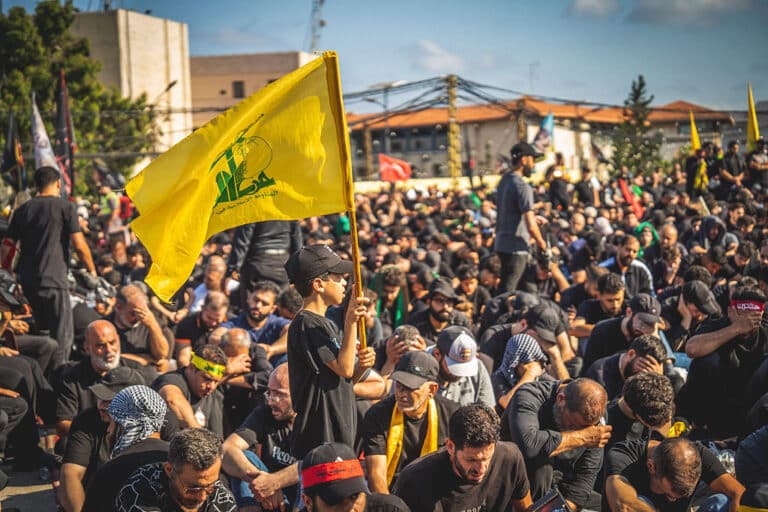
Years of war have left Palestinians and Lebanese Shias frustrated with Hamas and Hezbollah, with two new polls suggesting an opening for diplomacy with Israel. But that openness has limits. Most Palestinians oppose Hamas disarming before Israel fully withdraws from Gaza, while a significant minority of Lebanese Shias want Hezbollah to retain its weapons. In Gaza, support for armed struggle has also begun to climb again after falling earlier this year.
Among Palestinians, support for Hamas has fallen to 19%, down from 35% a year ago and 24% in August 2026, according to a poll conducted by the Palestinian Center for Policy and Survey Research (PSR) on October 7–11. Meanwhile, 42% identified negotiations as the most effective path to Palestinian statehood, up from 36% a year ago. Yet 74% opposed Hamas disarming before a full Israeli withdrawal from Gaza.

In Lebanon, a September survey of 800 Shias conducted by Statistics Lebanon found that 38.5% had little or no trust in Hezbollah, although a majority still expressed at least some trust in the group. Asked how they would prefer to resolve the conflict between Israel and Hezbollah, 63.3% chose some form of security agreement with Israel, either direct or brokered by a third party. More than 71% said decisions about war and peace should rest exclusively with the Lebanese state.
The findings come amid continued violence and disputes over disarmament on both fronts. In Gaza, the October 2025 ceasefire has not ended near-daily Israeli strikes, and Hamas has yet to fulfill its commitment to disarm. Israeli strikes have also continued in Lebanon, where Hezbollah opposes efforts to bring its arsenal under state control.
Hamas’s support keeps sliding
Hamas’s declining support reflects a broader disillusionment with established Palestinian factions. When PSR asked Palestinians which party or political orientation they supported, 22% chose Fatah and 19% chose Hamas. A third chose “none of the above,” including 48% in the West Bank and 11% in Gaza.
Hamas’s decline has been sharpest in the West Bank, where its support fell from 32% in October 2025 to 18% in August 2026 and 13% this month. In Gaza, support fell from 41% to 33% to 27% over the same period.
Many Palestinians appear open to alternatives: 56% said they would consider voting for a newly established independent list of professional, economic, and national figures.

Fatah and Hamas have long dominated Palestinian politics. Fatah, a secular nationalist movement, leads the Palestine Liberation Organization, which recognized Israel during the Oslo process in 1993. Hamas, an Islamist movement founded in 1987, does not recognize Israel and is designated a terrorist organization by the U.S., the EU, and other governments. After winning the 2006 legislative elections, Hamas seized control of Gaza from Fatah in 2007. The Fatah-led Palestinian Authority has since governed parts of the West Bank.
The October survey focused on legislative elections scheduled for November 28, which would have been the first since 2006. On the final day of polling, however, Palestinian Authority President Mahmoud Abbas postponed the vote until September 2027. He cited Israeli military operations, settlement expansion, settler violence, movement restrictions, and the withholding of Palestinian tax revenues. The poll found that 53% supported holding elections on schedule.
PSR tested support for competing electoral lists in three rounds: before providing additional information, after introducing Palestinian-American businessman Bashar Masri’s background, and after describing the lists’ platforms. The results measure preferences among likely voters who had settled on a choice.
Despite Hamas’s declining party support, its joint electoral list with Mohammed Dahlan, a former rival with close ties to officials in the UAE, remained competitive, receiving between 16% and 23% across the three polling rounds.
Dahlan formed the list with Hamas and several other factions in September. It presents itself as a broad Palestinian alliance, giving Hamas a potential route back into electoral politics at a time when its future role in governing Gaza remains contested. Support was concentrated in Gaza, where the list received 30% in the final round, compared with 7% in the West Bank.
A list led by Qaddoura Faris and Fadwa Barghouti, and backed by imprisoned Fatah leader Marwan Barghouti, received between 20% and 23%. Barghouti is serving multiple life sentences in an Israeli prison for his role in attacks that killed five people. His appeal spans Palestinian political divisions: he is a senior Fatah figure with a history of armed action who has also supported a two-state solution and cooperation among rival factions.
Masri’s independent list received between 15% and 25%, gaining support after respondents learned about his background. The official Fatah list, led by PA Vice President Hussein al-Sheikh and backed by Abbas, received between 12% and 17%. A list led by Mustafa Barghouti, head of the Palestinian National Initiative, received between 12% and 15%.
In a separate leadership question presenting seven candidates, Marwan Barghouti led with 34%. Masri and Hamas leader Khalil al-Hayya each received 13%, followed by Mustafa Barghouti at 12%, Abbas at 6%, and al-Sheikh at 4%.
Fewer Palestinians see the war as a Hamas victory
Far fewer Palestinians now see the war as a victory for Hamas. According to PSR’s October poll, only 16% believe Hamas emerged victorious, while 17% believe Israel did and 62% believe neither side won.
Earlier polls asked who respondents expected to win. The share choosing Hamas fell from 70% in December 2023 to 67% in June 2024, 43% in May 2025, and 39% in October 2025. The shift was particularly pronounced in the West Bank: a year ago, 48% expected Hamas to win; this month, only 16% said it had.
Views of the October 7 attack have also shifted. In a late-2023 PSR poll, 72% of Palestinians, including 82% in the West Bank, said Hamas’s decision to launch the attack was correct. By October 2025, support had fallen to 53% overall. PSR has not reported results for that question since.
A separate poll by the Jerusalem Media and Communication Center (JMCC) asked a different question: whether the attack served Palestinian national interests. In August 2026, 15.7% of West Bank respondents said it had, down from 45% in September 2024.
Support for negotiations holds, but armed struggle rebounds in Gaza
Negotiations remain Palestinians’ preferred path to statehood, but a rebound in support for armed struggle in Gaza has interrupted the shift toward diplomacy.
In October, 42% of Palestinians identified negotiations as the most effective way to end the occupation and establish a state, up from 36% a year earlier. That was slightly below August’s 44%, the highest level in four years. Support for armed action, meanwhile, fell from 40% in October 2025 to 27% in August 2026 before rising to 33% this month. Another 18% chose popular nonviolent resistance.

The rebound in support for armed action came entirely from Gaza, where it rose from 21% in August to 37% in October. Over the same period, support for negotiations there fell from 55% to 41%. In the West Bank, support for armed action continued to decline, from 32% to 29%. PSR attributes the increase in Gaza to Israel’s continued daily strikes since the ceasefire began.
The surveys also explored what a political settlement might look like. A two-state solution envisions an independent Palestinian state alongside Israel, encompassing the West Bank and Gaza, with East Jerusalem as its capital. Most proposals use the “1967 lines” as a starting point, with mutually agreed land swaps that could allow Israel to retain some large settlement blocs. Also known as the Green Line, these are the 1949 armistice lines that separated Israel from the then-Jordanian-controlled West Bank and Egyptian-controlled Gaza before the Six-Day War.

In October, 53% of Palestinians supported a two-state settlement based on those lines with East Jerusalem as the Palestinian capital, while 44% opposed it. Support stood at 56% in the West Bank and 48% in Gaza. Separately, 54% favored regional peace agreements, and 56% supported consultative talks with Israeli figures who oppose the occupation. Settlement expansion was the most frequently cited obstacle to statehood, chosen by 41% of respondents.
Those findings require some caution: support for a two-state solution varies with the wording of the question and the alternatives offered. In August, 44% supported a two-state solution when asked about it without further details, while 50% opposed it. But when respondents were offered three options — two states along the 1967 lines, a confederation, or one state with equal rights — 56% chose two states.
Palestinians hesitant about Trump’s Gaza plan
The polls also tested support for key elements of the Trump administration’s plan for Gaza. U.S. President Donald Trump unveiled the 20-point plan in September 2025, leading to a ceasefire the following month. Its first phase included a partial Israeli withdrawal, an exchange of Israeli hostages for Palestinians held in Israel, and humanitarian aid. The UN Security Council endorsed the plan in November.
The second phase, launched in January 2026, focuses on demilitarization, technocratic governance, and reconstruction. Under the plan, the National Committee for the Administration of Gaza (NCAG), headed by former Palestinian Authority official Ali Shaath, would take responsibility for civil affairs, aid coordination, and restoring basic services.
The committee operates under the oversight of the Board of Peace, an international body chaired by Trump. Former UN Middle East envoy Nikolay Meladenov serves as its High Representative for Gaza, linking the board with the committee. The plan also calls for an international stabilization force to help demilitarize Gaza and offers a possible path to Palestinian statehood tied to PA reforms, without guaranteeing that outcome.

Disarmament remains a central sticking point. Israel says Hamas must surrender its weapons before further Israeli withdrawals, while Hamas has long insisted on retaining its arms as long as Israeli forces remain in Gaza. Earlier this year, Hamas announced that it had accepted a proposal from Mladenov to begin the second phase, including disarmament, although the timetable remains disputed.
Most Palestinians oppose disarmament before a full Israeli withdrawal. In October, 74% rejected that sequence, including 78% in the West Bank and 69% in Gaza.
Trust in the proposed governing institutions varies sharply by location. In October, 42% said they trusted a proposed technocratic committee to manage Gaza, including 60% in Gaza but only 29% in the West Bank. In August, a question specifically naming the NCAG found that 32% trusted it, while 24% trusted the Board of Peace. The different wording makes a direct comparison difficult.
Expectations for the ceasefire remain bleak: 61% anticipate continued insecurity, while 21% expect stability to be restored.
Frustration with the Palestinian Authority
Palestinians’ frustration extends beyond Hamas to the Palestinian Authority. In August, PSR found that 79% wanted President Mahmoud Abbas to resign, while 65% described the PA as a burden, up from 56% ten months earlier.
The PA was established in 1994 under the Oslo Accords, which provided for a five-year transition toward a negotiated settlement. Israel and the Palestine Liberation Organization were supposed to resolve issues including borders, Jerusalem, refugees, and Israeli settlements. Those negotiations never produced a final agreement, leaving an interim authority in place more than three decades later.
Under Oslo, the West Bank was divided into three administrative zones. The PA was assigned civil and internal security responsibilities in Area A, which includes major Palestinian cities, and civil responsibilities in Area B, where Israel retained overriding security authority. Israel retained civil and security control in Area C, roughly 60% of the West Bank. The PA runs schools, hospitals, and a police force and is one of the territory’s largest employers.

Yasser Arafat led the PA until his death in 2004. Abbas was elected in 2005 to a four-year term, but no presidential election has been held since. The last legislative election took place in 2006. After Hamas seized Gaza in 2007, the PA’s authority was effectively confined to parts of the West Bank.
Many Palestinians see the PA as corrupt and authoritarian. Its security coordination with the Israeli military is another source of resentment, with critics accusing it of policing Palestinians on Israel’s behalf. Israel and its supporters, meanwhile, have criticized the PA over payments to prisoners convicted of terrorist attacks and their families, as well as incitement in schoolbooks and official media. Israel’s government has also opposed a PA role in postwar Gaza.
A deep financial crisis has further weakened the authority. Israel’s withholding of tax revenues it collects on the PA’s behalf has contributed to its inability to pay employees their full salaries.
Public dissatisfaction also extends to Abbas’s potential successors. In October, his deputy, Hussein al-Sheikh, received just 4% support in PSR’s seven-candidate leadership question. Only 8% trusted him to manage economic recovery.
Meanwhile, insecurity remains widespread in the West Bank. In August, 87% of residents said they feared settlement expansion would cost them their land or homes.
Hezbollah’s base shows signs of strain
In Lebanon, the polling comes after years of fighting that have devastated many of the Shia communities where Hezbollah draws its support.
Founded in the early 1980s with backing from Iran’s Revolutionary Guards, Hezbollah is both a Shia Islamist armed movement and a political party. It holds parliamentary seats and has served in government alongside the Amal Movement, the other major Shia party, led by Parliament Speaker Nabih Berri. Its influence also rests on an extensive network of schools, hospitals, and social services. Hezbollah retained its arsenal after Lebanon’s 1975–1990 civil war, allowing it to operate as a military force outside state control.
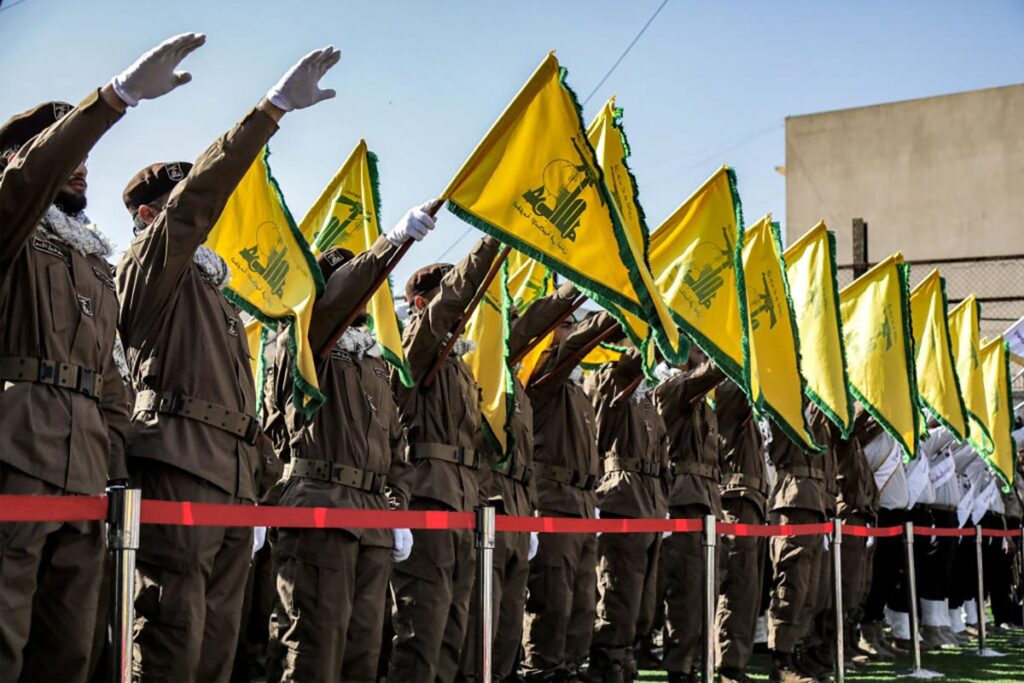
Hezbollah began attacking Israel on October 8, 2023, describing its actions as solidarity with the Palestinians. The fighting escalated into war in 2024, when Israel killed much of the group’s senior leadership, including longtime leader Hassan Nasrallah, and invaded southern Lebanon. A U.S.-brokered ceasefire followed in November 2024, but Israeli strikes continued, and Hezbollah rebuilt its military infrastructure and arsenal in violation of the agreement.
Fighting escalated again after Israel and the United States launched a war against Iran on February 28, 2026, killing Supreme Leader Ali Khamenei. Hezbollah resumed rocket attacks on Israel. On March 2, Lebanese Prime Minister Nawaf Salam announced a ban on the group’s military and security activities and demanded that it surrender its weapons.
Israel launched ground operations in southern Lebanon on March 16. The war has killed more than 4,000 people in Lebanon and displaced more than 1 million, most from predominantly Shia areas in the south, the Bekaa Valley, and Beirut’s southern suburbs.
On April 16, Israel and Lebanon agreed to a 10-day ceasefire, which was subsequently extended several times. The U.S.-hosted negotiations
What Lebanese Shias think now
The Statistics Lebanon survey interviewed 800 Lebanese Shia adults nationwide in September, mostly in person. The firm’s director, Rabih El-Habr, told Al Jadeed television that residents of southern Lebanon were interviewed by phone because researchers could not work there in person.
The findings suggest widespread dissatisfaction with Hezbollah’s handling of the war. About two-thirds of respondents said the group had achieved none of its goals or only some at a high cost. Another question found that 42.1% felt disappointment, anger, or concern about its leadership’s handling of the war and its aftermath.
Asked what kind of Shia leadership they wanted to see grow stronger, 51.5% chose experienced political leadership and 22% preferred a new generation of young leaders. Just 5.9% chose the current leadership.
On Hezbollah’s arsenal, 66.4% supported handing its weapons to the state in some form, while 29.6% wanted the group to retain them as it does today. Support for a handover did not necessarily mean immediate, unconditional disarmament. In his television interview, El-Habr said about 34% favored a gradual transfer or integration into the state, while 16.5% supported handing the weapons to the army unconditionally.
In a separate question about Hezbollah’s future, 34.8% — the largest share — said it should become a purely political party. Only 10.6% wanted it to remain an independent military force outside state control.
Lebanese state institutions drew greater confidence. The army was trusted by 78.5% of respondents, and 51.1% saw it as the main guarantor of long-term security, compared with 16.5% who chose Hezbollah. Only 11.9% said Hezbollah should follow its own leadership’s decisions when they conflict with those of the Lebanese government. Meanwhile, 80% placed their Lebanese identity ahead of their sectarian or party identity.
The findings come with methodological limitations. Statistics Lebanon, which is owned by the founder of the Lebanon Files news site and the Polethics political consulting firm, has not published its full questionnaire or a margin of error.
How the findings compare with earlier polls
The Statistics Lebanon findings suggest Hezbollah’s standing among Shias may have weakened, although differences between surveys make the extent of that shift difficult to establish. El-Habr compared his results with a 2024 Arab Barometer survey, which found that 85% of Lebanese Shias had a great deal or quite a lot of trust in Hezbollah. The surveys used different methods and question wording, however, limiting direct comparisons.
The new findings also contrast sharply with an Information International survey conducted face-to-face among 2,000 Lebanese adults between April 28 and May 5. Among Shia respondents, 92.9% opposed direct negotiations with Israel, 92.1% opposed a peace agreement, and 87.5% opposed disarming Hezbollah.
Even that survey revealed distinctions between opposition to disarmament and views about how it might happen. Asked where Hezbollah’s weapons should go if the group surrendered them, half of Shia respondents chose the Lebanese Army, while 36.6% chose Iran. Meanwhile, 84.9% said Hezbollah was entitled to seek political concessions in exchange for giving up its arsenal.
Question wording may explain some of the differences. Information International asked directly whether respondents supported or opposed negotiations, a peace agreement, and disarmament. Statistics Lebanon asked what kind of security arrangement they preferred, and its unpublished questionnaire leaves unclear whether respondents could reject an agreement outright. Support for a security arrangement also does not necessarily imply support for a broader peace agreement or normalization.
Similarly, support for handing weapons to the state “in some form” leaves room for gradual or conditional arrangements. The timing differed, too: Information International conducted its fieldwork shortly after the April ceasefire, while Statistics Lebanon surveyed respondents months later. Without comparable questions asked over time, it is difficult to separate changes in opinion from differences in survey design.
Similar frustrations, different conclusions
The polls point to frustration with Hamas and Hezbollah, alongside continued debate over diplomacy and disarmament. In the Statistics Lebanon survey, two-thirds of Shia respondents supported transferring Hezbollah’s weapons to the state in some form, and most trusted the Lebanese Army. Among Palestinians, nearly three-quarters opposed Hamas disarming before a full Israeli withdrawal. Most also described the Palestinian Authority as a burden.
PSR interprets the Palestinian findings as a distinction between diplomacy and deterrence: respondents can favor negotiations as the best path to statehood while opposing disarmament before Israeli forces withdraw. In Lebanon, the findings suggest an opening for a greater state role, although earlier polling makes the scale of that opening uncertain.
Frustration with an armed movement does not automatically translate into support for its disarmament — or peace with Israel. Whether these attitudes become a lasting opening for diplomacy will depend in part on whether negotiations deliver greater security and credible alternatives to the groups’ rule.