
Around Purim time in Israel, you’ll see ads in local WhatsApp groups for “Megillah reading by women for women.” The readings take place in community centers, shuls, and living rooms with folding chairs squeezed between coffee tables and strollers. A few women show up in costume, or at least a glittery hat or plastic crown, letting themselves get a little silly in a space that feels, for once, entirely their own.
A women’s reading is often a cooperative event, where several women take turns reading the Megillah. The cadence is slower than with the usual men’s reading, with more pauses to let the words land. And the sound is different, too: softer voices, gentler rhythms, fall easily on the ear.
In 2019, Chaya Ben Baruch of Safed took her daughter, Kirin, to a women’s Megillah reading. Kirin is an adult with Down syndrome, and she had always found it hard to follow the text. But at the slower pace of the women’s reading, she was able to follow every word.
Chaya later said: “This made me think. If women can read the Megillah, why shouldn’t women write one?”
When Orthodox women became scribes
In the United States, non-Orthodox movements have produced women scribes who write Torah scrolls, mezuzot, tefillin, and megillot. In Orthodox circles, women scribes were unheard of.

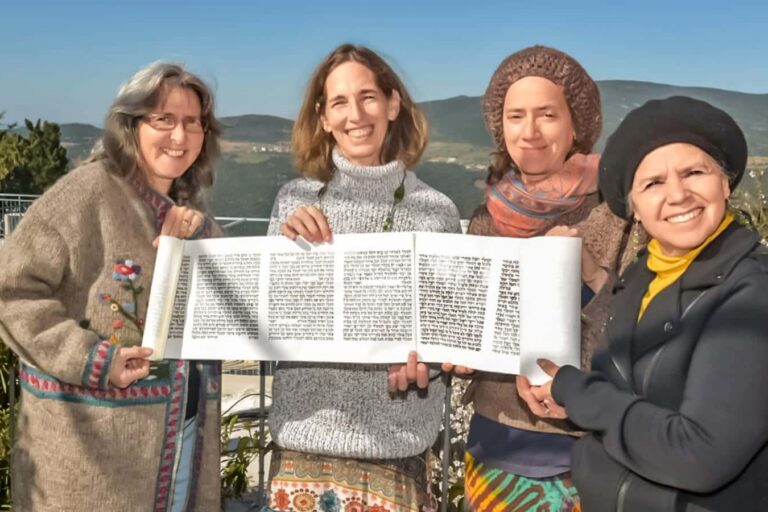
Until 2020, when four women in Safed, Israel, unrolled a Megillah they had written together. The scroll was kosher according to all the halachot, and approved by two Orthodox rabbis.
“The name of God doesn’t appear in the Megillah,” Ben Baruch said, “Which makes the idea of a woman scribe easier to accept.” But when she started looking for guidance and tutoring, doors closed. No one would talk to her.
“I was annoyed that a 13-year-old boy could learn to write a Megillah, but women couldn’t,” she said. “People said, ‘there are enough men writing.’”
Not much stops Chaya Ben Baruch. A talented artist, she was already proficient in Hebrew calligraphy. Now she needed to learn to write the letters according to halachic requirements: the precise shapes, spacing, and strokes that transform beautiful handwriting into valid sofrut. She began by viewing YouTube videos, then found an Orthodox sofer (scribe) who gives sofrut courses online.
“I didn’t lie to him,” she said. “I let him know I’m a woman. He accepted me. I was required to write two papers: I chose one on the sofit letters (letters whose form changes at the end of a word, like mem and pay), and the other on why women can write megillot.”
But when it came to showing her work in his online critique group, the rabbi made one request,
“Don’t call yourself Chaya,” he told her. “Use the name Chaim.” He worried that the other students would object to a woman.
It was the first time Ben Baruch was obliged to disguise her gender. It would not be the last.
Writing it into being
Ben Baruch soon realized that the project was too big to tackle alone. Three other women agreed to join: Allison Ofanansky, author of 11 children’s books, as well as a translator and editor; Sheva Chaya Shaiman, a glassblower; and Susan Zahavi, who runs a B&B in Safed.
Zahavi enrolled in the online course, too, and she and Ben Baruch shared what they learned with their co-scribes. Additionally, the group took classes from a sofer who was related to one of them, practicing with calligraphy markers and stencil templates before graduating to ink and quill. For a Megillah created in Safed, they chose Arizal script, associated with Rabbi Isaac Luria, a towering 16th-century mystic and scholar in Safed whose teachings revolutionized Kabbalah in the city.

A Megillah can’t be printed. In Judaism, all holy texts must be hand-written with a quill, so the women learned the ancient techniques to make them. “You soften the tip of the feather with vinegar, then cut it on a slant with a razor,” Ben Baruch explained. “Nobody sells razors anymore; we had to order them online.” Later, she discovered a halachically acceptable alternative: a plastic nib.
The ink, too, must also fit halachic standards, but making it themselves proved too complicated for the group. Knowing that it was unlikely that a sofer would sell to a group of women preparing to write a Megillah, they bought the ink from a friend of Ben Baruch’s husband.
The group’s journey went step by step through paths that were sometimes open and sometimes blocked. “Some people would have tarred and feathered us if they knew what we were doing,” Ben Baruch said, wryly.
“I went to a sofrut store in Jerusalem, where they sell the alternative plastic nibs,” Chaya recounts. “They acted as if I was tamei (impure) and wouldn’t talk to me until I said I needed them for my husband.”
The women divided the Megillah into sections and met once a week to compare work and critique one another’s letters, spacing, and consistency. Once they moved from sharpies and templates to freehand writing with ink, a local sofer agreed to check their writing.
Getting the parchment was another story. It was purchased in Bnei Brak, and, as usual, ordered by Ben Baruch’s husband’s name, out of fear the store wouldn’t sell or deliver to her. A friendly local sofer helped with another crucial supply: gid, thread made out of animal sinew, used to sew the Megillah pieces together.

Making it work
These women aren’t professional sofrim (scribes) who have quiet studios and long, uninterrupted hours to devote to holy texts. Each has a full-time job and a family. Practice had to happen in the margins of ordinary life: They had to make time to practice writing whenever there was a free moment, whether that was late at night, early in the morning, or in the narrow pockets of time in between errands. One of them even took her writing tools on vacation, unwilling to lose any momentum.
The group’s focus on writing perfect letters became obsessive. “There were scraps and sheets of paper covered in letters all over the house,” Ben Baruch remembered. In Zahavi’s home, there was one heart-sinking moment when someone shook a wet umbrella too close to a piece of parchment with fresh writing on it. Drops splattered the surface, and a handful of letters bled and warped, rendered unusable.
Kosher parchment doesn’t come cheap, and the waste of painstaking effort and time felt like a small disaster. But the parchment was redone, and the work progressed steadily as the group moved on to more advanced methods and materials.
Ben Baruch said, “Each time we switched to a new media – calligraphy pen to ink, paper to parchment – it took weeks or months to master it. We even changed the humidity to 50% in the rooms where we wrote, according to advice from a sofer. We all hesitated when it came to actual writing on real parchment. It took a while to build up the courage to do something this holy.”

When the parchments were complete, two sofrim checked them, both with computer scans and by hand, line-by-line. Ben Baruch stitched the Megillah together into the traditional rolled scroll. The wooden case was handmade by the group. A quilting artist sewed the beautiful cover.
The first public reading
The first public reading was announced with some anticipation that troublemakers might show up. The women sidestepped that risk by scheduling it at 11:00 a.m. “Before the seudah (festive meal),” Chaya laughed, “When all the guys were already drunk.”
Since then, their Megillah has been read publicly every year. For the four women who put in the intense study and labor to produce it, the experience was life-changing. It changed how they related to the text and to their own religious lives.

“We aren’t the same as before we started the project,” Ben Baruch said. “I’ve gotten to know the letters on a level I’d never known. It made me feel closer to God, in a way I hadn’t anticipated. Now I know there’s this way to connect with HaShem that’s available to every Jew, not only to men.”
“I had no idea how much I’d learn, and how empowering it would be,” Zehavi added. “It connected me to my roots as a Jewish woman. I felt the desire to be holier.”
Ofanansky pointed to the rarity of women’s voices in the biblical narrative. “Women’s experiences aren’t gone into too much in the Torah, and only one story was authored by a woman, Esther. But there’s drama and even humor in Megillat Esther. We get a full character who changes and develops throughout the story.” Ofanansky said that studying Esther’s experience and ultimate triumph helped her get through a personal bad time.
Shaiman described the impact in practical, creative terms. “I grew as a person, as an artist, and as a part of the community. I feel the process getting into my art. Ultimately, it was about connecting to God in a deeper, more authentic way.”
The Safed Women’s Megillat Esther is kept in a private home for safekeeping throughout the year.
“It’s not my Megillah,” Ben Baruch said. “It belongs to Safed.”