
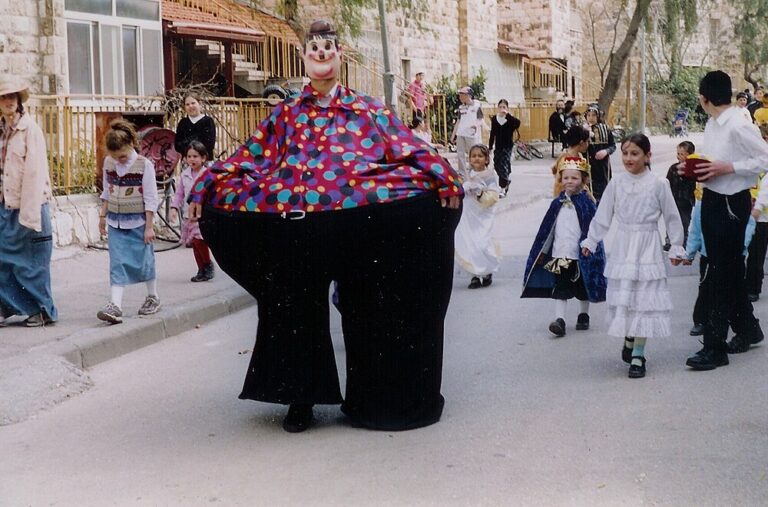
I’ve been a Jerusalemite for most of my life. As a young adult, I loved celebrating Purim outside Jerusalem after the fast of Esther, sleeping in the following day, and then heading back to Jerusalem to hear megillah and another round of festivities that evening in Jerusalem for Shushan Purim.
For years, that rhythm had been my norm. Only as an adult did I realize how unique it is.
Most Jews celebrate Purim on the 14th of Adar, immediately after the Fast of Esther, which in 5786 falls from sundown Monday, March 2 to nightfall Tuesday, March 3, 2026. Jerusalem, though, celebrates Purim a day later, on Shushan Purim, the 15th of Adar, which in 5786 begins at sundown Tuesday, March 3, and continues into Wednesday, March 4, 2026.
Why does Jerusalem celebrate a day later? Where does that custom come from? And was Jerusalem always the only place to mark Purim on the 15th, or did other cities celebrate on Shushan Purim too?
Read more: Unpacked’s Purim guide 2026
When do Jews celebrate Purim?
In the Book of Esther, we learn that on the 13th of Adar, the Jews fought their enemies, and on the 14th, they were able to rest and celebrate. In the capital of Shushan, however, the battles continued on the 14th, and the Jews only rested on the 15th. The megillah even highlights that “village Jews who live in unwalled towns” celebrate on the 14th, a phrase that implies a parallel category for walled cities.
Therefore, in the megillah itself, it is noted that walled cities shall celebrate Purim on the 15th of Adar. These two options of celebration dates are already presented in the book of Esther. But why is Jerusalem the only place that marks this today?

What are walled cities?
Our sages in the Talmud explain that “walled cities” does not mean cities that happened to have walls in the time of the Purim story. Instead, the determining fact is whether a city was walled during the time of Joshua bin Nun, roughly 1000 years before the story of Purim (Megillah tractate, 2:2). This move is not just technical. The Jerusalem Talmud (Megillah tractate, 71:1) frames it as a way to honor the Land of Israel even while the Purim story unfolds in exile: if the miracle happened far from home, the calendar still points us back toward the Land of Israel.
Rabbinic sources also preserve traditions about which places were considered walled from that earliest period. The Mishnah (Tractate Arakin 32:1) provides a list of 10 cities that were walled at the time of Joshua: Tzipori, Gush Halab (Jish), Yodfat, Gamla, Gdud, Hadid, Ono, and Jerusalem. Besides Jerusalem, the other cities are based in the Galilee and Northern Israel, where there was a large Jewish settlement throughout the First and Second Temple era, and it became even more prominent after the destruction of the Second Temple, when Jewish settlement and scholarship shifted and concentrated there.
Beyond this list, there are additional locations within Israel and outside of Israel whose“walled” status is debated. This is because the Jewish law also determined that cities near the walled city might be obligated in observing Shushan Purim, which widens the debate beyond a single set of city walls. And in the modern period, archaeological findings and historical geography have also entered this halachic debate about the status of various cities and when they should observe Purim. As a result, cities such as Tiberias, Tzfat, Haifa, Lod, Shilo, Akko, and Hebron, as well as places outside Israel like Damascus in Syria, Izmir in Turkey, and Baghdad in Iraq, appear in halachic discussions with varying degrees of certainty and differing communal practice.
Because it is not definite that these were walled cities during the time of Joshua, and that Purim is a rabbinic holiday, more leniency is taken regarding the definitive decision of observing only Shushan Purim in these debated locations.
What happens in these walled cities during Shushan Purim?
In Israel, most of these “walled cities” celebrate Purim on the 14th like everywhere else. Still, some more observant individuals might add to their observance on the 15th as well: they may hear or read the megillah again without a blessing, and they may try to fulfill other Purim mitzvot, like a festive meal, charity (matanot la’evyonim), and giving food baskets (mishloach manot), on both days.
There are active communities in Tiberias, Tzfat, Lod, and Hebron that observe Purim on both the 14th and 15th of Adar. At the same time, no broadly accepted rabbinic authority has declared that any city outside Jerusalem should only celebrate on the 15th. So the debates and different observances continue to this day in these “supposedly walled cities.”
Outside Israel, many of the places that come up in historical discussions no longer have active Jewish communities. That makes the question largely theoretical: without a community keeping Purim from year to year, the practical tradition never develops in the same living, consistent way it has in Israel.
All of this is why Jerusalem remains the only location where the practice is clear and settled: we definitely know it was a walled city, and Purim celebrations only take place on the 15th of Adar. Other cities may have strong arguments or meaningful customs, but for now, Jerusalem is still the only place in the world that celebrates Purim a day after everyone else.
Purim sameach!