
Mark Twain once wrote that history doesn’t repeat itself, but it rhymes. This week, contemporary events in Jewish history did not only rhyme; they resonated deeply with events from thousands of years ago that occur in this week’s Torah Portion.
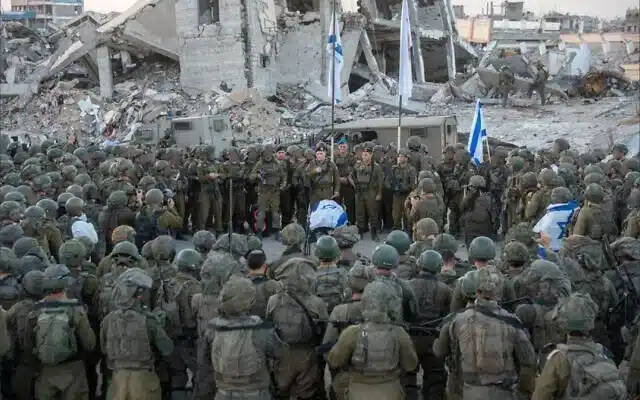
On January 26, 2026, the remains of IDF Master Sergeant Ran Gvili, the last Israeli hostage held in captivity in Gaza, were located and brought back to Israel, 843 days after he was kidnapped on October 7, 2023. His return marks the first time since 2014 that no Israeli hostages are being held in captivity in Gaza.
In Parshat Beshalach, read this Shabbat in synagogues around the world, we encounter one of the final actions Moses and the Israelites take before leaving Egypt: “And Moses took with him the bones of Joseph.” (Exodus 13:19)

Why does the Torah mention this detail? What is so important about taking the bones of Joseph out of Egypt?
The Torah’s insistence on transporting bones is striking. Jewish tradition develops two closely related ideas from this moment: the spiritual significance of burial in the Land of Israel, and the obligation to treat every part of the human body with care and dignity.
Burial in the land of Israel
Already in the Torah, the patriarchs express a powerful desire to be buried in the Land. Jacob makes Joseph swear: “Do not bury me in Egypt… carry me out of Egypt and bury me in their burial place.” (Genesis 47:29–30)
The Gemara understands burial in the Land of Israel as spiritually transformative. In Ketubot 111a, Rabbi Anan teaches: “Anyone who is buried in the Land of Israel is as if he is buried beneath the altar [in the Temple].”
The Land itself is seen as having a redemptive quality. Being buried there is not about nationalism or geography alone; it is about closeness to holiness, to atonement, and to ultimate renewal.
Why bones matter
Jewish law does not treat the body as a disposable shell. Even after life has ended, the human body retains dignity. The Torah commands: “You shall surely bury him on that day.” (Deuteronomy 21:23)
The Gemara (Sanhedrin 46b) explains that burial honors the divine image (tzelem Elokim) in which every human being was created. This is why Jewish law is meticulous about collecting and burying bones and remains.
Rabbi Aharon-Ya’akov Greenberg notes that the word for bones, atzmot, can also be read as atzmiut — essence. When Moses carried Joseph’s bones out of Egypt, he also carried Joseph’s values with him.

The same can be said about the return of Ran Gvili’s remains.
Gvili was a police officer in the Israel Police Special Patrol Unit (YASAM). On October 7, while recovering at his parents’ home from a broken shoulder, he put on his uniform and told his mother, “Do you really think I’ll stay home when I know my guys are fighting?”
He rushed to the area of Kibbutz Alumim alongside other officers and soldiers, fell during a firefight with Hamas terrorists, and his body was taken to Gaza. More than two years later, his remains were brought home.
Final thought
From these two moments, separated by thousands of years, we learn what Judaism insists we never forget: the sanctity of the Land of Israel, the value of every human being, and the responsibility to care for one another with dignity — even in death.