

I grew up in a Russian-American home where Ashkenazi food wasn’t a trend, a curiosity, or a choice. It was simply what we ate. Ukrainian borscht stained the sides of our pots a deep magenta, the kind of color that lingered no matter how hard you scrubbed. Gefilte fish was made from scratch using my grandmother’s metal grinder, the one she brought from the Soviet Union, heavy and indestructible.
She’d set up shop in the garage because grinding pounds of fish inside made the house smell unbearable. I can still picture her standing there, methodically feeding fillets through the grinder, unfazed, as if this were the most normal thing in the world, because for her, it was. When it was done, she topped the gefilte fish with sharp red horseradish and sweet pickled carrots. At the time, I didn’t appreciate any of it. It felt old-fashioned, messy, and deeply uncool. I ate it because it was there, because it was expected. Now, I would give anything to taste it again.
For much of my life, Ashkenazi food lived in that space: something you tolerated out of obligation, not something you celebrated. Survival food. Immigrant food. Food that carried memory, thrift, and improvisation, but rarely prestige.
Recently, I saw duck confit matzoh ball soup on a menu, a dish that perfectly captures this moment. Duck confit, with its French fine-dining pedigree, shares a bowl with matzoh ball soup, the ultimate Jewish comfort food. The pairing feels almost jarring at first, but that tension is the point. It reflects a broader shift: Ashkenazi food is being treated not as something to dress up or disguise, but as something sturdy enough to hold technique, luxury, and reverence all at once.
A new generation of Ashkenazi cooking
Across kitchens in Israel and the diaspora, a new generation of chefs is reimagining Ashkenazi cuisine not by rejecting it, but by taking it seriously. Dishes once dismissed as bland or unsophisticated are being revisited with intention, craft, and pride. The goal isn’t to make Ashkenazi food “cool.” It’s to finally admit what our grandparents already knew: it always mattered.
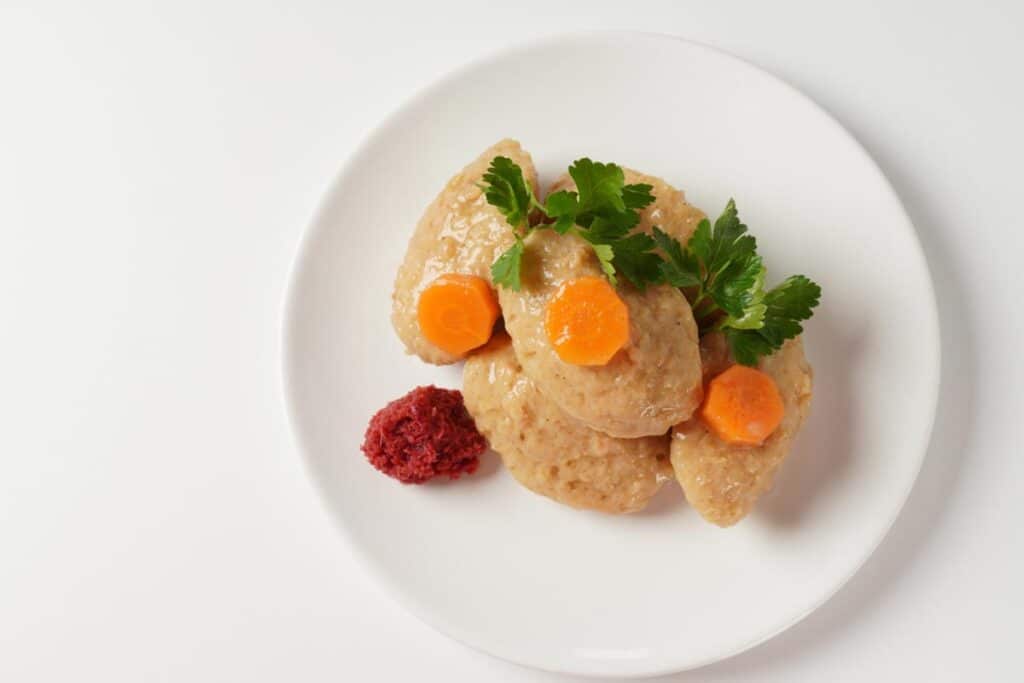
For a long time, Ashkenazi food was just there. It showed up at holidays, in grandparents’ kitchens, on folding tables in synagogue basements, wrapped in foil and served on paper plates. It wasn’t something you bragged about or sought out. If anything, it was the food you quietly compared to whatever felt more exciting or modern.
That’s starting to change. A generation removed from immigrant survival mode and from the pressure to blend in is coming back to these dishes with fresh eyes. Not because we have to eat them, but because we want to. The question has shifted from “Is this enough?” to “Is this actually good?”
At the same time, the wider food world has caught up. Pickling, fermenting, slow-cooking, using every part of an ingredient, the techniques Ashkenazi kitchens have relied on for generations, are now being recognized as deliberate, thoughtful, and even cool. What once felt basic is being recognized as intentional.
Reclaiming Ashkenazi food now is part nostalgia, part discovery, and entirely about pride. It’s the realization that the food many of us grew up with is strong enough to stand on its own, whether it’s served exactly as our grandparents made it or given a modern twist. Either way, it belongs on the table.
How chefs are bringing back Ashkenazi cuisine
At Saba in New Orleans, Alon Shaya’s matzoh ball soup arrives in a rich duck confit broth, with tender carrot and dill drifting through the bowl. It feels familiar but somehow new, the kind of dish that makes you pay attention.

In Philadelphia, Michael Solomonov at Zahav serves Sabbath Chicken with Uzbeki apricots and schmaltz potatoes, alongside a sunchoke latke topped with labneh and smoked trout roe. He isn’t reinventing tradition so much as widening the frame, showing what it can become when you honor the instincts behind it.
And it isn’t only happening in restaurants. At home, Chanie Apfelbaum’s Gefilte Pizza from “Millennial Kosher” adds a playful twist to a classic. Naama Shefi, founder of the Jewish Food Society and author of “The Jewish Holiday Table,” has documented dozens of kugel variations in the organization’s recipe archive, including versions with roasted fruits, caramelized onions, and nuts. Each dish is a small reminder that these recipes are alive, adaptable, and still deeply rooted in the kitchens that raised us.
These foods are meant to do so much more than put a smile on your face. Alongside memory, they carry the confidence to take something once overlooked and show how it can be bold, surprising, and entirely relevant today.


Reclaiming Ashkenazi food now is a quiet kind of pride. The flavors that shaped our families, our holidays, our kitchens aren’t just “old-fashioned.” They can evolve, delight, and feel entirely new without losing what made them ours in the first place. And in that evolution, we reconnect with who we are and where we come from.
It’s like wearing a Chai necklace: a simple symbol from our past that travels with us, familiar and personal at once, carrying meaning we get to define for ourselves. Each bite, each dish, is its own version of that, living tradition in our hands and ours to celebrate.