
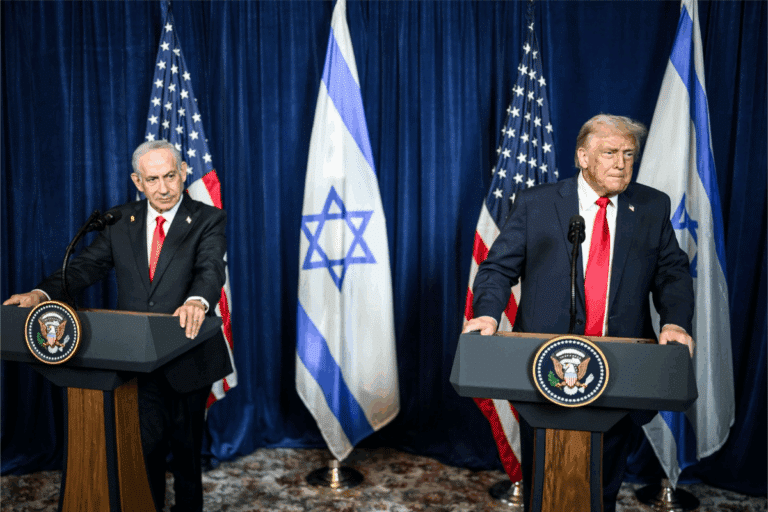
United States President Donald Trump and Israeli Prime Minister Benjamin Netanyahu met at Mar-a-Lago on Monday to discuss the next stage of the Gaza peace plan, as well as other issues in the Middle East.
In a press statement ahead of the meeting, Trump stated that he and Netanyahu would discuss five major subjects, one of which was the Gaza peace plan. They also discussed Iran’s attempts to rebuild its missile and nuclear programs and Israeli tensions with Syria and Turkey, among other issues.
Will the Gaza peace plan advance to the next stage?
Trump’s Gaza plan, announced in September, was intended to be implemented in several stages. The first stage — involving the IDF’s partial withdrawal from half of Gaza, the release of the remaining Israeli hostages, and the release of about 2,000 Palestinian prisoners — has been mostly completed. The body of one Israeli hostage, Ran Gvili, is still being held by Hamas.
One of the key components of the following stages of the Gaza plan is the establishment of a Board of Peace, led by the U.S., which will oversee the ceasefire and coordinate the various mechanisms necessary to implement the peace plan.
Another central part is the International Stabilization Force, an internationally funded and staffed security force meant to ensure all terrorist groups in Gaza are disarmed, to take care of public security, and to keep the peace between Israel and Gaza.
A transitional government, led by Palestinian technocrats, is supposed to handle the civilian administration of Gaza in the next stage of the plan. After the Palestinian Authority, which currently handles Palestinian affairs in the West Bank, undergoes a series of educational and political reforms, control of Gaza will be handed over to it.
Negotiations have been ongoing between the U.S. and other countries concerning the makeup of the Board of Peace and the ISF. It remains unclear who will participate in and fund both bodies, a lack of clarity that has sparked concerns that the plan could collapse before it even begins.


Israel has expressed opposition to Turkey and Qatar having a central role in the ISF, as both countries have actively supported and hosted Hamas leaders for years. When asked about the issue on Monday, Trump responded that he has a great relationship with Turkish President Recep Tayyip Erdoğan and that he’d consider it, but acknowledged that “a lot of it will have to do with Bibi (a nickname for Netanyahu).”
Trump also insisted that Netanyahu respects Erdogan and “they’re not going to have a problem.” He also told reporters that the U.S. is “thinking very seriously” about selling F-35 fighter jets to Turkey, a move that has deeply concerned Israel as it could harm the Jewish state’s military advantage in the region. Until recently, Israel was the only country in the Middle East to which the U.S. had agreed to sell F-35s. In November, Trump announced that the U.S. would start selling the advanced fighter jets to Saudi Arabia.
Regardless of the details of the next stage, many Israelis are demanding that the peace plan not move forward until the body of the last Israeli hostage is returned to Israel. When asked on Monday if he would guarantee that this would happen, Trump responded that “we’re doing everything we can,” but would not commit to holding off on the second stage.
Gvili’s parent, Talik and Itzik, met with Netanyahu and Trump on Monday. In an article published by Talik through JNS, the Gvilis stressed that they were demanding that there be no move to the second phase of the plan until their son is brought home.
“The diplomatic wheels cannot continue moving forward while Ran is not here. Phase 1 is not merely a recommendation; it is the moral basis for our existence as a society. All talk of future arrangements, rehabilitation of Gaza, or ‘the day after’ is empty as long as Ran is not home. We are here to remind everyone that behind the numbers and strategies is our child, a loyal defender and a family whose life has stopped,” Talik wrote.
“We came to the U.S. because we believe that the United States has the power and influence to turn over every stone,” she added. “President Trump, who advocates for strength and decisiveness, must understand that Ran is the ultimate symbol of that decisiveness. His return will be the true victory over terror.”
In responses to questions about these demands, Trump noted that reconstruction of the Gaza Strip would begin soon, regardless of whether the disarmament of Hamas started or was completed. He stressed that the U.S. is moving “as quickly as we can” on the next stage of the plan and emphasized the need for Hamas to be disarmed. He did not commit to holding off on the next stage of the plan until Gvili was returned to Israel.
Trump stressed that Hamas will be given a “very short period of time” to disarm, adding that “we’ll see how that works out.” He warned that a group of 59 countries is willing to enter Gaza and take care of disarming Hamas by force if the terrorist group refuses to disarm on its own.
Trump and Netanyahu were also asked about the potential future role of the PA in Gaza. Netanyahu noted that Trump had demanded a list of reforms that the PA would need to undergo beforehand. He implied that Israel would approve of the PA’s entry to Gaza if these reforms are implemented, saying the guidelines proposed by Trump were clear.
In the past, Netanyahu has repeatedly insisted that Israel will not allow the PA to reenter Gaza. He and others have argued that the PA also promotes the destruction of Israel, so allowing them into Gaza would just be replacing one regime that wants to annihilate Israel with another.
Trump also responded to questions about unrest and violence carried out by Israeli civilians against Palestinians in the West Bank, noting that he and Netanyahu don’t agree on 100% of the issues in the West Bank. He stressed that he didn’t want to discuss the matter further at the moment, but added that he was sure Netanyahu would “do the right thing.”
Trump expresses optimism about the future of Syrian-Israeli relations
Concerning ongoing tensions between Syria and Israel, Trump expressed optimism that the two countries would reach an agreement concerning security issues. He also took the opportunity to praise Erdogan for playing a role in the downfall of former Syrian president Bashar al-Assad, saying, “he really gets a lot of credit. Bibi agrees with that.”
Netanyahu added that Israel is interested in having a peaceful border with Syria and ensuring the security of the Druze and other minorities in the country. While in past statements, the prime minister has emphasized Israel’s demand for a demilitarized zone in southern Syria, he did not raise the issue in his comments on Monday.
Trump warns Iran: We’ll strike immediately if the nuclear program renews
Trump also warned Iran not to try to rebuild its missile and nuclear programs on Monday. He noted that he had heard Iran was trying to rebuild, stressing that “if they are, we’ll have to knock ’em down, but hopefully that’s not happening.” He expressed hopes that Iran would return to the table and negotiate a new nuclear deal.
The president refused to comment on a question about overthrowing the Iranian regime. Trump stressed that if Iran continues with its missile program, he’ll support further strikes on the country, and if it renews its nuclear program, he warned, “we’ll do it (strike) immediately.”
When asked about the situation in Lebanon, Trump stressed that the Lebanese government is at a “bit of a disadvantage” when it comes to its ability to disarm Hezbollah. He noted that Hezbollah has been “behaving badly,” saying, “we’ll see what happens.”
Trump also referenced Netanyahu’s efforts to obtain a pardon from President Isaac Herzog in his ongoing trials, stating that he believes Herzog will grant Netanyahu the pardon. He said he spoke with Herzog and that the Israeli president told him “[the pardon’s] on the way.” Herzog’s office denied that the two had spoken since Netanyahu filed his request for a pardon. However, it added that Herzog had explained to a representative of Trump the technical process of handling a pardon request several weeks ago.
After the meeting, Trump said that he thinks the two sides managed to reach many conclusions about various issues. Netanyahu agreed that it was a “very productive meeting.” Netanyahu also announced that Israel would be awarding the Israel Prize, the state’s highest cultural honor, to Trump. He invited Trump to visit Israel on Yom Haatzmaut, Israeli Independence Day, when the award is presented.