
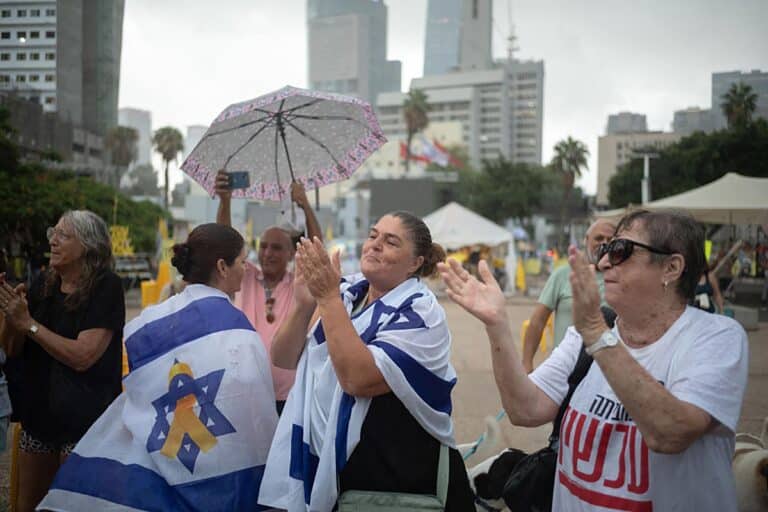
Israel and Hamas agreed to a ceasefire and hostage release deal on Wednesday night, as part of the first phase of a plan to end the Gaza war presented by United States President Donald Trump last week.


The agreement sparked celebrations among Israelis and Palestinians early Thursday morning. Still, many of the details remain unclear, and one central question remains: Is this just a pause or the end of the war?
What does the agreement include?
While the details remain hazy, most reports indicate that all 48 remaining hostages will need to be released by Monday at the latest, although Trump indicated that the process could end up taking longer than expected due to logistical issues. In return, Israel will release about 2,000 Palestinian prisoners and withdraw to an agreed-upon line within Gaza.
An apparent copy of the agreement published by Israel’s KAN broadcaster states that the deal marks the end of the war in Gaza, with both Hamas and Israel agreeing to take the necessary steps to stop the conflict.
The agreement stipulates that all Israeli hostages must be released within 72 hours of the Israeli government approving the deal. If any of the remains of the deceased hostages can’t be recovered within that time period, Hamas will be required to provide any information it has on the location of the remains to Israel. Hamas has claimed that it doesn’t know where nine of the bodies of the 28 deceased hostages are. It is unclear as of yet what will happen if those nine aren’t returned by the end of the deadline. A task force involving the mediators and the Red Cross will work to ensure all the remains are recovered.
Israel, in turn, will release about 2,000 Palestinian prisoners, including 250 serving life sentences. The full list of which prisoners will be released has not, as of yet, been published. A list of the prisoners serving life sentences who will be released will be published to allow for appeals against their release. A partial list was published by Israeli media early Friday morning. The list included several senior terrorists who organized a series of suicide bombings against Israeli civilians in the early 2000s.
Palestinian officials claimed on Friday morning that negotiations concerning the list of Palestinian prisoners who would be released were still ongoing and that the list was not finalized.
Additionally, a task force formed by the U.S., Qatar, Egypt, Turkey, and other countries approved by both Israel and Hamas will work to ensure the ceasefire is implemented.
On Thursday night, the Israeli government officially approved the deal. Within 24 hours of that approval, the IDF was required to withdraw to the agreed-upon line. Reportedly, this will leave Israel in control of a little over 50% of Gaza.
The Associated Press reported on Thursday night that the U.S. would send about 200 troops to Israel to help support and monitor the ceasefire. According to the report, U.S. Central Command will establish a “civil-military coordination center” in Israel to ensure the flow of humanitarian aid into Gaza. The team will also help monitor the transition to a new government in Gaza.
Troops from Egypt, Qatar, Turkey, and the United Arab Emirates are expected to join the U.S. team.
Only the first phase
This agreement is only the first phase of a 20-point plan released by Trump last week. At the end of this phase, Israel will still hold over half of the Gaza Strip, and Hamas will remain armed and present in Gaza.
The rest of Trump’s plan includes steps meant to lead to a complete Israeli withdrawal from Gaza and an end to the war between Israel and Hamas.
These steps include:
- The disarmament of Hamas and other terrorist groups in Gaza.
- The creation of an international security force to enforce this disarmament and police the Strip.
- The creation of a technocratic, apolitical Palestinian committee, joined by international experts, to temporarily govern Gaza.
- A “Board of Peace” run by the U.S. and other countries to handle the funding for Gaza’s reconstruction.
- The implementation of sweeping reforms in the Palestinian Authority, including educational and political reform. Once these reforms are completed, control of Gaza will be transferred from the temporary committee to the PA.
The plan includes other details as well about the entry and exit of Palestinians from the Strip and the handling of humanitarian aid.
While finalizing the hostage deal was already difficult, achieving these other steps will be even more of a challenge. Hamas has already publicly rejected many of these demands, including the requirement to disarm and to give up any role in the future governance of Gaza. On Thursday, Hamas repeatedly reiterated its rejection of these demands.
Additionally, Israel has made clear it won’t fully withdraw from Gaza until its war goals are achieved, including the dismantling of Hamas and the demilitarization of Gaza.
Hamas and Israel both presented the agreement reached on Wednesday evening differently. Israel described the deal as a hostage release agreement, while Hamas described it as a deal to end the war in Gaza.
The nine hostages Hamas claims it can’t find may also become a sticking point if they aren’t released by the end of the 72-hour deadline.
Even if the hostages are all released, that won’t necessarily mean the end of the war. In the past, ceasefire agreements between Israel and Hamas have repeatedly failed as each side accused the other of violating the terms. With no clear terms stipulating that this phase must lead to the following stages of the Trump plan, and no agreements on the details of the following phases, the conflict could easily renew after this phase is completed.
World leaders, hostage families welcome deal
Israeli Prime Minister Benjamin Netanyahu welcomed the deal on Thursday morning, calling it a “great day for Israel.”
“I thank the heroic soldiers of the IDF and the entire security apparatus, whose bravery and sacrifice brought us to this day. I thank, from the bottom of my heart, President Trump and his team for their mobilization for the sacred task of releasing our hostages,” Netanyahu said. “God willing, we will continue together in order to achieve all our aims and expand the peace with our neighbors.”
Trump expressed hopes that the agreement on the first phase of the peace plan would be the first step toward “a Strong, Durable, and Everlasting Peace.”
“All Parties will be treated fairly! This is a GREAT Day for the Arab and Muslim World, Israel, all surrounding Nations, and the United States of America, and we thank the mediators from Qatar, Egypt, and Turkey, who worked with us to make this Historic and Unprecedented Event happen. BLESSED ARE THE PEACEMAKERS!” the president added.
“The world has come together around this deal,” Trump told Fox News on Wednesday night. The president added that he told Netanyahu that “Israel cannot fight the world,” in a conversation after the deal was reached.
Trump is expected to arrive in Israel on Sunday and may address the Knesset.
The Hostages and Missing Families Forum welcomed the agreement with “a mix of excitement, anticipation, and concern.”
The Forum stressed that “This represents important and meaningful progress toward bringing everyone home, but our struggle is not over and will not end until the last hostage returns.”
“There are 48 hostages held by Hamas. Our moral and national obligation is to bring them all home—both the living and the deceased. Their return is essential to the healing and recovery of Israeli society as a whole. We will not rest until the last hostage comes home,” the Forum added.
The Tikvah Forum, which represents a group of hostage families who opposed the practices of the Hostage and Missing Families Forum, thanked Netanyahu and Strategic Affairs Minister Ron Dermer for their work on the deal. The Forum stressed that many of the hostage families had not yet received information about the fate of their loved ones.
“We understand the price that Israeli society will pay for our loved ones. We have been careful throughout not to pressure the State of Israel to submit to Hamas’ dictates,” the Forum said. “The State of Israel must do everything to prevent future abductions.”
Hamas described the agreement as a deal to end the war in Gaza and secure Israel’s withdrawal from the Strip.
“We highly appreciate the efforts of our mediating brothers in Qatar, Egypt, and Turkey. We also value the efforts of US President Donald Trump, who seek to bring about a definitive end to the war and a complete withdrawal of the occupation from the Gaza Strip,” Hamas added.