
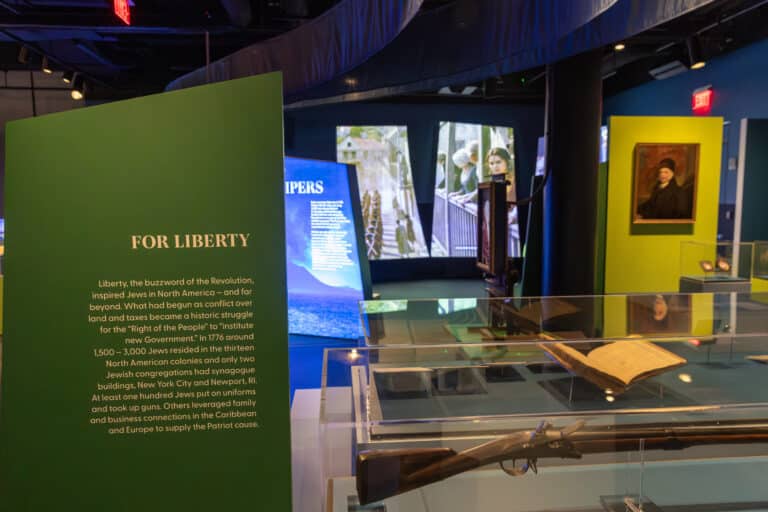
In November 1776, a small Caribbean island fired a cannon at an American ship — and in doing so, made history. The exchange, known as the “First Salute,” marked the first international recognition of the United States. Now, a new exhibition at the Weitzman National Museum of American Jewish History in Philadelphia is bringing that moment, and the often-overlooked role of Jewish merchants and Caribbean trade networks in the American Revolution, back into view.
The exhibition, “The First Salute,” which will run until April 2027, traces how the American fight for independence extended far beyond the colonies, relying on global trade networks and unlikely allies. Drawing on newly displayed artifacts — from a 250-year-old cannon recovered from St. Eustatius to letters tied to the movement of revolutionary supplies — it tells the story of how Jewish merchants, many with ties across the Atlantic, helped funnel goods, information, and support to the Patriot cause.
“It’s a largely unknown story, but one that tells us a great deal about how the country came to be,” curator Josh Perelman told Unpacked.
A revolution far beyond the colonies
The American Revolution is often taught as a series of battles fought along the eastern seaboard. But in reality, it was a global conflict, one that stretched across oceans and depended on far-flung networks of trade, diplomacy, and risk.
“Most people don’t realize there was a Jewish community in North America, and an even more sizable Jewish community in the Caribbean, who were invested in this effort to create a new kind of society,” Perelman added.

At the center of that network was the small Caribbean island of St. Eustatius, then one of the busiest ports in the Atlantic. By the late 18th century, its harbor had become a critical waypoint for goods moving between Europe, the Caribbean, South America, and the American colonies, including weapons and gunpowder, often disguised as ordinary trade goods, that the Continental Army desperately needed.
Because Jews had often been pushed into finance, trade, and mercantile work in Europe, Perelman said, they developed the Atlantic-world connections that later made them valuable to the Patriot cause. By the time revolutionaries needed weapons, gunpowder, and supplies, “history placed Jews exactly in the right places, with the right skills, the right connections.”
Jewish merchants, who made up 30% of the European population on St. Eustatius at the time, played an outsized role in that system. Many had roots in the Iberian Peninsula, having fled persecution in Spain and Portugal during the Spanish Inquisition, and later built extensive commercial ties across the Atlantic. As a Dutch colony, St. Eustatius offered Jews more religious freedom than in most of Europe. The population grew, and by 1739 had become established enough to build a synagogue, Honen Dalim. By the time of the Revolution, that community was deeply embedded in the commercial networks that made St. Eustatius so valuable to the American cause.
“The First Salute” exhibition places those networks at the center of the story, showing how the fight for independence depended not just on soldiers and statesmen, but on merchants operating in the shadows of empire. In doing so, it reframes the Revolution not as a purely American story, but as one sustained by global connections, and by communities, including Jews, whose contributions have often gone overlooked.
The cannonfire heard ‘round the world
On November 16, 1776, an American ship sailed into the harbor of St. Eustatius flying the Grand Union Flag and carrying news of a fledgling nation. The vessel, the Andrew Doria, approached a Dutch-controlled port that, unlike Britain, was not yet at war with the colonies. What happened next was both brief and consequential.

As the ship entered the harbor, it fired a customary salute. The island’s governor returned it.
That exchange of cannon fire — simple, almost procedural — marked the first international recognition of the U.S.
At the time, the moment did not come with ceremony or sweeping declarations. But it sent a signal that rippled far beyond the Caribbean: the American cause was no longer just a rebellion. It was something other nations might acknowledge and eventually support.
In “The First Salute” exhibition, that moment is brought into physical focus, bringing together artifacts that trace the flow of goods, people, and ideas through the island. They transform what might seem like a footnote into something more tangible: a reminder that the birth of the U.S. was not only argued in Congress halls or fought on battlefields, but signaled across oceans.
When the Tide Turned
Since St. Eustatius helped sustain the American cause, it also made the island and its Jewish community a target.
In 1781, British Admiral George Rodney seized the island, determined to shut down the flow of goods that had been quietly fueling the Revolution. But what followed was not just a military operation. It was something more deliberate.
According to accounts highlighted in “The First Salute,” Rodney moved first against the Jews. While smuggling was widespread on the island, Rodney’s actions made clear that Jews were singled out, revealing antisemitic currents that shaped not only policy but punishment.

He ordered that 100 Jewish men be rounded up and imprisoned, confiscating the wealth they carried. Within a day, he ordered that around a third of them be deported to St. Kitts. Families were stripped of property. Homes were looted. Even the island’s Jewish cemetery was disturbed in a search for valuables.
The message was unmistakable: the same networks that had made Jewish merchants valuable to the revolutionary effort now made them vulnerable.
Rodney’s campaign extended across the island, but his initial focus underscored a deeper reality of the moment. Jewish residents of St. Eustatius had taken a risk, supporting a fragile, uncertain rebellion in the name of economic opportunity and, for some, the promise of greater religious freedom. When the British reasserted control, that gamble came at a steep cost.
That distraction may have had major consequences: while Rodney remained focused on extracting wealth from St. Eustatius and punishing the local Jewish population, British forces failed to stop a French fleet from reaching the Chesapeake, where it would help trap Cornwallis at Yorktown and turn the tide of the war.
But for the Jewish community of St. Eustatius, the consequences were immediate and lasting. The island that had once been a bustling hub of trade and a key node in the Revolution’s global network never fully recovered.

That loss is still visible today. In the years following, the Jewish population left for the U.S. or Europe. Today, there is no longer a Jewish community on St. Eustatius, and the once-active synagogue now stands in windowless ruins. Yet the story has not disappeared entirely: residents continue to preserve and clean what remains of the synagogue and Jewish cemetery.
In the exhibition, that physical absence gives the chapter a different kind of force. It complicates the story of the Revolution, revealing not just a triumph of independence, but a moment shaped by risk, backlash, and the uneven realities of belonging, even at the founding of a nation built on the promise of liberty.
What was life like for Jews in the early United States?
Perelman said part of the reason this history is less familiar, even to many American Jews, is that most Jewish family narratives in the U.S. begin much later, with Ashkenazi immigration in the late 19th and early 20th centuries. But the Jewish communities tied to the Revolution often followed a different path, with roots in Sephardi, Caribbean, and Atlantic-world history.
“There’s a real lack of recognition that there is Jewish diversity,” Perelman said, adding that exhibitions like “The First Salute” help broaden the stories Americans tell about Jews.
By the time of the American Revolution, Jews made up only a sliver of the colonial population. On the eve of the war, roughly 2,000 to 3,000 Jews lived among about 3 million people in the colonies, concentrated largely in port cities like New York, Philadelphia, Newport, Charleston, and Savannah.

“The story of those early Jews was largely forgotten,” Historian Jonathan Sarna, a leading scholar of American Jewish history, said. “It’s urgent to remind people now… that in real life, Jews were not only in the new United States, but actually played a role. Obviously, their numbers were very small, but they were disproportionately significant.”
Many early American Jews were merchants, brokers, and traders, with family and business ties that stretched across the Atlantic world. As Sarna put it, “when you have a new country that is fighting for its life, merchants who can obtain all sorts of necessary goods, notwithstanding a blockade, are very valuable.”
That was especially true during the Revolution, when the Patriot cause depended not only on battlefield victories but on money, intelligence, gunpowder, weapons, and supplies. Jewish merchants were often positioned at the center of those networks, moving goods and information between North America, the Caribbean, and Europe.
One of the most revealing examples is Jonas Phillips, a Jewish merchant who rose from indentured servant to prominent member of Philadelphia’s Jewish community. In July 1776, Phillips wrote a letter in Yiddish to relatives in Holland, describing the unfolding revolution, describing the unfolding revolution and enclosing a printed copy of the Declaration of Independence.
The letter never arrived. It was intercepted en route — likely passing through St. Eustatius — and eventually ended up in British archives. But its survival offers a rare window into the moment: a Jewish merchant, tied into global trade networks, simultaneously tracking the political stakes of independence and the economic opportunities it created.
Phillips’ engagement with the founding moment did not end with the Revolution. In 1787, he wrote to the Constitutional Convention in Philadelphia, urging the framers to ensure religious liberty and equal rights for Jews. According to Sarna, it was the only letter on religious freedom sent to the convention — and it came from a Jewish voice arguing that Jews had been loyal to the revolutionary cause and deserved full inclusion in the new nation.
Another key figure was Haym Salomon, a Polish-born Jewish broker who became one of the Revolution’s major financiers. After being arrested by the British as a spy, Salomon escaped to Philadelphia, where he worked closely with Robert Morris, the superintendent of finance, helping raise funds for the Continental Congress and the war effort.
Figures like Phillips and Salomon complicate the idea that Jews were merely witnesses to America’s founding. They were few in number and still faced limits in a Christian-majority society — but they were present at the beginning, helping to shape the nation’s founding in ways that are only now being more fully understood.
Why did Jews support the American Revolution?
For many Jews, the Revolution was not only a political break from Britain, but a promise of something rare: religious freedom. Sarna explained that Jews were drawn to the founding generation’s commitments to liberty and religious tolerance, ideas that helped shape the new nation’s self-understanding.
“What the ‘First Salute’ unveils is a universally relatable human story about people who risked their lives and livelihoods for a vision of liberty that literally existed nowhere else in the world,” Perelman said. “And for Jews in particular, this vision of liberty is especially crucial, given their historical experiences of persecution, discrimination, and diaspora.”
For Jews in North America, colonial life often offered more stability and possibilities than life in Europe had. But supporting the Revolution still meant taking a dangerous bet. The ideals of liberty and religious freedom were deeply compelling to people who had lived with exclusion and persecution, yet if the rebellion failed, Jews risked being left vulnerable to renewed punishment under British rule.
At the same time, those same historical experiences had shaped the roles Jews played in the Atlantic world. Often pushed into trade and finance in Europe, many had developed the networks and skills that made them valuable to the revolutionary cause — moving goods, information, and resources at a moment when the outcome of the war was far from certain.
“The Jewish community of St. Eustatius did not stand in the margins of history,” current St. Eustatius Governor Alida Francis said during the exhibit’s opening. “They helped to move it.”
Perelman said the exhibit pushes against a flattened version of the Revolution, one that can make the people who supported independence seem more uniform than they were. Instead, he said, the Revolution brought together people from different backgrounds who were willing to stake their futures on an uncertain idea.
“We all have a stake. We all have a history. We all have a connection,” he said.
The exhibition suggests that the story of the American Revolution — and of American Jewish life — has always been broader than it is often remembered.