
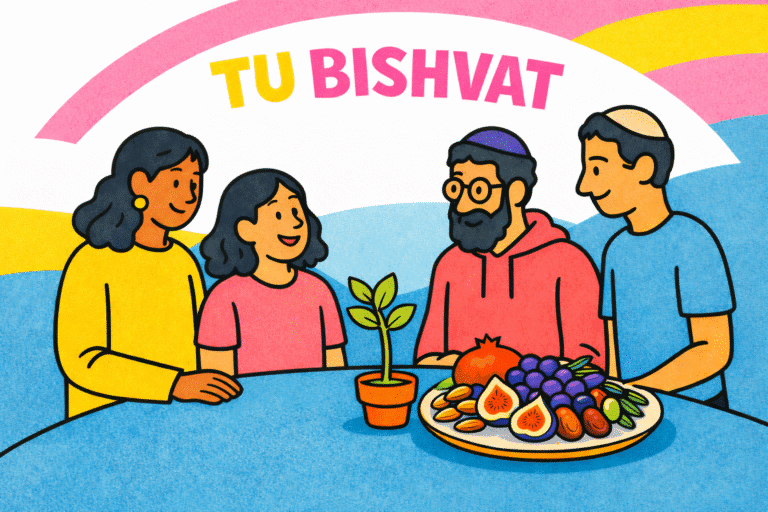
Beginning the evening of February 1, 2026, Jews around the world will celebrate Tu Bishvat (15th of the Hebrew month of Shvat). The holiday appears in the Talmud (Rosh HaShanah 2a) as one of the four “new years” in the Jewish calendar. We most often hear it called “the New Year of the Trees.”
Yet what need was there to set this date? Why do we need to know the ages of trees?
At first glance, that title sounds almost poetic, but the original purpose was practical: Jewish agricultural law needed a clear cutoff date to determine a tree’s “age” and to sort fruit into the correct tithing year. By setting an official start to the agrarian year, it was possible to mandate which years farmers should submit specific tithes to the Temple.
So why choose the 15th of Shvat? The Talmud links it to the seasonal rhythm of the Land of Israel: by mid-Shvat, most of the annual rainfall has already fallen in Israel, the ground is saturated, which led the rabbis to conclude that it’s a good time to plant new trees (Rosh Hashanah 14a).
During the Mishnaic period, around 200 C.E., the rabbis realized the need to establish a seven-year agricultural cycle. The seven-year calendar separates different tithes to different years. In the third and sixth years, farmers gave an additional tithe designated for the poor (ma’aser ani), ensuring that the system built regular support for vulnerable members of the community into the calendar itself.
The seventh year is shmitta (the sabbatical year), when the land is left to “rest.”w
Shmitta’s agricultural laws apply primarily in the Land of Israel. Produce grown during a shmitta year is treated as hefkar (ownerless), meaning it should be made accessible rather than harvested as a normal commercial crop. Some Israelis put a notice on their garden or field gate reading that one may enter and take fruit. Not for resale, though, nor to take exaggerated amounts: only enough for oneself or a family.
The need to know a tree’s age comes from a prohibition
Tu B’Shvat is actually the new year for fruit rather than for trees. Fruit from trees less than three years old, defined as orlah, may not be eaten. (Leviticus 19:23) The biblical prohibition remains to this day and obtains both in Israel and the diaspora. In the fourth year, the fruit (neta revai) was treated as sacred and, in Temple times, was brought to Jerusalem to be eaten there; only from the fifth year onward could the fruit be eaten normally.
To observe these practices, we need to determine the tree’s age. This is how we figure it out:
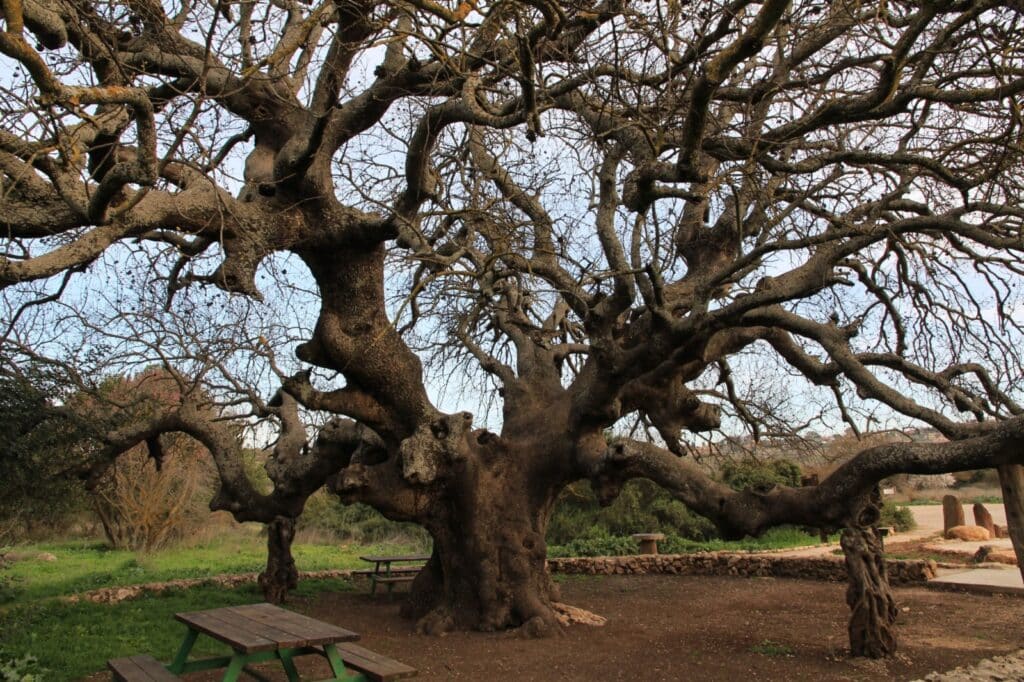
As the 15th of Shvat occurs in the rainy winter, farmers of ancient times weren’t harvesting fruit. Trees stood bare in the fields and orchards. Marking the start of the agricultural year at this dormant time made it possible to establish whether the fruit belonged to the current or the previous year by noting when its tree flowered. Fruit from a tree that bloomed before the Tu Bishvat deadline counts as produce from the previous year. In those times, most of Israel’s fruit trees began flowering after Tu Bishvat. Their fruit would then count as produce of the current year. Keeping track of when the trees were planted and when they bloom allows us to determine their ages.
Today, Israelis enjoy local late-winter fruit, especially abundant citrus fruit. A December or January walk around almost any Israeli neighborhood reveals lemons, oranges, clementines, and other citrus fruits hanging off trees. Markets are full of them. Citrus fruit was known during Mishnaic times, but usually brought in from other countries, an expensive imported item.
So why do we celebrate Tu Bishvat?
Halachic considerations apart, today, many consider Tu Bishvat the Jewish Earth Day, a natural connection between Biblical agricultural laws and conservation.
In Israel, everyone is encouraged to take an active part in building the land. On Tu Bishvat, schools let out, and the kids pile into buses headed for muddy fields to plant trees. Many organizations sponsor festive tree plantings on the day, from seniors clubs and youth groups to the Jewish National Fund. Tu Bishvat activities include forest tours, home planting talks, and Tu Bishvat seders.
These efforts have made a difference: Israel is one of the few countries to end the 20th century with more trees than it had at the beginning.

Traditionally, Tu Bishvat is the day almond trees bloom. In Israel, they do, on the dot. In private gardens and along highways, clouds of pink and white almond blossoms tremble in the wind, announcing the coming end of winter. Almonds are shkedim in Hebrew, from the word shaked — hasty — because the trees flower without waiting for warmer weather.
Another thing that makes the day festive is the springtime songs that little kids go around warbling, which they learn in their kindergartens. Everyone knows the songs; you even hear them played on the radio. It raises a nostalgic smile for adults who grew up singing the same tunes.
Traditional Tu Bishvat foods
Carob is an iconic Israeli fruit eaten on Tu Bishvat. The tree is native to the land, tall and shady, a welcome sight to hot, thirsty hikers on a trail. The part we eat is its long, dark-brown, fleshy pods. But be careful — the seeds inside are hard enough to crack teeth. An interesting thing about carob seeds is that their weight is so unfailingly uniform that long-ago jewelers established them as the universal weight measure for gems: the carat.
The fruit itself is sweet, with a slightly cheesy flavor, and best fresh, although it keeps for a long time after harvest.
The Talmud relates an incident with the sage Honi Ha-Maagal and a carob tree. The sage came upon a man digging a hole to plant a carob. He stopped and asked the man,
“How long until that tree gives fruit?
“Seventy years,” the man replied, intent on his digging.
“You surely won’t be alive to enjoy it,” said Honi. “So why go to the work and trouble of planting the tree?”
The man paused. “My ancestors planted carobs that I eat from today,” he said. “I’m planting this one for the sake of my children and grandchildren. I won’t sit under its shade or eat its fruit, but they will.”
Seen through an ecological lens, the story illustrates stewardship of the land and care for the well-being of future generations.
The Tu Bishvat seder
In the 16th-century, Safed, sages instituted the kabbalistic Tu Bishevat seder. Participants eat fruits from the seven species of the Land of Israel: “…a land of wheat, barley, [grape] vines, fig trees and pomegranates, a land of olive trees and honey” (Deuteronomy 8:8).
The leading kabbalistic rabbi, Isaac Luria, known as the Arizal, taught that eating 10 specific fruits and drinking four cups of wine in a specific order releases sparks of holiness in the fruit and wine, increasing spiritual growth and bringing one closer to God.
As in Passover, we drink four cups of wine. There’s plenty of discussion around each fruit and metaphors to Jewish life and mystic significance. The Tu Bishvat seder somewhat resembles the Passover seder in that there’s a procedure to follow, but it’s flexible and cheerful, and dare I say it — fun.
Here’s a link to a printable Tu Bishvat seder.
Aish offers a different guide to the Tu Bishvat seder, with kabbalistic explanations and meditations:
I myself once attended a rollicking Tu Bishvat seder organized by the Ascent organization in Safed. It was well irrigated with wine, and most participants went home in a very, er, cheerful state of mind.
It’s customary to eat a fruit from a variety you hadn’t tasted since last season. This allows us to say the moving Shechechiyanu blessing, in which we thank God for bringing us in life to this time. Some people refrain from eating a specific fruit — oranges, for instance — until Tu Bishvat, to say Shechechiyanu then.
On the seder menu, there should be fruits falling into distinct categories:
- Various nuts with the shells, such as walnuts, almonds, pistachios, and coconut
- Fruits with peels like oranges, pomegranates, and avocado
- Fruits with edible seeds, such as strawberries and blueberries
- Fruits with inedible pits, such as peaches and plums
- Wine or grape juice, both white and red
Each kind of fruit invokes specific comparisons and discussion.
Remember to say the appropriate blessing before eating and drinking — acknowledging God’s bounty is the point of the whole event. Wind up the evening with the blessings after food. Birkat ha-mazon (the blessing after eating bread) covers all the different kinds of food you ate.
Below is an easy, vegan, no-cook recipe that incorporates: honey, almonds, wheat, and carob, all native to Israel.
Carob Nut Balls
Ingredients:
3/4 cup almond butter
1/2 cup carob powder
1/2 tsp. cinnamon
1/2 cup honey
1 tsp. vanilla
1 cup puffed wheat
1/2 cup chopped walnuts or pecans
For coating:
1. 1/4 cup dried, powdered coconut
2. 4 Tbsp. cocoa powder mixed with 4 Tbsp. carob powder and 1/4 tsp. cinnamon
3. Blend 3 Tbsp. carob powder and 1/4 cup sugar. Melt 2 Tblsp. margarine or cocoa butter/oil, remove from heat and mix in carob powder/sugar. If needed, thin the coating with a little warm milk (soy, almond, coconut milks are fine). If too thin, add a little more carob powder.
Vigorously mix the almond butter, carob powder, cinnamon, honey and vanilla. The dough will be stiff.
Add the nuts and cereal. Wet your hands to form the dough into balls. The surface of the balls should be moist in order to help the coating stick.
Roll each ball in one of the coating mixes. Refrigerate till firm.