
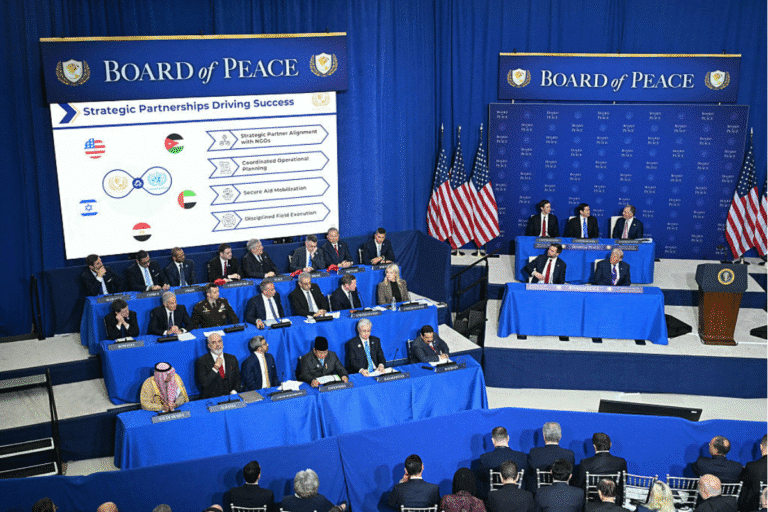
New details about plans for the Gaza Strip were revealed on Thursday after the Board of Peace held its inaugural meeting in Washington, D.C. The meeting provided some clarity on pressing questions concerning governance, reconstruction, and security issues, but left many unresolved.
What is the Board of Peace?
The Board of Peace (BoP) was first mentioned in United States President Donald Trump’s 20-point peace plan for Gaza last year. The Board’s mandate was affirmed by a United Nations Security Council resolution.
The Board has two Executive Boards, one focusing on high-level investment and planning and another focused on the day-to-day supervision and monitoring of the implementation of the peace plan in Gaza. The National Committee for the Administration of Gaza (NCAG) – the Palestinian technocratic government meant to take over Gaza – will operate under the auspices of the Board.
The second stage of the Gaza peace plan, which included the establishment of the Board, was launched in January before the first phase of the plan — which required the return of all the hostages held by Hamas, was completed. The body of Ran Gvili, the last of the 255 hostages held by Hamas, was retrieved by Israel in early February after intensive intelligence operations by Israeli forces. The IDF searched hundreds of graves at a cemetery in northern Gaza before finding Gvili’s body.
The Board of Peace isn’t focused solely on Gaza, with Trump and other leaders saying it could be used to address other conflicts around the world.
World leaders pledge billions for Gaza, but much more is needed
In an opening address, Trump said that 59 countries had signed onto the Board of Peace to aid in the development of Gaza. However, about half of the countries present at the meeting were there as observer states, not as full members. Many world leaders have expressed concerns about the possibility that the Board is meant to replace the U.N., although many have also acknowledged that, for Gaza, there don’t appear to be any other options available beyond the Board.
President Trump Participates in the Board of Peace Event https://t.co/F4CWWpi5kg
— The White House (@WhiteHouse) February 19, 2026
Trump announced that the U.S. would contribute $10 billion to the Board of Peace, and that Kazakhstan, Azerbaijan, the United Arab Emirates, Morocco, Bahrain, Qatar, Saudi Arabia, Uzbekistan, and Kuwait have contributed over $7 billion toward the relief package for Gaza. In addition, the UN Office for Coordination of Humanitarian Assistance (OCHA) is raising another $2 billion, and Japan has agreed to host an aid fundraiser at some point.
Politico reported that the $10 billion pledged by Trump will be part of a 10-year rebuilding plan and will be worked on in conjunction with Congress. The contribution would start with an initial investment of about $1.25 billion for ordnance removal, temporary housing, security, medical provisions, and other needs.
Trump added that China and Russia also both intend to contribute to the rebuilding and stabilization effort in Gaza, a statement that reportedly sparked some concerns among European leaders.
“I want to have everybody, get all sides, because it doesn’t help when you have all sides with one ideology. You have to have everybody together for this,” Trump said.
Many world leaders at the meeting offered to help with providing funds, contractors for reconstruction efforts, and digital services for Gaza. Kazakhstan announced it would provide scholarships to Palestinian students to study in Kazakh universities over a five-year period and help build up Gaza’s food security. Romania offered to increase flights to help evacuate Gazans who need medical treatment for care in Romanian hospitals, as well as to help develop Gaza’s emergency services and public administration, and to provide scholarships and rebuild schools. Morocco announced it would deploy a field hospital to Gaza and lead a deradicalization program to fight hate speech and promote tolerance and coexistence.
The prime ministers of Egypt, Qatar, and Pakistan, and the foreign ministers of Saudi Arabia, Turkey, and Kuwait emphasized their insistence that the Board of Peace ensure the creation of a Palestinian state. Morocco and Egypt emphasized the need to maintain stability in the West Bank as well.
There is still a lot of work that needs to be done to implement stage two of the Gaza peace plan. While the several billion dollars announced for Gaza during the meeting is substantial, it’s still only a fraction of the estimated $50 billion it will cost to rebuild the Strip, according to the U.N., World Bank, and European Union. It will also take substantial time and money to clear the tens of millions of tons of debris covering much of Gaza.
Ensuring a peaceful and prosperous Gaza. pic.twitter.com/o4YRgPNkK7
— The White House (@WhiteHouse) February 19, 2026
Additionally, while the entry of humanitarian aid into Gaza has increased significantly, the entry of critical supplies such as temporary housing caravans and tents has been restricted, leaving many without roofs over their heads throughout the winter. Many of the supplies needed for such housing are considered “dual-use” by Israel’s Coordinator of Government Activities in the Territories (COGAT), meaning that they could be used for both civilian and military purposes.
While the NCAG is set to take over administration of Gaza at some point in the near future, Hamas still controls half of Gaza and the NCAG is still based in Cairo. The other half is controlled by Israeli forces. It is still unclear when and how the NCAG will enter Gaza and take control.
The International Stabilization Force and the need to disarm Hamas
The president expressed hopes that Hamas would give up its weapons as the ceasefire stipulates, warning that if the terrorist movement doesn’t, “they’ll be very harshly met. They don’t want that.” He referenced ongoing clashes between Israel and Hamas, including Israeli strikes on Hamas commanders and military infrastructure and Hamas attacks on Israeli forces, calling these incidents “little flames.”
The ceasefire agreement requires Hamas and all other factions in the Gaza Strip to disarm, leaving the International Stabilization Force and a Palestinian police force as the only armed forces in the Strip.
Israeli Cabinet Secretary Yossi Fuchs said Monday that the U.S. is giving Hamas a 60-day period to disarm, warning that if this doesn’t happen, “the IDF will have to complete the mission.”
The New York Times reported that during a meeting between Mladenov and Hamas’s chief negotiator, Khalil al-Hayya, in Cairo earlier this month, Mladenov tried to press al-Hayya on the issue of disarmament, but al-Hayya refused to discuss the issue.
High Representative for Gaza Nickolay Mladenov announced that on Thursday morning, the Board of Peace started recruiting the Palestinian police force, adding that 2,000 people had already applied by the time of the meeting. The force will be formed under the NCAG and trained in Egypt.
Mladenov added that the force would be tasked with ensuring that all the factions in Gaza, including Hamas, are disarmed, emphasizing that reconstruction could only really begin once demilitarization is completed. He noted that a fully formulated framework to achieve this goal has been agreed on by the mediators, although the details of how exactly it will be implemented still need to be discussed with the factions on the ground.
U.S. Maj.-Gen. Jasper Jeffers, the head of the ISF, explained the framework for the stabilization force in detail for the first time. The ISF will be divided into five sectors, with one brigade in each sector. The force will have its first deployment in the Rafah area in southern Gaza, which is currently mostly under Israeli control. It will then gradually expand into the other sectors, with the end goal being to have 12,000 police officers and 20,000 ISF soldiers on the ground.
Jeffers also revealed that five countries have committed to sending troops to the ISF, including Indonesia, Morocco, Kazakhstan, Kosovo, and Albania. Indonesia will serve as the deputy commander for the ISF and has committed to providing up to 8,000 troops and even more if necessary. “With these first steps, we will help bring the security that Gaza needs for future prosperity and enduring peace,” Jeffers said.
While Jeffers didn’t name Turkey in the list of countries contributing forces, Turkey’s foreign minister announced during the meeting that Turkey would be interested in deploying troops to the ISF and taking part in the training of the Palestinian police force. Israel has expressed staunch opposition to both Turkey and Qatar having any involvement in the ISF, as both are seen as sponsors of Hamas, housing Hamas leaders, issuing statements in support of the terrorist group, and allowing them to operate from their countries.
Head of new Gaza gov emphasizes dire conditions in Gaza
Dr. Ali Shaath, the head of the NCAG, thanked Trump for his efforts, stating that “a new governing authority is now in place for Gaza with a clear mandate and a clear commitment to establishing development and stability.”
Shaath stressed that the conditions in Gaza are severe. “Large parts of Gaza Strip are severely damaged, destroyed, actually. Humanitarian needs are acute. Law and order remain fragile. This is not a normal operating environment, Mr. President, which is precisely why discipline and prioritization matter.”
Shaath listed four categories of priorities the NCAG has set for itself: “First, restore security. They are the professional civilian police under one authority, one law, and one weapon, including training and developing 5,000 Gazan police to be deployed in 60 days. Secondly, revive economic activities and livelihoods, creating decent jobs, especially for our young population. Thirdly, ensure sustainable emergency relief as described earlier. Fourthly, restore basic services including electricity, water, health, and education, and last but not least, [freedom of] access and movement. Our mandate is simple, Mr. President, step by step to build the foundation for lasting peace, dignity, and prosperity for the people of Gaza, and this is where we count on your continued leadership and support. Blessed is the peacemaker.”
Building a new Gaza
Cypriot-Israeli developer Yakir Gabay explained that the Board of Peace is working to recycle and remove 70 million tons of rubble and unexploded bombs, and to dismantle the hundreds of miles of tunnels crisscrossing Gaza. Gabay said there is a detailed master plan for housing, infrastructure, medical care, manufacturing, and agriculture.
“We lined up many regional contractors who build housing for millions of people in the Middle East. They will join the massive redevelopment with competitive pricing. The funding is ready and will be invested in a free economy. The local population will build their own cities which will create hundreds of thousands of jobs and will revive the economy,” Gabay said. “The Gaza coastline is 26 miles long. It can be developed as a new Mediterranean Riviera with 200 hotels and potential islands. The value goes to the Gazans through the Gaza Sovereign Fund. This plan is all subject to a full disarmament of Hamas. Thank you very much. Together we will make this vision into a reality.”
Israeli tech entrepreneur Liran Tancman spoke at the event as well, describing a plan to connect Gaza digitally and economically to the rest of the world: “Gaza was once a vital trade hub between Asia and Europe. Reconnection is a return to its roots. Even the word gauze comes from Gaza, where silk was woven and exported to Europe,” Tancman said. “So we brought together Palestinian, Arab, and American partners to deliver practical solutions.”
Tancman described a series of steps planned for the future, including a plan to upgrade Gaza’s 2G network to a network with free high-speed access to essential services by July. The NCAG is also building a digital platform for e-payments, financial services, e-learning, and healthcare services.
“In parallel, we’re advancing an Amazon-like logistics system to help Palestinian launch businesses, import globally, and trade securely. This will lower prices, drive growth, and help transform Gaza into an open, transparent, corruption-free economic zone,” Tancman said.
Businessman Mark Rowan, a member of the Board of Peace’s Executive Board, announced that the development will begin in Gaza, with a plan to build 100,000 homes for 500,000 residents. Over time, 400,000 homes will be built for the entirety of the population, along with over $30 billion of infrastructure.
“This is not a problem of money or collateral. This is a problem of peace. The coastline alone [has] $50 billion of value on a conservative basis. The housing stock [is] more than $30 billion rebuilt. The infrastructure [is] more than $30 billion 115 billion dollars of value. It just needs to be unlocked and financed,” Rowan explained.
A video presented during the meeting stated that the goal of the Board of Peace is to have the Rafah area fully rebuilt within the next three years and to significantly develop Gaza’s economy. By year 10, Gaza is meant to be self-governed and fully rebuilt.
Ajay Banga, the head of the World Bank, announced that the funds being pledged would be housed in the Gaza Reconstruction and Development Fund at the World Bank. The organization will help manage and disperse the money, along with building legal and transparency mechanisms to ensure donors know how their money is being used.
Businessman and Trump’s son-in-law, Jared Kushner, addressed the meeting as well, summarizing some of the goals of the Gaza plan. Kushner noted that Tancman had asked him before the meeting, “Are you sure I should be presenting? I’m a Jewish Israeli and I’m working on Gaza.” Kushner said he responded “that’s exactly why you should be presenting today. If Jews and Muslims work together, Israelis and Palestinians with Americans and English and Bulgarians and people from all around the world, then we can kind of join on a common goal which is peace and togetherness, and that’s really what we’ve done.”
Trump rejects concerns about countries unwilling to join the Board
Trump rejected concerns about world leaders who are still hesitant to join the Board: “Almost everybody’s accepted, and the ones that haven’t will be. Some are playing a little cute. It doesn’t work. You can’t play cute with me. They’re playing a little bit, but they’re all joining. Everybody will, most of them very immediately. [There are] a few that we really don’t want because they’re trouble. We’ll take care of them.”
He added that Norway had agreed to host a Board of Peace event at some point, although publicly, Norway has been hesitant to support the body. Norway’s Foreign Ministry clarified that it would hold a meeting of the Ad-Hoc Liaison Committee for Palestinian aid – a body established in 1993 in the wake of the Oslo Accords and which is not connected to the Board of Peace – this spring, but clarified that it still firmly rejects the idea of joining the Board. The Ministry added, however, that Norway is in contact with the U.S. about how to discuss the peace plan for Gaza at the event as well.
Concerning the relationship between the Board of Peace and the United Nations, Trump said they’re working very closely with one another. “We’re going to bring them back. I think the U.N. has really great potential. The Board of Peace is going to be almost looking over the U.N. and making sure it runs properly. We’re going to strengthen the U.N. We’re going to help them moneywise.”
Israel stresses need for deradicalization education in Gaza
Israeli Foreign Minister Gideon Sa’ar represented Israel at the meeting, stressing the need for deradicalization efforts to counter decades of education by Hamas and the Palestinian Authority, which glorified hate and terrorism.
“Our previous plans for Gaza failed because they never addressed the core issues: Terror, hate, incitement, and indoctrination,” Sa’ar said. “At the heart of President Trump’s comprehensive plan are the disarmament of Hamas and Islamic Jihad, demilitarization of Gaza Strip, and deradicalization of Palestinian society there. It’s the first plan to address the root of the problem. We support it and are working and will work toward its success.”
“As Mr. Mladenov emphasized, Hamas must be disarmed. That includes all its weapons, its terror infrastructure, underground tunnel network, and weapons production facilities must all be dismantled,” the foreign minister added. “As the plan emphasized, there must be a fundamental deradicalization process. The infrastructure that indoctrinates Palestinian children to hate and kill Jews in educational and religious institutes should no longer exist. All those are important not only for the Israelis. Gazans have lived under a terror regime for decades. The people of Gaza must be liberated from these terrorists.”
In the official photo of the gathering, Sa’ar was placed next to Qatari Foreign Minister Mohammed bin Abdulrahman Al Thani, a decision which sparked a flurry on social media.
The U.S. organizers of the Board of Peace leaders family photo positioned the Israeli foreign minister and the prime minister of Qatar next to each other pic.twitter.com/bhoU4onoR0
— Barak Ravid (@BarakRavid) February 19, 2026
FIFA to invest tens of millions in soccer programs for Gaza
FIFA is partnering with the Board of Peace as well and plans to launch projects worth $75 million in Gaza, including the construction of arenas, pitches, stadiums, and academies. The initiative will work to form youth, amateur, and regional leagues.
“We don’t have to just rebuild houses or schools or hospitals or roads. We also have to rebuild and build people, emotion, hope, and trust, and this is what football, my sport, is about,” FIFA president Gianni Infantino said.
Trump threatens Iran as U.S. military buildup in the Middle East continues
Trump also referenced ongoing tensions with Iran, noting the U.S. strikes on Iranian nuclear facilities last year and warning that “now we may have to take it a step further, or we may not.” The president added that it would likely become clear within the next 10 days or so whether Iran would agree to a deal or not.
“We do have some work to do with Iran. They can’t have a nuclear weapon. It’s very simple. You can’t have peace in the Middle East if they have a nuclear weapon. They can’t have a nuclear weapon, and they’ve been told that very strongly.”
In recent days and weeks, the U.S. has transferred an enormous amount of military equipment to the Middle East, including two aircraft carriers. The massive movement of equipment has increased concerns that a war between the U.S. and Iran could be imminent. Trump is reportedly considering both limited strikes aimed at pushing Iran into a nuclear deal on America’s terms and larger operations aimed at overthrowing the government in Iran.