

It’s one of the most enduring images in the Jewish imagination: Theodor Herzl leaning over the hotel balcony in Basel, his eyes fixed on some distant horizon. In a single frame, it captures both the longing of a people in exile and their determination to reclaim political sovereignty.
The man behind the camera is largely forgotten today, but in the cultural circles of his time, Ephraim Moses Lilien was a household name. Long before Israel became a state, it first needed an image of itself. As an illustrator, printmaker, and photographer, Lilien pioneered the visual language of Zionism, shaping not only how Jews remembered themselves, but how they imagined their future.
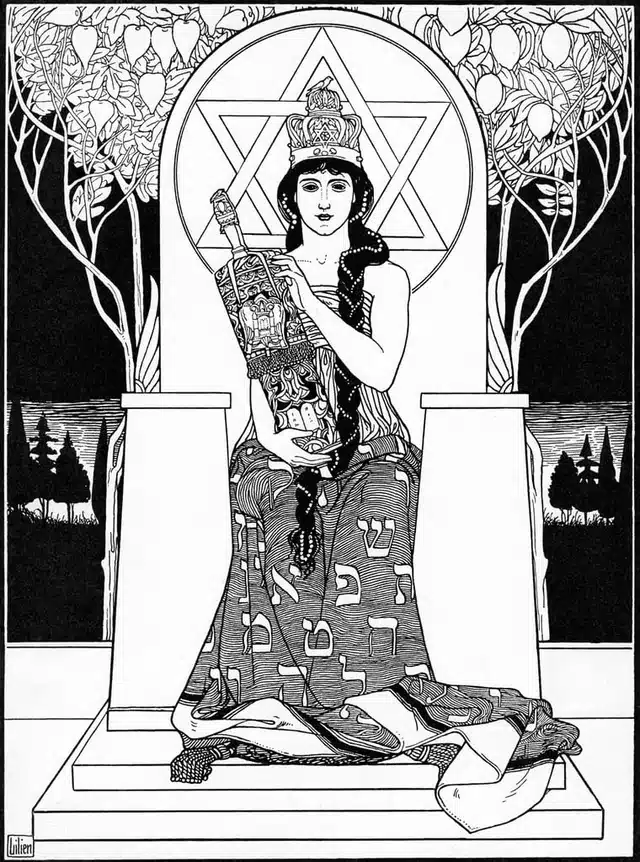
Lilien was born in 1874 in Drohobycz, a Galician town of “Torah-loving, hardworking mechanics and shopkeepers.” The son of a poor lathe-turner, he could not afford the formal training needed to develop his artistic gifts. He scraped out a meager living painting signs and was only able to move to Kraków with the support of wealthier relatives. There, he studied under Jan Matejko, whose monumental historical paintings helped shape modern Polish national identity.
Still, the support only got him so far. After two years, he was forced to return home. Back in Drohobycz, Lilien won a design competition and hoped to use the prize money to enroll at Vienna’s Academy of Fine Arts, but even that proved insufficient. He instead set his sights on Munich, then a center of an emerging avant-garde movement.
A new Jewish image
Lilien came of age during a period of dramatic change. Industrialization was transforming how the world worked and looked. While the new technology undoubtedly made life easier, many artists believed it came at the cost of beauty.
From this tension emerged Art Nouveau, an international style that rejected the monotony of mass production in favor of flowing lines and organic forms. Its adherents believed art should escape the academy and enter everyday life, celebrating craftsmanship, beauty, and nature over industrial uniformity.
Known by different names across Europe, it was called Jugendstil in Germany. Lilien could hardly have arrived at a better moment. He first found success as a photographer and later as an illustrator for the movement’s flagship magazine, Jugend. His sinuous black-and-white compositions were dreamlike and steeped in symbolism, as if drawn from some collective unconscious.

These currents were not confined to the arts. As Lilien’s reputation grew, a parallel conversation was gathering momentum in the Jewish world.
European Jewish life was also undergoing radical change. Emancipation offered Jews civil equality, but often only on the condition that they leave their collective identity behind, while nationalism often excluded them altogether. As antisemitism intensified, many Jews turned their frustrations inward. Herzl concluded that the only solution was a state of their own — and with it, a New Jew altogether.
From that realization, Zionism took many forms: political, labor, and revisionist. Though not especially ideological, Lilien gravitated toward the cultural camp. Thinkers such as Ahad Ha’am argued that political independence alone would not solve the Jewish question. The Jewish people also needed a cultural and spiritual renaissance. Where others focused on statecraft or economics, cultural Zionists believed true emancipation required spiritual regeneration: the revival of Hebrew, the creation of a national art, and the renewal of Jewish life from the inside out.

Drawing the New Jew
In 1900, Lilien illustrated “Juda,” a collection of biblical ballads by Borries von Munchhausen, a philosemitic poet who would later become a Nazi sympathizer. The book became an “overnight sensation,” and its imagery foreshadowed Lilien’s vision of the New Jew: statuesque, dynamic, physically confident, even sensual.
Consider the popular depiction of Jews at the time: rootless, subversive, even physically repulsive. Against that backdrop, Lilien’s work was revolutionary. It challenged stereotypes that had dominated the European imagination for centuries. At best, the Jew was portrayed as a frail scholar or wandering peddler. For Lilien, he was a prince.
Translating that vision into reality was the ambition behind “Muscular Judaism,” a concept coined by Max Nordau. Like many Zionist thinkers of his generation, Nordau believed centuries of exile had weakened the Jewish condition. By recovering the vigor, self-confidence, and national pride embodied in Lilien’s subjects, the Jewish people could achieve national renewal.

The following year, Lilien attended the Fifth Zionist Congress in Basel, where he took his famous portrait of Herzl. To him, the Zionist leader was the living embodiment of the New Jew.
The depth of that admiration is evident in one of his most striking commissions: an illustrated Lutheran Bible. There, Lilien depicted Moses at pivotal moments in the biblical drama — kneeling before the burning bush, smashing the tablets, and towering above Mount Sinai with the Ten Commandments in hand.
In each scene, Moses bears Herzl’s unmistakable features. The symbolism was unmistakable. Herzl was not merely a politician but a prophet; Zionism was not merely a national movement but the realization of a national destiny.

In addition to organizing a Jewish art exhibition at the Congress, Lilien designed its official poster. It depicts an elderly Jew seated behind a barrier of thorns while an angel at his shoulder points toward the Land of Israel. On the distant horizon, beneath a blazing sun, a farmer tends his livestock.
The angel offers consolation, reminding the Jew of his inheritance, but the gesture is also insistent. The destination is distant yet real. Between the Jew and the land lies darkness, but the path has already been revealed. It suggests that Zionism had to exist first in the imagination before it could exist in political reality.
Art after Kishinev
Lilien was keenly aware of his people’s suffering, having grown up in poverty himself. In 1902, he illustrated the Yiddish labor poet Morris Rosenfeld’s “Songs of the Ghetto,” a collection of poems depicting the hardships of Jewish life in exile. His drawings captured its spirit-crushing effects. Older Jews with weathered faces labor behind cobwebs, while a young boy languishes behind barbed wire, his potential stunted before it can flourish. The final image is a dilapidated cemetery.
But worse was coming. News of the Kishinev pogrom in 1903 spread rapidly through newspapers across Europe and the U.S., convincing many Jews that assimilation alone could never guarantee safety. For Zionists, Kishinev became proof that the Jewish question demanded a political solution. The pogrom shocked the Jewish world, and Lilien responded with a haunting memorial of a Jew burning at the stake. By the Seventh Zionist Congress in 1905, the dream of a homeland had become a matter of survival. Yet Lilien never abandoned the belief that art remained central to national renewal.

The following year, he traveled to Ottoman-era Palestine with fellow artist Boris Schatz, where they founded the Bezalel School of Art in Jerusalem, named after Bezalel, the biblical artisan who oversaw construction of the Tabernacle. By supporting Jewish artists and cultivating a national style, the academy sought to give visual expression to Jewish national and spiritual renewal.
Combining European techniques with Middle Eastern motifs, biblical themes, and local craftsmanship was not merely an artistic choice but a political one. In the spirit of cultural Zionism, Bezalel’s founders were laying the cultural foundations of a future state.
Lilien would return to Palestine three more times, but marriage, children, and the First World War gradually shifted his priorities. At 41, he was drafted into Austria’s Military Press Corps. In 1923, World Zionist Organization president Chaim Weizmann honored him with a major exhibition on the occasion of his 50th birthday. Lilien would see only one more, dying in Badenweiler in 1925.

Legacy
In Krakow’s former Jewish quarter, where Lilien once studied, a mural honors his legacy. It was created by Broken Fingaz, an Israeli art collective that counts him among its favorite artists.
Their work is visible across the walls of Haifa, and its debt to Lilien is unmistakable. His ornate line work lives on, fused with graffiti, psychedelia, and other contemporary influences. That is often how his influence is felt today: not by his name, but as woven into Israeli visual culture, whether or not viewers recognize its source.
Lilien helped lay the foundations of artistic life in the Yishuv and develop what became known as the Eretz Yisrael style. Bezalel remains Israel’s oldest art school and still bears the logo he designed. Yet his most enduring contribution was not institutional but imaginative. For Lilien, Jewishness was never simply an inheritance. It was the central subject of his artistic project. Through his work for Zionism and Jewish culture, he reshaped how Jews pictured themselves. A photograph, even one as iconic as Herzl on the Basel balcony, can define a moment. Imagination defines generations. It shapes how people understand who they are and who they might become.
Lilien demonstrated the power of art in the making of a nation. He gave Zionism its visual language before it had a flag, an army, or a state. The nation Herzl imagined would eventually be built through diplomacy and politics, but Lilien ensured it could first be seen.