
The Jewish calendar is full of anniversaries, but so is the regular calendar.
Every week marks the anniversary of events that helped shape Jewish history, whether that’s a Nobel Prize-winning discovery, a pivotal Supreme Court decision, the birth of an iconic artist, the founding of a community, or a moment that changed the course of the Jewish people.
Welcome to Unpacked’s latest series, “This Week in Jewish History.” Each week, we’ll take a look back at the stories worth remembering and why they still matter today.
Check out previous editions here.
Khmelnytsky pogroms (July 22, 1648)
“History doesn’t repeat itself,” Mark Twain once wrote. “But it often rhymes.”


It sure does.
In 1653, Jewish historian, Talmudist, and Kabbalist Nathan Nata ben Moses Hannover dipped his quill pen in ink and carved damning words to paper. “And now I shall commence writing of the Evil Decrees which came through [Cossack commander] Chmiel, may his name and memory be obliterated, in the lands of Russia, Lithuania and Poland in the [Hebrew] years [5]408, ‘409, ‘410, ‘411 and ‘412.”
So begins “Yeven Mezulah,” since translated into English as “Abyss of Despair,” Hannover’s 17th-century account of the brutal Khmelnytsky pogroms. Between 1648 and 1657, forces led by Cossack commander Bohdan Khmelnytsky, sometimes joined by Crimean Tartar allies and local peasants, devastated Jewish communities across what is now Ukraine, Poland, and Lithuania.
The true death toll remains disputed. Older accounts estimated that between 40,000 and 100,000 Jews were killed, while more recent demographic research has placed the number closer to 18,000 to 20,000. Hundreds of Jewish communities were destroyed or badly damaged, and thousands of other Jews were displaced, taken captive, or left to die from starvation and disease.
As antisemitic catastrophes so often do, the Khmelnytsky pogroms took place during a period of serious political upheaval. Between the spring of 1648 and 1657, Ukrainian Cossacks and peasants revolted against the rule of the Polish-Lithuanian Commonwealth and the nobles who controlled much of the region.
At the time, Jews in Poland had enjoyed a period of relative tolerance, and many had risen to prominent positions, serving the Polish nobility as estate managers, tax collectors, and business administrators. That highly visible role led many Cossacks and peasants to view Jews as agents of the Polish ruling class — and even as proxies for Polish domination — rather than as another vulnerable minority living under the same system.

To liberate themselves from Polish rule, the Cossacks and their Tatar allies did what antisemites have so often done: redirected their anger away from the true perpetrators of injustice and toward the Jewish people.
On July 22, 1648, Cossack forces besieged the fortified city of Polonnoe, now Polonne, Ukraine. Until then, the city had served as a safe haven for Jews and Polish nobles fleeing violence elsewhere in the region.
Because the city was heavily fortified, the invading army realized that it would be impossible to take it by force. Instead, they negotiated a false truce. When the city opened its gates, Cossack and Tatar forces burst inside, slaughtering thousands of Jews. Thousands of survivors were taken captive, with some later sold in the Mediterranean and Ottoman slave markets.
To many Ukrainians, Khmelnytsky is a national hero who saved the Ukrainian peasantry from Polish domination. But his memory is so painful within Jewish history that for centuries Jews described the Cossack hero as “Chmiel the Wicked,” regarding him as one of the most vicious, darkest villains the Jewish people had encountered before the Holocaust.
Yet the story of Polonnoe did not disappear with the community that was destroyed there. It survived because Jewish scholars like Hannover recorded it, preserving the memory of those who otherwise might have been lost to history. That tradition of learning and documentation brings us to a very different milestone in Jewish history: the founding of the Hebrew University of Jerusalem.
Construction begins for the Hebrew University of Jerusalem (July 24, 1918)
For the Jewish people, education is (almost) everything.
The Torah commands parents to teach its laws and history to their children. Centuries later, the first-century sage, Joshua ben Gamla, established a system of teachers for children across ancient Judea — the world’s first- ever decree mandating compulsory universal public education.
For centuries, the Jewish community’s strict emphasis on education was responsible for unusually high literacy rates. Without a strong tradition of Jewish literacy, we might not have important historical testimonies like “Yeven Mezulah,” as described above.

It was only natural, then, that one of the modern Zionist movement’s earliest priorities would be to establish the necessary infrastructure for rigorous academic life in the Land of Israel. What’s a Jewish state without a few trailblazing universities?
The idea of creating a Hebrew university in Jerusalem had circulated within the Zionist movement since the late 19th century. Dr. Chaim Weizmann, Albert Einstein, Martin Buber, Sigmund Freud, and other leading Jewish thinkers helped develop the idea and rally support for it.
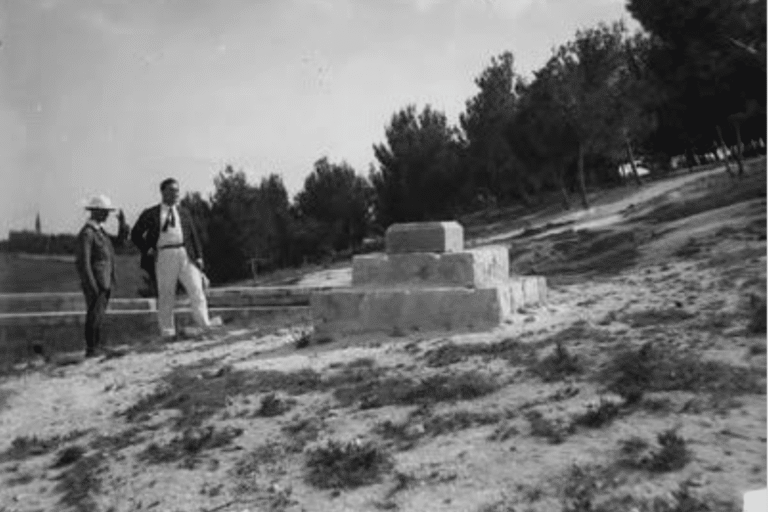
On July 24, 1918, thousands of people gathered atop Mount Scopus for the laying of the university’s cornerstones. Among those present were Weizmann, General Edmund Allenby, Zionist leader Ze’ev Jabotinsky, and James de Rothschild.
On that fateful day, before an audience of thousands, the Zionist movement laid 12 foundation stones, representing the 12 Tribes of Israel, an important reminder that, in Jerusalem, the past, present, and future of the Jewish people are always deeply intertwined.
The Hebrew University of Jerusalem officially opened its doors to students seven years later, in 1925. That ceremony drew another crowd of thousands, along with prominent dignitaries including Lord Arthur Balfour, Winston Churchill, and Allenby.
In the century since, Hebrew University has become one of Israel’s leading research institutions, renowned worldwide for its groundbreaking contributions to the sciences, agriculture, medicine, and Jewish studies. It has educated four Israeli prime ministers, four Israeli presidents, nine Supreme Court justices, 10 Nobel Prize laureates, the current president of Guatemala, and many of the country’s most influential scholars and public figures. The Hebrew University discovered breakthroughs in care for Alzheimer’s Disease and ovarian cancer, developed new irrigation and agricultural technologies, and advanced fields ranging from medical science and artificial intelligence to food production and automotive safety. Its proximity to important archeological sites in Jerusalem has positioned the Hebrew University as a world leader in Jewish studies, Middle Eastern history, and more.
Having co-founded the institution, Albert Einstein, who delivered the university’s first scientific lecture in 1923, donated his entire literary estate, personal writings, and intellectual property to the institution upon his death. Today, the Albert Einstein Archives at Hebrew University contain more than 80,000 documents. That’s right: Einstein’s original notes for the general theory of relativity are sitting safe and sound in the capital of the Jewish state.
The founding of Hebrew University is emblematic of many things: the millennia-old Jewish devotion to education, the relentless dedication of the Zionist movement to build the institutions and infrastructure necessary to run a functioning state, and the wonderful fruits that come from the collaboration of great Jewish thinkers.
It’s been 108 years since that fateful ceremony, and Hebrew University remains as prestigious as ever. Here’s to the next 108!