
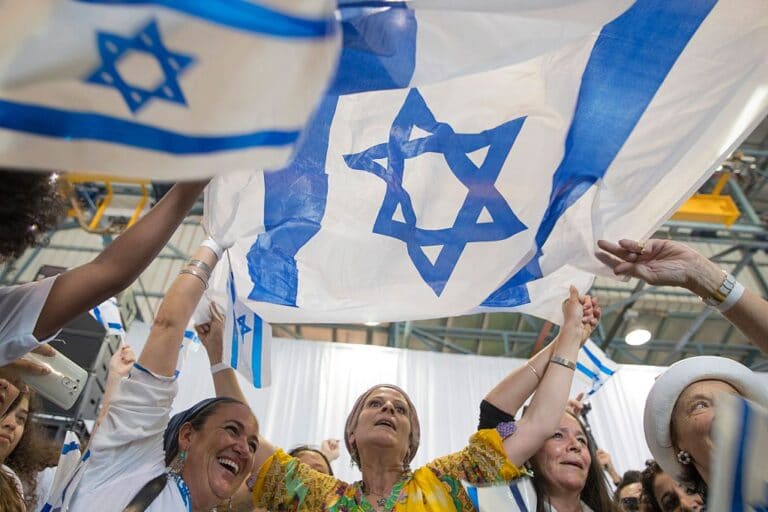
Whenever I tell Israelis I made aliyah, they usually smile and say “mazel tov!” Then, almost in the same breath, they ask why. The question comes out half-joking, half-serious: Why would you move here? Aren’t you afraid? They look at me like I’ve done something irrational and maybe even heroic, as if choosing to live in Israel means willingly signing up for chaos.
It’s a strange paradox: Diaspora Jews are running toward Israel — the one place where Jewish life feels whole and visible — while many Israelis dream of getting out, away from the chaos of politics and the constant threat of war. For Israelis, danger is ordinary; for Diaspora Jews, hiding is. One side fears death, the other fears disappearance.
The truth is, both are right. For Israelis, war and uncertainty have become part of daily life, normalized in the same way school shootings have in the United States. For many Diaspora Jews, danger is the quiet, suffocating pressure to tone down or tuck away our Jewishness — to take off the Star of David necklace, lower our voices, and think twice before mentioning Israel in public.
Israelis don’t experience Israel as a miracle; they experience it as reality. For them, the country isn’t a biblical dream or a symbol of redemption. It’s home, with all the ordinary frustrations that come with living anywhere. Life here is less about ideology and more about logistics: rent prices and supermarket bills, traffic jams on the Ayalon, endless government bureaucracy, taxes, and reserve duty. Israelis often love their country the way one loves a difficult family member — fiercely and protectively, but not without irritation.
War is not an “event” here; it’s a condition of life. People joke, fall in love, raise children, and drink coffee with sirens echoing in the background or news alerts flashing across their phones. A rocket is launched, the Iron Dome intercepts, and within minutes, the cafés are full again. This is strength, yes, but also a kind of quiet numbness, part of the emotional cost of adapting to the unbearable.
That’s the paradox of Israeli life: The closer one lives to the miracle, the less miraculous it feels. Israelis live inside the dream the Diaspora still romanticizes, and maybe that’s why so many can no longer see it for what it is, or why it sometimes takes a new immigrant’s eyes to remind them.
Outside Israel, Jewishness often feels like something to hide or downplay. You learn to scan rooms before mentioning Israel, to read people’s faces before making a joke that might be “too Jewish,” to soften the parts of yourself that might offend. Antisemitism outside of Israel is moralized, intellectualized, and absorbed into polite conversation. You hear it in the language of justice, in slogans and sound bites that flatten the complexity of Jewish life into simple villainy. And so, many Diaspora Jews learn the quiet art of shrinking, making ourselves small enough to belong.
That’s why Israel pulls at those of us who make aliyah so strongly. It’s not because we think it’s perfect or peaceful. It’s because it feels honest. Israel is the only place for Jews where existence doesn’t require justification.
For all their differences, Israelis and Diaspora Jews are shaped by the same unease, even if they speak about it in different languages. Israelis often see Diaspora Jews as soft: too protected, too sensitive, too easily shocked by realities they themselves grew up with. Diaspora Jews see Israelis as hardened — too cynical, too blunt, too numb to the miracle they inhabit. Each side mistakes the other’s survival strategy for weakness instead of recognizing it as a response to a different kind of vulnerability.
The result is a strange kind of blindness: we look at each other and see not reflection, but contrast. Israelis can’t understand why anyone would choose their kind of fear — a life of insecurity, where you’re always a minority at someone else’s mercy. Diaspora Jews can’t understand how Israelis live without constant awe — how they can argue about politics over WhatsApp while sirens go off, how they can complain about parking in a country that exists against all odds. Between us lies the same story, told in two dialects: one of endurance, the other of longing.
If Israel is the body of the Jewish people, the Diaspora is its soul. Israel protects the survival of the land, safety, continuity, and the ability to defend ourselves. The Diaspora preserves our moral voice through ideas, creativity, and conscience that have always allowed Judaism to speak to the wider world. They have always needed each other. Without Israel, Diaspora Jews lose a sense of home and security. Without the Diaspora, Israel risks shrinking inward, losing the moral depth and self-critique that comes from being part of something larger than itself. When either side forgets the other, the wholeness of the Jewish story is lost.
The challenge of our time is to see these worlds not as opposites, but as two expressions of the same covenant. One is rooted in soil, the other in spirit. One is shaped by survival, the other by memory. Together, they keep the Jewish people alive and awake.
So when Israelis ask why I came here, I tell them I wanted to stop living Jewish life as theory and start living it as reality. I was tired of explaining my existence, tired of translating myself. Even in its chaos, I would rather live in a country that demands everything of me than one that asks me to hide who I am. Life in Israel is imperfect and often exhausting, but it’s unapologetically ours. And for me, that is enough.
