For some American Jewish children learning about the Holocaust, a haunting question follows: If something similar happened here, would a neighbor risk their life to hide them?
Shalev Biton, 27, who lives in Tel Aviv, had never imagined needing to ask that question.
“We never imagined anything like this could happen before October 7,” Biton told Unpacked. “There was nothing even close to a feeling of not being safe in your country.”
He trusted that the Israeli army would protect him if anything happened. But on October 7, 2023, as Hamas attacked the Nova music festival and communities across southern Israel, that protection did not come in time.
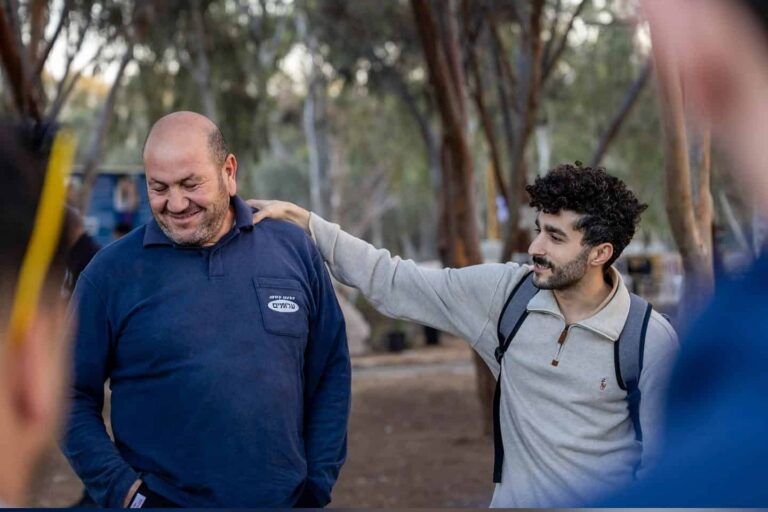
Instead, Biton found refuge with Yunis Alkarnawi, a Bedouin Muslim from Rahat who sheltered him and other festivalgoers alongside Thai workers at the farm he guarded. When a Hamas gunman arrived at the gate, Alkarnawi risked his own life to keep them hidden.
Today, the two men share their story with audiences in Israel and abroad — recounting both the terror of that day and the bond that emerged from it.
The warning that sent him running
Biton was lying in a tent at the Nova festival when rockets began flying overhead. He packed his belongings, but having experienced rocket attacks before, he did not initially realize that a much larger assault was underway.
In his recorded testimony, he recalled hearing gunfire that he believed was about two kilometers away. When his worried mother called, he reassured her that everything would be fine.

Then he and his friends went to their car to leave.
“There was a huge traffic jam, and it took 40 minutes just to go a short distance,” he said. “Around 7:40 a.m., I remember a woman next to me shouting: ‘There are terrorists on motorcycles.’”
Biton, who had served in the Israel Defense Forces, said he had heard about the possibility of a Hamas attack. But he had imagined an incursion involving perhaps 100 terrorists, not thousands.
The woman’s warning changed his understanding of what was happening. His cousin, speaking to him by phone, also warned that the situation was unprecedented and urged him to avoid shelters and kibbutzim.
Biton began to run.
At one point, he said, he was fleeing alongside more than a thousand people. For the first two kilometers, he could barely feel his body. After about an hour, exhaustion set in, and he walked another three kilometers. He believed the police were overwhelmed and could not come to his aid.
Eventually, he reached the farm where Alkarnawi was working.
Finding refuge with a stranger
At first, neither man knew whether he could trust the other.
Biton feared that Alkarnawi might be from Gaza and alert Hamas to his presence. Alkarnawi, meanwhile, needed to determine whether Biton was a fleeing festivalgoer or an attacker.
“It was a tense moment,” Biton said. “On that day Hamas killed Muslims and Thai workers, but he told me when he looked at my earrings, he knew that he didn’t have to worry about me trying to harm him.”
Alkarnawi took Biton and the other young Israelis in, giving them food, water and a place to rest.
“When you are running in the scariest moments in your life, and then you feel safe, the adrenaline goes down, and suddenly you are very tired,” Biton said.
For a brief time, he believed the danger had passed.

Then, around noon, Alkarnawi warned them to hide. A Hamas gunman was approaching.
“We were 24 Thai people, eight Israelis, no guns,” Biton said. “We had some steel pipes. Obviously, we knew what would happen if the terrorist came into the farm.”
A gunman at the gate
Alkarnawi told Unpacked that the gunman was tall, carrying a Kalashnikov rifle and wearing a headband that identified him as a member of Hamas.
Rather than wait for the man to approach him, Alkarnawi spoke first. In Arabic, he explained that he guarded the farm.
The gunman demanded that he open the gate.
“I told him I guard the barn, but I don’t have the keys, even though I really had them in my pocket,” Alkarnawi recounted.
He knew the lie could cost him his life. But allowing the gunman inside would put everyone hiding there in danger.

Then the man made an accusation.
“You are hiding naked Jews,” Alkarnawi recalled him saying.
Alkarnawi feared that the gunman might have spotted the people he was sheltering. But he also considered another possibility: Festivalgoers had been running through the heat without shirts, and the accusation did not necessarily mean the man had seen anyone inside.
Alkarnawi denied that Jews were hiding there.
Eventually, the gunman left.
When Alkarnawi called for the survivors to come out, Biton hesitated. He feared that Hamas had captured their rescuer and was forcing him to lure them out of hiding.
But Alkarnawi was telling the truth. They were safe, and civilians later arrived in cars to drive them away.
Biton hugged him and called him his guardian angel.
“I didn’t know how I could possibly thank him other than to share the story of what he did,” Biton said. “When I get married, he will definitely be under my chuppah,” the Jewish wedding canopy, “if his religious observance permits it.”
A reminder of his son
Alkarnawi, 51, said his decision to shelter the group drew partly on his faith. He cited a teaching in the Quran, with a parallel in Jewish tradition, that saving one life is like saving an entire world.
But his reasons were also deeply personal.
The young people reminded him of his son, who had died after a 10-month battle with cancer despite efforts by Israeli doctors to save him. Seeing them in need, Alkarnawi said, felt as though his own son were asking for help.
He understood the danger of taking them in — and of confronting the gunman at the gate.
“I knew he would kill us all if he came inside,” he said.
Alkarnawi has since received awards for his bravery. Though others call him a hero, he said his hope is for peace and for people to live without being harmed.
Sharing their story
The friends Biton attended Nova with survived. But another friend who was at the festival, Tiferet Lapidot, was murdered by Hamas.
“She was an amazing soul,” he said. “We met in Australia. Until this day, it’s hard to imagine such a kind person was taken from us.”
Both Biton and Alkarnawi said they sought therapy after their experiences. Sharing their story has also become part of how they process what happened.
They have spoken to audiences together roughly 160 times, according to Biton, including at events abroad and gatherings with visiting groups in Israel.
Biton said that, amid growing polarization, he wants their story to remind people of the human connections that can cross religious and ideological divides.
“We all want a life shared in Israel,” he said.
Speaking about the experience, he added, is cathartic. He recently addressed a rally against antisemitism outside the United Nations in Manhattan.
For now, the two men plan to continue speaking publicly. Through their story, they hope to show what it can mean to see someone in danger and choose to help.
“We are hoping people can live their best lives,” Biton said.