
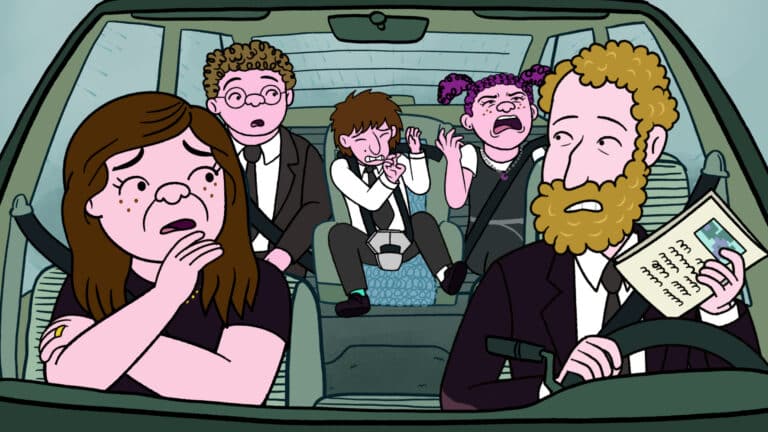
Five years after wrapping his acclaimed series, “Bojack Horseman,” Raphael Bob-Waksberg is back with a project — one that promises more heart, more family, and more Judaism.
“Long Story Short,” premiering on Netflix Friday, Aug. 22, trades in the anthropomorphic animals and Hollywood satire of BoJack for something more personal. The 10-episode animated series traces the lives of the Schwoopers, a loud, complicated Jewish family whose story unfolds from the 1950s through 2022. Each episode zeroes in on a relationship or character, cutting between past and present to show how love, grief, and conflict reverberate across generations.
The series is loosely inspired by Bob-Waksberg’s own upbringing in Palo Alto, where he grew up in a Jewish household that was progressive, outspoken, and deeply involved in community life. He often jokes that his parents were “professional Jews”: his father led the Bay Area Council for Soviet Jewry, advocating for Jewish emigration from the Soviet Union, while his mother ran a Judaica shop that served as a hub for Jewish culture.
That spirit of activism, culture, and family messiness is baked into “Long Story Short,” which follows Naomi Schwartz (Lisa Edelstein) and Elliot Cooper (Paul Reiser) as they navigate life with their three children — Avi (Ben Feldman), Shira (Abbi Jacobson), and Yoshi (Max Greenfield). Even their blended surname, Schwooper — an amusing mash-up of Schwartz and Cooper — reflects the show’s playful exploration of Jewish identity and family legacy.
With a sharp attention to the small moments that shape us — like inside jokes, awkward tiffs, and patterns that repeat across generations — the show melds laugh-out-loud satire with emotional gut-punches in a way that feels uniquely Jewish.
And that balance — one that seamlessly blends uncomfortable topics and tragedy with sharp wit and emotional honesty — is at the heart of Bob-Waksberg’s creative vision.
“Jews more than anybody know how to milk comedy from pain. There’s no joy without sadness and no sadness without joy — it’s all intermingled. That feels very Jewish to me, and that, yes, even in the roughest of times, there’s going to be jokes,” Bob-Waksberg told Unpacked. “In a way that is deeply woven into who I am. It is inconceivable that I could make a show that was just funny or just sad; I think all my work is going to have strains of both.”
Crafting Jewish humor in “Long Story Short”
Dark humor was central to the success of “BoJack Horseman,” but “Long Story Short” takes that sensibility into new territory. By centering explicitly Jewish storylines and characters, Bob-Waksberg is able to braid together comedy and heartbreak in a register that feels both fresh and deeply familiar.

Many of the show’s plot points are distinctly Jewish. In one episode, a $108 donation to the Anti-Defamation League is angrily ripped up because a deceased relative never received a bar mitzvah candle. In another, a character decides to convert to Judaism after finding unexpected comfort during the Yom Kippur viddui confessional — while grappling with guilt over unethical behavior at work. Even the show’s “visual afikomen” gags reward sharp-eyed viewers. Yet at the same time, the lessons are universal, such as when only daughter Shira struggles to replicate her mother’s knish recipe, a challenge that resonates far beyond Jewish kitchens.
For Bob-Waksberg, leaning into overtly Jewish stories opened up a new creative well. He admitted that he often bumps into writer’s block, but drawing from his own Jewish background gave him a trove of material.
“There’s this whole other array of stuff that I haven’t used. And to be able to make jokes about that is really fun. And to get to use that language and that shorthand, it’s a hoot,” he said.
Some of the references are pure “Jewish Inside Baseball.” One joke riffs on the historical differences between Litvaks from Vilna and Vitebsk; another has youngest son Yoshi praised at his bar mitzvah service with a slangy shout from his best friend Danny (Dave Franco): “Dude, your davening was on point!” Danny adds that their Holocaust survivor tutor, Mr. Leibowitz, was “kvellin’ like a felon.”

In this way, “Long Story Short” deftly balances being a show about Jews with being a Jewish show. At its core, though, it’s about the Schwooper family, making it accessible to everyone — from Jewish day school alumni to those who have never met a Jew. Bob-Waksberg hopes that audiences will feel at home with the characters, even if they don’t recognize every reference.
“The stories we tell are pretty universal, so a lot of the thinking was that these are Jewish characters, and they have a Jewish shorthand, and they will be hopefully recognizably Jewish to other American Jews, but you don’t have to understand all the references to follow what’s happening in the story.
“We all have parents and siblings that we don’t always see eye-to-eye with, we have fears and concerns and anxieties. We’re telling these stories through a Jewish lens, but I like to think they’re universal stories,” he said.
To capture that balance, Bob-Waksberg made sure to staff the writers’ room with Jews from across the religious and cultural spectrum, alongside non-Jewish writers who could help broaden perspective and shape other characters. Sometimes, he recalled with a laugh, the Jewish writers would gleefully push edgy material, only for their non-Jewish colleagues to wave them off.
“For a wide audience, we didn’t want to be creating new stereotypes,” he joked.
Following the Schwooper family through the decades
What separates “Long Story Short” from many of its contemporaries is the ambitious structure of each episode, leaping between decades to show how single moments ripple across generations. When asked why he wanted to set so much of his story in the early aughts, Bob-Waksberg bluntly responded: “The present is so boring.”

Yet the real brilliance of the time-hopping is not nostalgia but perspective — it allows audiences to see the Schwoopers in full, their flaws and triumphs laid bare across decades. With only 10 half-hour episodes, the device gives the family a depth and intimacy that a linear story could never achieve.
“Long Story Short” refuses to center on one moment in time. Its decades-spanning structure flattens the past and present, allowing relationships to be seen from multiple angles, and moral choices to echo across eras. The effect is bittersweet: an acknowledgment that while time has moved on, the stories we leave behind keep circling back.
“Long Story Short” provides a diverse look at what it means to be Jewish
Bob-Waksberg’s turn toward a more explicitly Jewish story deepened after becoming the father of two children. As he reevaluated his own childhood — deciding what lessons to pass on and what patterns to break — he found himself drawn to the very questions that shape the Schwoopers’ journey: how moments from our past can echo across a lifetime.


In “Long Story Short,” those echoes often take the form of how the Schwoopers relate to Judaism. Oldest son Avi rejects Jewish practice altogether, refusing to teach his daughter Jewish customs because he associates them with the pain and negativity he feels toward his family. His sister Shira, by contrast, embraces her Jewish identity with her Black convert wife, Kendra (Nicole Byer). The couple considers Jewish day school for their children and grounds their family life in Jewish ethics and traditions.
For Bob-Waksberg, these divergent paths reflect the reality of Jewish identity: it looks different for everyone.
“The way we talk about Jewishness, especially the way Jews talk about Jewishness, so much is tied up with our own experience of it,” Bob-Waksberg said. “There is no Pope of the Jews who is the standard bearer for what a Jew is or should be. And so we all kind of have our own individual experiences.
“I like the idea that for Avi, all of his complicated feelings about his own family, he’s kind of put into the box of being Jewish — he cannot extract one from the other.”
Avi, Bob-Waksberg said, misplaces his resentment of his family onto a resentment of Judaism “because that feels like a safer thing for him to resent.”
That spectrum of identity was key to building the Schwooper siblings. Not only did it allow for richer storytelling across different segments of the Jewish community, but it also captured a truth about Jewish life: identities shift. Touchstones can change — whether it’s synagogue practice, holiday foods, or pop culture references — and what feels central to one’s Jewishness at age 13 might look completely different at 33 or 53.
“I like the idea of showing one’s relationship with Judaism as being a fluid thing,” Bob-Waksberg said. “For a lot of adults, you identify one way as a kid, and then you kind of figure out for yourself how you might practice or see yourself. And so I just wanted to explore the looseness of that and to kind of show that not all Jews are the same, but also not all people even are the same with themselves.”

The series wears that identity openly, even defiantly. Naomi embodies the archetypal Jewish matriarch: sharp-tongued, hypercritical, yet endlessly proud of her children. Her daughter Shira, by contrast, reflects a newer generation’s approach to Jewish identity. Her wife, Kendra, quips, “We’re a lesbian couple with biracial, Jewish sons. We’re impressive.” Together, they represent the show’s embrace of a wide Jewish spectrum — traditional and modern, religious and secular, deeply rooted and newly chosen.
“Long Story Short” is one of the few television shows to genuinely grapple with Jewish diversity. It portrays characters across denominational lines, from Orthodoxy to secularism, and touches on experiences from conversion to inherited guilt. While there is still room to expand the portrayal of Jews of different racial and ethnic backgrounds, the series succeeds in rejecting the notion of Jews as a monolith.
For Bob-Waksberg, the beauty of the Schwoopers is that they’re a mess — loving, flawed, unmistakably Jewish, and at the same time queer, Black, interfaith, Conservative, Orthodox, and everything in between.