

America’s story has never been shaped by just one group of people. It’s a tapestry woven together by generations of immigrants, dreamers, innovators, activists, artists, and entrepreneurs, each leaving their own mark on the country.
For much of history, Jews faced legal restrictions and persecution around the world. In the United States, they found unprecedented opportunities to build businesses, shape public life, create art, and contribute to the nation’s growth while openly embracing their Jewish identity.
As the U.S. celebrates its 250th anniversary, it’s also a chance to celebrate the Jewish Americans who helped shape the nation along the way. Since the earliest days of the republic, Jews have played outsized roles in American life, financing the Revolutionary War, writing songs that became national anthems, discovering life-saving vaccines, fighting for civil rights, breaking barriers in government, and transforming everything from baseball and Broadway to Hollywood and Silicon Valley.
No list could ever capture every Jewish American who changed history. But these 25 people offer a window into the remarkable impact Jewish Americans have had on the U.S. over the past 250 years, and the many ways they’ve helped define what America is today.
1. Haym Salomon (April 7, 1740 – Jan. 6, 1785)
When people think about the American Revolution, names like George Washington, Thomas Jefferson, and Alexander Hamilton often come to mind. But behind the scenes, Haym Salomon played a crucial role in helping keep the young nation afloat.

Born in Poland to a Sephardic Jewish family, Salomon immigrated to New York before the outbreak of the Revolutionary War. A successful broker and merchant, he quickly became a supporter of the Patriot cause. During the war, he was arrested by the British on suspicion of spying, later escaped, and resumed helping the revolution.
As the Continental Congress struggled with mounting debt and a lack of reliable funding, Salomon used his financial expertise to raise money for the fledgling government. He brokered loans, sold government securities, and personally advanced funds to government officials and military leaders, often without expecting immediate repayment. Among those he assisted was James Madison, who relied on Salomon to cover expenses while serving in Congress.
Read more: How Jews helped shape the American Revolution — and the ‘First Salute’ that made history
Historians continue to debate exactly how much of the Revolution’s finances flowed through Salomon, and some popular stories about his role have been exaggerated over the years. But there is broad agreement that he was one of the most important financiers of the Patriot cause and helped sustain the revolutionary government during some of its most difficult years.
Salomon died in 1785 at just 44 years old, leaving behind significant debts because many of the loans he made were never repaid. Today, he’s remembered as one of the earliest Jewish Americans to leave a lasting mark on the nation’s history.
2. Levi Strauss (Feb. 26, 1829 – Sept. 26, 1902)

Few pieces of clothing are more closely associated with the U.S. than a pair of blue jeans, and they exist thanks in large part to Levi Strauss, a Jewish immigrant who helped turn a practical solution into an American icon.

Strauss immigrated to the U.S. from Bavaria with his family in 1847 after his father’s death. Like many immigrants of the era, he was searching for opportunity in a rapidly growing country. After spending several years working in the family dry goods business in New York, he headed west during the California Gold Rush. In 1853, he settled in San Francisco and founded Levi Strauss & Co., selling clothing, fabrics, and other supplies to miners, merchants, and settlers.
One of his customers was Jacob Davis, a tailor from Nevada who had devised a way to make work pants stronger by reinforcing stress points with copper rivets. Davis lacked the money to patent the invention, so he approached Strauss, who agreed to become his business partner. In 1873, the two men received a U.S. patent for riveted work pants, creating what would become the first blue jeans.
Originally designed to withstand the demanding conditions of mining camps and ranches, jeans quickly became popular with workers across the American West. Over the following century, they evolved from durable workwear into a global fashion staple embraced by everyone from cowboys and factory workers to Hollywood stars, musicians, and world leaders.
3. Emma Lazarus (July 22, 1849 – Nov. 19, 1887)
Millions of immigrants have entered New York Harbor, greeted by the words, “Give me your tired, your poor, your huddled masses yearning to breathe free.” Those iconic lines were written by Emma Lazarus, a Jewish American poet whose words became synonymous with the American dream.

Lazarus came from a prominent Sephardic Jewish family in New York City whose roots in the U.S. stretched back generations. Her ancestors had fled religious persecution in Spain and Portugal centuries earlier, before eventually settling in the American colonies. She was a gifted writer from a young age, publishing her first book of poetry as a teenager.
Although she was already an accomplished poet, Lazarus became increasingly engaged with Jewish causes in the 1880s as thousands of Jewish refugees fled violent pogroms in the Russian Empire. She volunteered to help newly arrived immigrants, advocated for Jewish refugees, and wrote passionately about the importance of ensuring their safety and opportunity.
In 1883, she was asked to contribute a poem to help raise money for the pedestal of the Statue of Liberty. Her sonnet, “The New Colossus,” reimagined the statue not as a symbol of military victory, but as a beacon of hope for immigrants arriving in the U.S. Although the poem received little attention during her lifetime, it was cast onto a bronze plaque inside the Statue of Liberty in 1903, nearly two decades after her death.
Today, Lazarus’s words have become some of the most recognizable in American history. For generations of immigrants arriving by sea, her poem captured both the promise of the New World and the hope that newcomers, including countless Jews fleeing persecution, could find freedom and build new lives in the U.S.
4. Joseph Pulitzer (April 10, 1847 – Oct. 29, 1911)

Every year, the highest honor in American journalism bears the name of Joseph Pulitzer. But long before the Pulitzer Prize existed, Pulitzer helped transform the way Americans consumed the news.
Born to a Jewish family in Hungary in 1847, Pulitzer immigrated to the U.S. as a teenager with little money and limited English. After briefly serving in the Union Army during the Civil War, he settled in St. Louis, where he worked a variety of jobs before entering the newspaper business. His sharp reporting and political instincts quickly propelled him from reporter to newspaper owner.
In the 1880s, Pulitzer purchased the New York World and turned it into one of the country’s most widely read newspapers. He championed investigative reporting, exposed government corruption, and covered the lives of ordinary Americans alongside national politics. At the same time, he embraced eye-catching headlines, illustrations, and human-interest stories, helping pioneer what became known as mass-market journalism. His fierce circulation battle with William Randolph Hearst also contributed to the rise of sensationalist “yellow journalism,” a legacy that remains debated today.
Despite those controversies, Pulitzer believed journalism should ultimately serve the public. Before his death in 1911, he left much of his fortune to Columbia University to establish a graduate school of journalism and create annual prizes recognizing excellence in reporting, literature, music, and public service.
5. Louis Brandeis (Nov. 13, 1856 – Oct. 5, 1941)
When Louis Brandeis was appointed to the U.S. Supreme Court in 1916, he became the first Jewish justice in the court’s history, a milestone that reflected both the growing role of Jewish Americans in public life and the barriers they still faced.

Born in Kentucky to Jewish immigrants from Bohemia, Brandeis built a reputation as one of the nation’s most respected lawyers. Known as the “People’s Lawyer,” he fought monopolies, championed workers’ rights, defended consumers, and argued that businesses should be held accountable to the public.
During his 23 years on the Supreme Court, Brandeis helped shape modern constitutional law, particularly in the areas of free speech, privacy, and government regulation. His opinions continue to influence American law, and he remains one of the most consequential justices in the court’s history.
Brandeis also became a leading voice in the American Zionist movement, believing that supporting a Jewish homeland and embracing American citizenship were complementary, not contradictory. His life helped redefine what it meant to be both proudly Jewish and fully American.
6. Henrietta Szold (Dec. 21, 1860 – Feb. 13, 1945)
Henrietta Szold proved that one person could transform Jewish life on both sides of the Atlantic.
Growing up in Baltimore to a family of rabbis and educators, Szold devoted her life to expanding educational opportunities and improving healthcare. In 1912, she founded Hadassah, which began as a small volunteer organization and grew into the largest Jewish women’s organization in the U.S.

Under her leadership, Hadassah funded hospitals, trained nurses, and helped build a modern healthcare system in what would later become the State of Israel. During the 1930s, Szold also led Youth Aliyah, rescuing thousands of Jewish children from Nazi-controlled Europe and helping them find safety in British Mandatory Palestine.
Today, Hadassah remains one of the largest Jewish organizations in the U.S., a lasting testament to Szold’s vision and leadership.
7. Julius Rosenwald (Aug. 12, 1862 –Jan. 6, 1932)
Julius Rosenwald believed wealth should be used to create opportunity for others. As the president of Sears, Roebuck and Company, he helped transform the mail-order retailer into one of the largest businesses in the U.S. But his greatest legacy may be what he did with the fortune he earned.
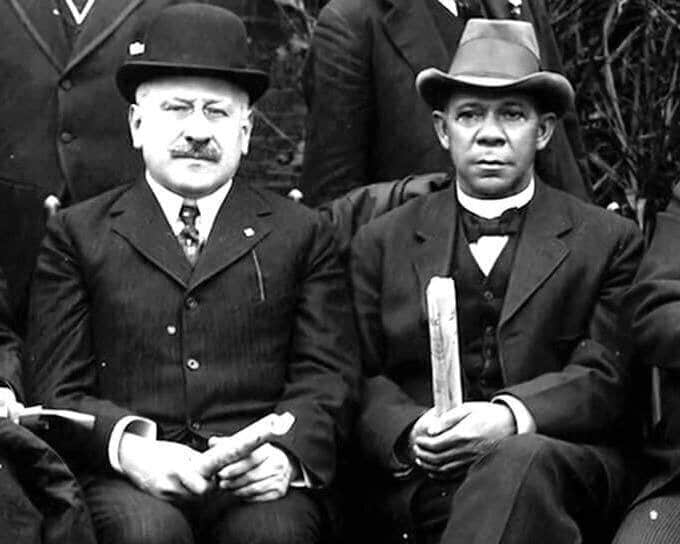
Inspired by educator Booker T. Washington, Rosenwald partnered with Black communities across the segregated South to fund the construction of nearly 5,000 schools, along with teacher homes and vocational buildings. At a time when public education for Black children was chronically underfunded, the “Rosenwald Schools” educated hundreds of thousands of students, including future civil rights leader John Lewis and poet Maya Angelou.
Read more: The early history of Black and Jewish relations in the U.S.
Rosenwald also gave generously to Jewish causes, museums, universities, and scientific research, but he believed philanthropy should solve problems during a donor’s lifetime rather than build a permanent family fortune. His commitment to education and equality made him one of the most influential philanthropists in American history.
8. The Warner Brothers
Long before Hollywood became synonymous with the movie industry, four Jewish immigrant brothers helped build it from the ground up.
Harry Warner (Dec. 12, 1881 – July 25, 1958), Albert Warner (July 23, 1884 – Nov. 26, 1967), Sam Warner (Aug. 10, 1887 – Oct. 5, 1927), and Jack L. Warner (Aug. 2, 1892 – Sept. 9, 1978) were born to a Jewish family in what is now Poland before immigrating to the U.S. as children in the late 19th century. Their family settled first in Canada before moving to Ohio, where the brothers took on a variety of jobs to help support the household. Like many immigrant families of the era, they saw opportunity in a rapidly changing U.S.

That opportunity came in an unlikely place: the brand-new motion picture industry. The brothers began by purchasing a projector and traveling from town to town screening silent films before opening their own movie theaters. The Warner brothers were among a generation of Jewish immigrant entrepreneurs, including the founders of Paramount, MGM, Universal, and Columbia, who transformed a small California town into the center of the global film industry.
The Warners quickly earned a reputation for taking risks. At a time when many studio executives doubted audiences wanted to hear actors speak, the brothers, led by Sam Warner, invested heavily in synchronized sound. Their gamble paid off in 1927 with the release of “The Jazz Singer,” starring Al Jolson. Although not the first film to experiment with sound, it was the first feature-length movie to successfully combine synchronized dialogue with a compelling story, ushering in the era of “talkies” and permanently changing the film industry.
Over the following decades, Warner Bros. became one of Hollywood’s defining studios, producing classics such as “Casablanca,” “The Maltese Falcon,” and “Rebel Without a Cause.” The studio also introduced generations of audiences to characters like Bugs Bunny and later became home to franchises including Harry Potter and the world of Batman.
The Warner brothers weren’t just successful movie producers. Alongside other Jewish immigrant studio founders, they helped invent Hollywood itself, creating an industry that would become one of America’s most influential cultural exports and forever change how stories are told around the world.
9. Irving Berlin (May 11, 1888 – Sept. 22, 1989)
Few people have shaped the soundtrack of America more than Irving Berlin. Over a career spanning more than six decades, the Jewish immigrant wrote an estimated 1,500 songs, helping define American popular music in the 20th century.
Born in the Russian Empire, Berlin immigrated to New York City as a young child after his family fled antisemitic persecution. Growing up on the Lower East Side, he worked a series of odd jobs before breaking into the world of Tin Pan Alley, where he quickly became one of the country’s most successful songwriters.
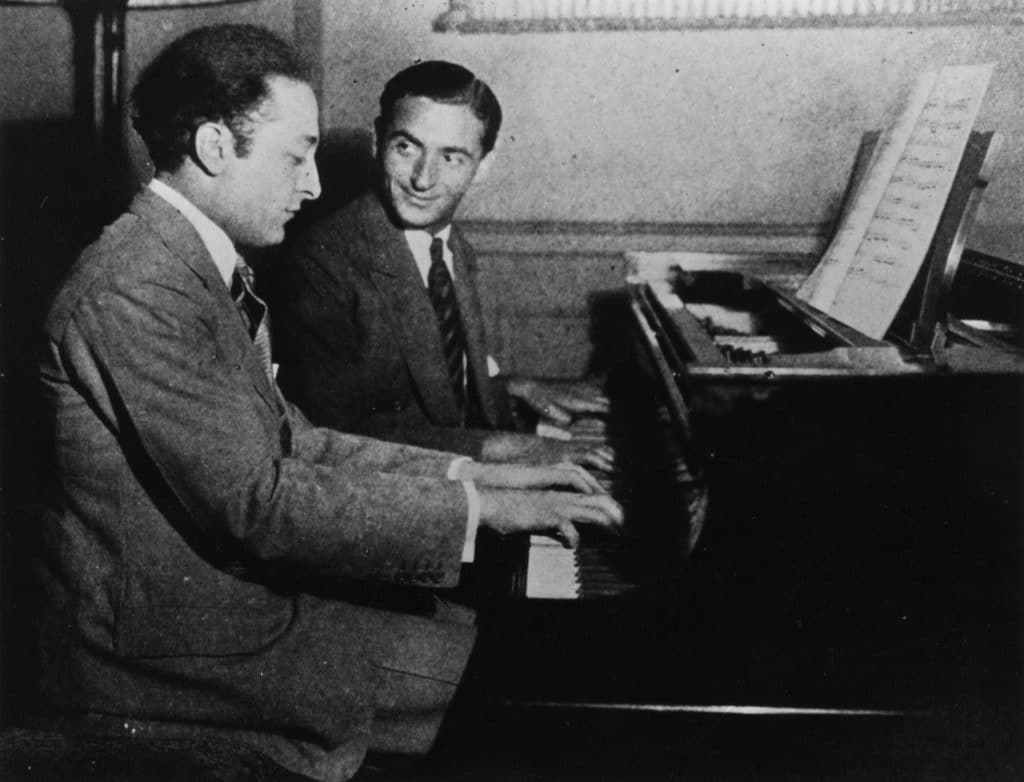
His catalog includes classics such as “God Bless America,” “White Christmas,” “There’s No Business Like Show Business,” and “Cheek to Cheek.” His music helped define Broadway, Hollywood, and the Great American Songbook, while “White Christmas” became one of the best-selling songs of all time.
Few artists have shaped America’s cultural identity as profoundly as Berlin, whose songs have accompanied the nation through celebrations, wars, holidays, and everyday life for more than a century.
10. George Gershwin and Ira Gershwin
Few creative partnerships have shaped American music as profoundly as George Gershwin (Sept. 26, 1898 – July 11, 1937) and Ira Gershwin (Dec. 6, 1896 – Aug. 17, 1983). Together, the brothers helped create a distinctly American sound by blending jazz, classical music, blues, and popular song while producing some of the country’s most enduring works.


The sons of Jewish immigrants from the Russian Empire, the Gershwins grew up in Brooklyn and found success at a young age in New York’s Tin Pan Alley. George composed the music while Ira wrote the lyrics, a partnership that produced dozens of beloved songs, including “I Got Rhythm,” “Someone to Watch Over Me,” and “Embraceable You.”
George also composed groundbreaking orchestral works such as “Rhapsody in Blue” and “An American in Paris,” while the brothers collaborated on the landmark folk opera “Porgy and Bess,” which featured classics like “Summertime.”
Although George died in 1937 at just 38 years old, the Gershwins’ music has endured for generations. Together, they helped define the Great American Songbook and forever changed the sound of American music.
11. Jonas Salk (Oct. 28, 1914 – June 23, 1995)

Few scientists have saved more lives than Jonas Salk. His development of the first successful polio vaccine transformed modern medicine and brought hope to millions of families living in fear of one of the 20th century’s most devastating diseases.
Raised in New York City to the children of Jewish immigrants, Salk was the first in his family to attend college. After earning his medical degree, he dedicated his career to medical research, focusing on viruses and vaccines. In the early 1950s, he led the team that developed the first safe and effective vaccine against polio, a disease that had paralyzed or killed hundreds of thousands of people worldwide.
When the vaccine was declared “safe, effective, and potent” in 1955, church bells rang across the U.S. and parents celebrated what many saw as a medical miracle. Asked who owned the patent for the vaccine, Salk famously replied, “Well, the people, I would say. There is no patent. Could you patent the sun?”
Within a few years, widespread vaccination campaigns dramatically reduced polio cases in the U.S. and around the world. Salk’s breakthrough helped pave the way for the near-eradication of the disease, making him one of the most influential medical researchers in American history.
12. Richard Feynman (May 11, 1918 – Feb. 15, 1988)
Richard Feynman changed the way scientists understand the universe. Widely regarded as one of the greatest physicists of the 20th century, his discoveries transformed the field of quantum physics and continue to shape scientific research today.
Born in Queens, New York, to a Jewish family, Feynman displayed an extraordinary talent for math and science from an early age. During World War II, Feynman joined the Manhattan Project under the scientific leadership of Jewish physicists J. Robert Oppenheimer, where he helped develop the world’s first atomic bomb.

After the war, Feynman’s groundbreaking work in quantum electrodynamics revolutionized scientists’ understanding of how light and matter interact. His contributions earned him the 1965 Nobel Prize in Physics and introduced concepts, including the now-famous “Feynman diagrams,” that remain essential tools for physicists.
Beyond the laboratory, Feynman became one of America’s best-known scientists thanks to his curiosity, humor, and gift for explaining complex ideas. His books, lectures, and public appearances inspired generations of students, making him not only a pioneering physicist but also one of the country’s greatest science communicators.
13. Sandy Koufax (Dec. 30, 1935 –)
For generations of baseball fans, Sandy Koufax has represented excellence on the mound. For many Jewish Americans, he also became a symbol of proudly embracing one’s identity.
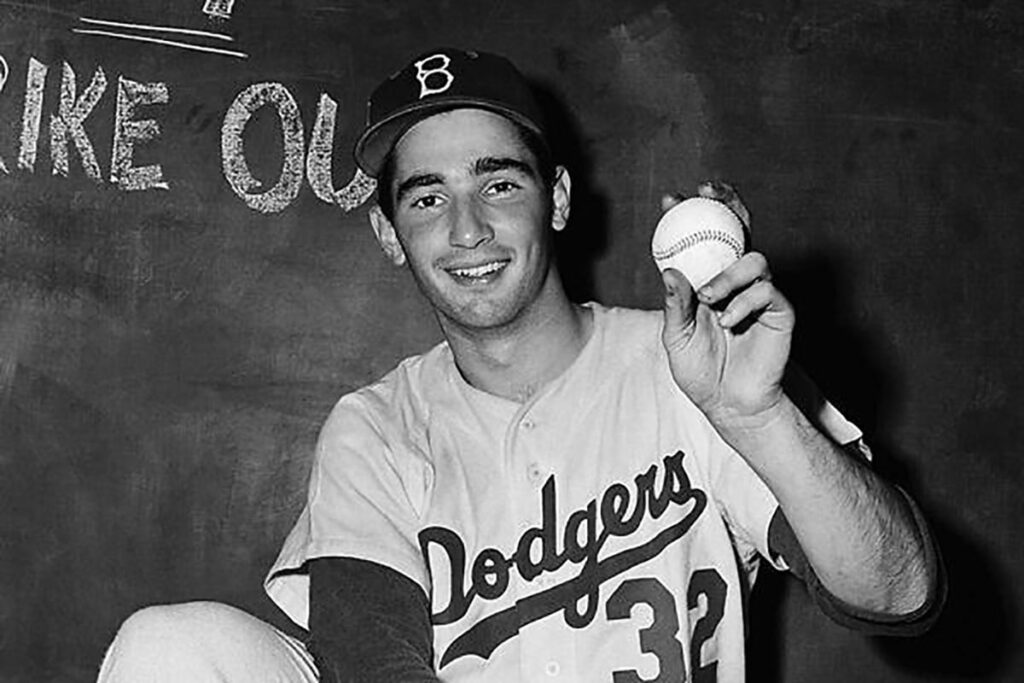
Raised in Brooklyn to a Jewish family, Koufax joined the Brooklyn Dodgers at just 19 years old before the team moved to Los Angeles. After overcoming early struggles, he emerged as one of the most dominant pitchers in baseball history. Between 1962 and 1966, he won three Cy Young Awards, pitched four no-hitters, including a perfect game, and helped lead the Los Angeles Dodgers to three World Series championships.
Koufax’s legacy extends far beyond his statistics. During the 1965 World Series, he chose not to pitch Game 1 because it fell on Yom Kippur, Judaism’s holiest day. His decision made headlines across the country and became one of the most enduring moments in American sports history, inspiring generations of Jewish athletes to embrace their faith without apology.
Though chronic arthritis forced him to retire at just 30 years old, Koufax remains one of baseball’s greatest pitchers and one of the most iconic Jewish athletes in American history.
14. Stan Lee (Dec. 28, 1922 – Nov. 12, 2018)
Stan Lee changed the superhero forever. As the creative force behind many of Marvel’s most iconic characters, he helped transform comic books from children’s entertainment into a global cultural phenomenon.

Born in New York City to Romanian Jewish immigrants, Lee began working in the comic book industry as a teenager. In the 1960s, alongside fellow Jewish creator Jack Kirby and artist Steve Ditko, he co-created heroes who felt more human than the flawless champions who had come before. Characters like Spider-Man, The Fantastic Four, Iron Man, Black Panther, The Hulk, and the X-Men struggled with everyday problems alongside extraordinary powers.
Lee and Kirby’s storytelling helped redefine the superhero genre, making their characters relatable, flawed, and emotionally complex. Many of their heroes were outsiders who faced prejudice or struggled to fit in, themes that reflected broader conversations about discrimination in postwar America and have often been interpreted through the lens of their Jewish backgrounds.
15. Barbara Walters (Sept. 25, 1929 – Dec. 30, 2022)
Barbara Walters changed American television journalism by breaking barriers for women in an industry long dominated by men.
Growing up in Boston to a Jewish family, Walters began her career as a writer and producer before joining NBC’s Today. In 1976, she became the first woman to co-anchor a network evening newscast, shattering one of television’s highest glass ceilings. She was also one of the first Jewish women to reach the highest ranks of American broadcast journalism at a time when few women held such prominent roles.

Over a career spanning more than five decades, Walters interviewed every U.S. president and some of the world’s most influential figures, from world leaders and celebrities to royalty. Her interviewing style, which combined tough questions with personal conversation, helped redefine the television interview and inspired generations of journalists.
In 1997, Walters co-created “The View,” a daytime talk show built around women discussing politics, culture, and current events. The program became a television institution and helped reshape daytime TV. By the time she retired, Walters had become one of the most influential journalists in American broadcasting history, opening doors for countless women who followed in her footsteps.
16. Betty Friedan (Feb. 4, 1921 – Feb. 4, 2006)

Betty Friedan helped spark the modern women’s rights movement in the U.S. Through her writing and activism, she challenged long-held assumptions about women’s roles in American society and inspired millions to push for greater equality.
Born in Illinois to Jewish parents, Friedan studied psychology before becoming a journalist. In 1963, she published “The Feminine Mystique,” a groundbreaking book that examined the frustrations many women experienced despite being told that marriage, motherhood, and homemaking should be enough to fulfill them. The book became a bestseller and is widely credited with launching the second wave of American feminism.
Three years later, Friedan co-founded the National Organization for Women, helping lead campaigns for equal pay, workplace protections, reproductive rights, and an end to sex discrimination. Her advocacy contributed to major legal and cultural changes that expanded opportunities for women across the U.S.
Though some of her views have since been debated and criticized, Friedan’s influence on American society is undeniable. Her work helped reshape conversations about gender, work, and equality, making her one of the most influential activists of the 20th century.
17. Harvey Milk (May 22, 1930 – Nov. 27, 1978)
Harvey Milk became one of the first openly gay elected officials in the U.S., transforming the fight for LGBTQ+ rights and inspiring generations of activists.
Raised in New York to a Jewish family, Milk served in the U.S. Navy before moving to San Francisco, where he became a leader in the city’s growing gay rights movement. In 1977, he was elected to the San Francisco Board of Supervisors, becoming the first openly gay man elected to public office in California.

During his nearly year-long time in office, Milk championed civil rights, affordable housing, public transportation, and an ordinance banning discrimination based on sexual orientation. He also became one of the nation’s most visible advocates for LGBTQ+ equality, urging people to live openly and encouraging others to enter public service.
On Nov. 27, 1978, Milk and San Francisco Mayor George Moscone were assassinated by former Supervisor Dan White. Though his life was cut short at just 48, Milk’s legacy continued to grow. Today, he is remembered as a pioneer of the modern LGBTQ+ rights movement and as a symbol of the power of representation in American democracy.
18. Gloria Steinem (March 25, 1934 –)

Gloria Steinem became one of the most recognizable leaders of the modern feminist movement, using journalism and activism to advocate for gender equality in the U.S.
Born in Ohio, Steinem discovered as an adult that her father came from a Jewish family that had immigrated from Germany and Austria. She began her career as a journalist, gaining national attention in 1963 after going undercover as a Playboy Bunny to expose the working conditions women faced at Playboy Clubs.
In the 1970s, Steinem emerged as a leading voice of second-wave feminism. She co-founded Ms. magazine, creating one of the first national publications focused on women’s rights and gender equality. Through her writing, speeches, and organizing, she advocated for equal pay, reproductive rights, protections against gender discrimination, and greater political representation for women.
For more than six decades, Steinem has remained one of America’s most influential activists. Her work helped reshape public conversations about gender and equality, leaving a lasting impact on American politics, journalism, and culture.
19. Barbra Streisand (April 24, 1942 –)
Barbra Streisand has spent more than six decades redefining what it means to be an entertainer. A singer, actress, director, producer, and songwriter, she has broken barriers for women in Hollywood while becoming one of the most successful performers in American history.

Born in Brooklyn to a Jewish family, Streisand rose to fame in the 1960s with her powerful voice, distinctive style, and refusal to conform to Hollywood’s beauty standards. She went on to star in acclaimed films including “Funny Girl,” “The Way We Were,” and “Yentl,” while recording dozens of bestselling albums.
In 1984, Streisand became the first woman to win the Golden Globe Award for Best Director for directing “Yentl,” a film about a young Jewish woman who disguises herself as a man to study the Torah. Throughout her career, she has also been a vocal advocate for civil rights, women’s equality, and Jewish causes.
One of the few entertainers to achieve EGOT status, Streisand’s influence extends far beyond the stage and screen. Her groundbreaking career helped expand opportunities for women in the entertainment industry while making her one of the most celebrated performers in American history.
20. Stephen Sondheim (March 22, 1930 – Nov. 26, 2021)
Stephen Sondheim transformed American musical theater with songs that were witty, emotionally complex, and unlike anything audiences had heard before. Widely regarded as one of Broadway’s greatest composers and lyricists, he helped redefine what a musical could be.

Sondheim developed an early passion for theater and was mentored by legendary Jewish composer Oscar Hammerstein II. He first gained national recognition by writing the lyrics for “West Side Story” and “Gypsy” before creating groundbreaking musicals of his own.
Over his career, Sondheim wrote music and lyrics for acclaimed shows including “Company,” “Sweeney Todd: The Demon Barber of Fleet Street,” “Into the Woods,” “Sunday in the Park with George,” and “A Little Night Music.” His work explored relationships, ambition, morality, and the complexities of modern life, elevating Broadway into a more sophisticated art form.
Winner of numerous Tony Awards, an Academy Award, a Pulitzer Prize for Drama, and the Presidential Medal of Freedom, Sondheim’s influence can still be seen across Broadway and beyond. His work forever changed the landscape of American theater and inspired generations of composers, lyricists, and performers.
21. Steven Spielberg (Dec. 18, 1946 –)
Few filmmakers have shaped American cinema as profoundly as Steven Spielberg. Over a career spanning more than five decades, he has directed some of the most successful and influential films ever made, redefining the modern blockbuster while also bringing some of history’s most difficult stories to the screen.
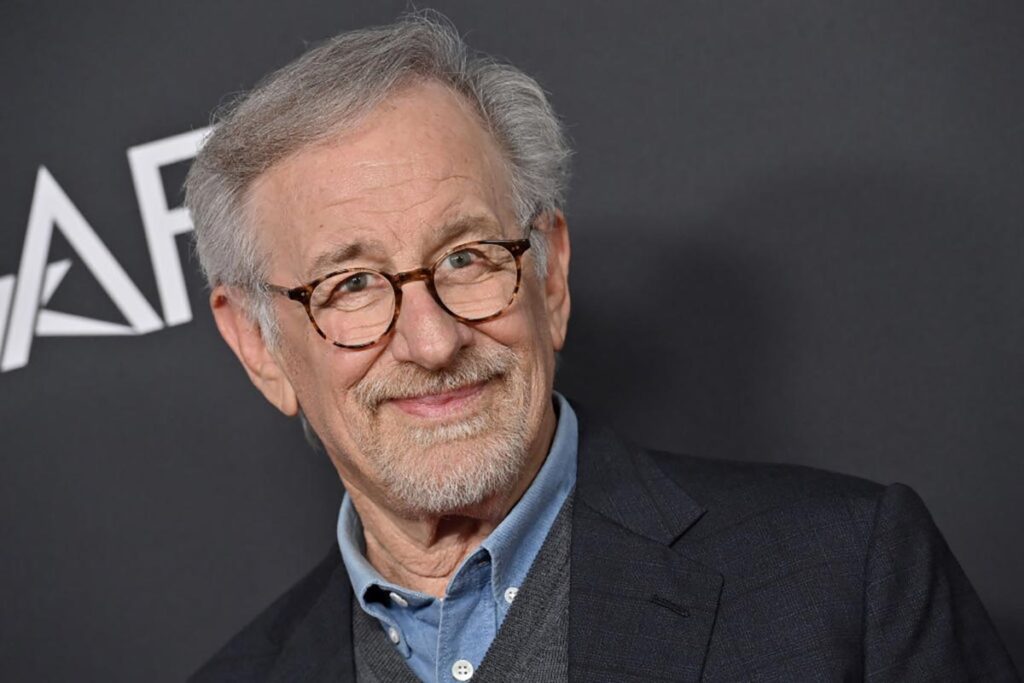
Born in Ohio to a Jewish family, Spielberg often spoke about experiencing antisemitism as a child, an experience that influenced both his identity and his work. He rose to prominence in the 1970s with films including “Jaws” and “Close Encounters of the Third Kind” before directing classics such as “E.T. the Extra-Terrestrial,” “Jurassic Park,” “Saving Private Ryan,” and the “Indiana Jones” films.
In 1993, Spielberg released “Schindler’s List,” a landmark film about the Holocaust that won seven Academy Awards, including Best Picture and Best Director. The film also marked a turning point in his relationship with his own Jewish identity, inspiring him to become more publicly engaged in Jewish life and Holocaust remembrance. After its release, he founded the USC Shoah Foundation, which has preserved the testimonies of tens of thousands of Holocaust survivors and other witnesses to genocide around the world.
By combining groundbreaking entertainment with powerful historical storytelling, Spielberg has shaped not only how audiences experience movies but also how generations of Americans understand history, memory, and the Holocaust.
22. Ruth Bader Ginsburg (March 15, 1933 – Sept. 18, 2020)
Ruth Bader Ginsburg transformed American law through her decades-long fight for gender equality. As both a pioneering lawyer and a Supreme Court justice, she helped expand legal protections for women and reshape the interpretation of equal rights under the Constitution.
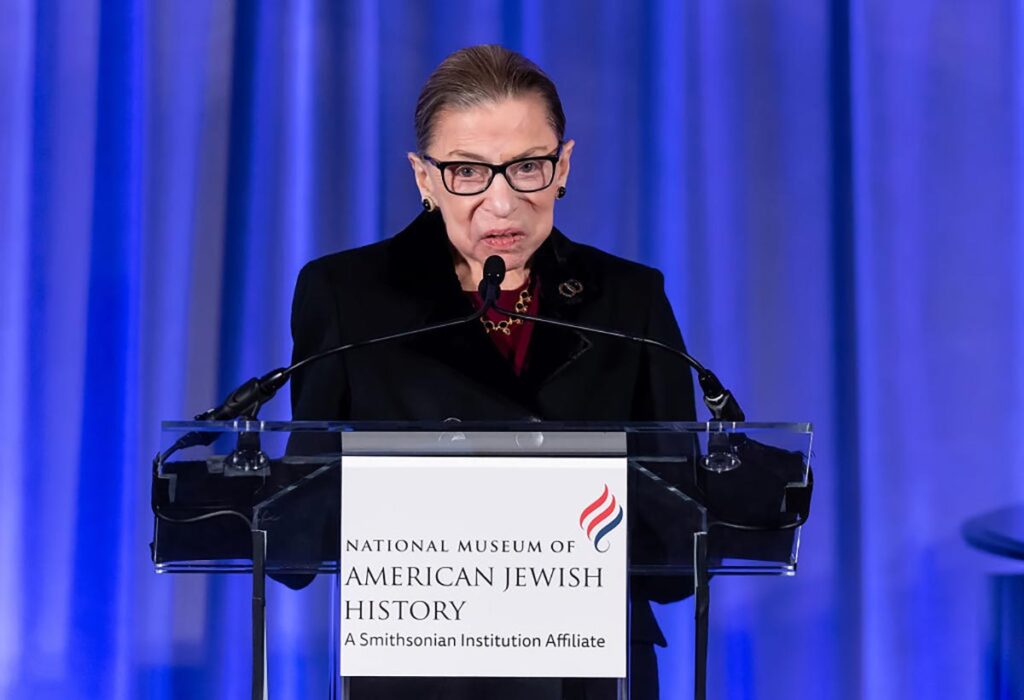
Ginsburg excelled academically but encountered widespread discrimination as a woman pursuing a legal career. After graduating at the top of her class from Columbia Law School, she struggled to find work despite her exceptional credentials.
In the 1970s, Ginsburg co-founded the Women’s Rights Project at the American Civil Liberties Union and argued a series of landmark cases before the U.S. Supreme Court, successfully challenging laws that discriminated on the basis of sex. In 1993, President Bill Clinton appointed her to the Supreme Court, where she served for 27 years.
Known for her thoughtful opinions, powerful dissents, and unwavering commitment to equal justice, Ginsburg became both a legal giant and an unexpected pop culture icon. Her work left a lasting imprint on American law and expanded opportunities for generations of women.
23. Deborah Lipstadt (March 18, 1947 –)
Deborah Lipstadt has spent her career defending historical truth against Holocaust denial and antisemitism. Through her scholarship, public advocacy, and government service, she has become one of the world’s leading voices on Holocaust education.

Dr. Lipstadt built her career studying the Holocaust and modern antisemitism. Her books, including “Denying the Holocaust,” helped expose the tactics used by Holocaust deniers and explained why denying historical facts poses a threat far beyond the events of World War II.
In 1996, British Holocaust denier David Irving sued Lipstadt for libel after she described him as a Holocaust denier. After a widely watched trial in London, the court ruled decisively in Lipstadt’s favor, concluding that Irving had deliberately distorted the historical record. The case became a landmark victory for historical truth and was later dramatized in the film “Denial.”
In 2022, Lipstadt was appointed the U.S. Special Envoy to Monitor and Combat Antisemitism. Through her writing, teaching, and public service, she has helped ensure that the Holocaust is remembered accurately and that efforts to distort or deny it are challenged with evidence and scholarship.
24. Sergey Brin (Aug. 21, 1973 –)
Sergey Brin helped change the way the world accesses information. As the co-founder of Google, he played a central role in creating the search engine that transformed the internet and became one of the most influential technologies of the modern era.
Born in Moscow to a Jewish family, Brin immigrated to the U.S. with his parents in 1979 after they faced antisemitism and restrictions on educational and professional opportunities in the Soviet Union. His family’s journey reflected the experiences of many Soviet Jews who sought greater freedom abroad.

While pursuing a Ph.D. at Stanford University, Brin met Larry Page. Together, they developed a search engine that ranked webpages based on their relevance rather than simply counting keywords. They founded Google in 1998, and the company quickly became the world’s most widely used search engine.
Today, Google powers billions of searches every day and has fundamentally changed how people learn, communicate, and navigate the digital world. Brin’s work helped usher in the information age, making him one of the most influential technology entrepreneurs in American history.
25. Mark Zuckerberg (May 14, 1984 –)
Mark Zuckerberg helped transform the way billions of people communicate. As the co-founder of Facebook, he played a central role in creating social media as we know it, fundamentally changing how people connect, share information, and engage with the world.
Zuckerberg began programming computers as a child growing up in White Plains, NY. While a student at Harvard University, he launched Facebook from his dorm room in 2004. Originally created for college students, the platform rapidly expanded into one of the largest social networks in history.

Under Zuckerberg’s leadership, Facebook grew into Meta Platforms, whose platforms, including Facebook, Instagram, WhatsApp, and Messenger, are used by billions of people around the world. The company has helped reshape everything from personal communication and entertainment to politics, journalism, and business.
Zuckerberg’s influence has also sparked significant debate over privacy, misinformation, political discourse, and the responsibilities of technology companies. Regardless of those controversies, his impact on how people communicate and consume information has made him one of the most consequential technology leaders of the 21st century.