
The Jewish calendar is full of anniversaries, but so is the regular calendar.
Every week marks the anniversary of events that helped shape Jewish history, whether that’s a Nobel Prize-winning discovery, a pivotal Supreme Court decision, the birth of an iconic artist, the founding of a community, or a moment that changed the course of the Jewish people.
Welcome to Unpacked’s latest series, “This Week in Jewish History.” Each week, we’ll take a look back at the stories worth remembering and why they still matter today.
Roundup at Vel d’Hiv sports arena (July 16-17, 1942)
Relations between Israel and France have rarely been as strained as they are today. As the war in Gaza dragged on and the Palestinian death toll surged, the relationship between the two countries, once among the nascent Jewish state’s closest allies, has deteriorated to its lowest point in decades. Last August, after France announced its intention to recognize a sovereign Palestinian state, Israeli Prime Minister Benjamin Netanyahu accused French President Emmanuel Macron of “[pouring] fuel on this antisemitic fire.”
“It is not diplomacy, it is appeasement,” Netanyahu wrote. “It rewards Hamas terror, hardens Hamas’s refusal to free the hostages, emboldens those who menace French Jews and encourages the Jew-hatred now stalking your streets.”
Macron’s Minister for Europe, Benjamin Haddad, rejected the accusation, responding: “France has no lessons to learn in the fight against antisemitism.”
History suggests otherwise.

As is the case in much of Europe, France has seen a sharp rise in antisemitic violence in recent years, from the brutal 2018 murder of 85-year-old Holocaust survivor Mireille Knoll to the antisemitic gang rape of a 12-year-old Jewish child in 2024.
But France’s less-than-stellar record on antisemitism goes back much further than the present day.
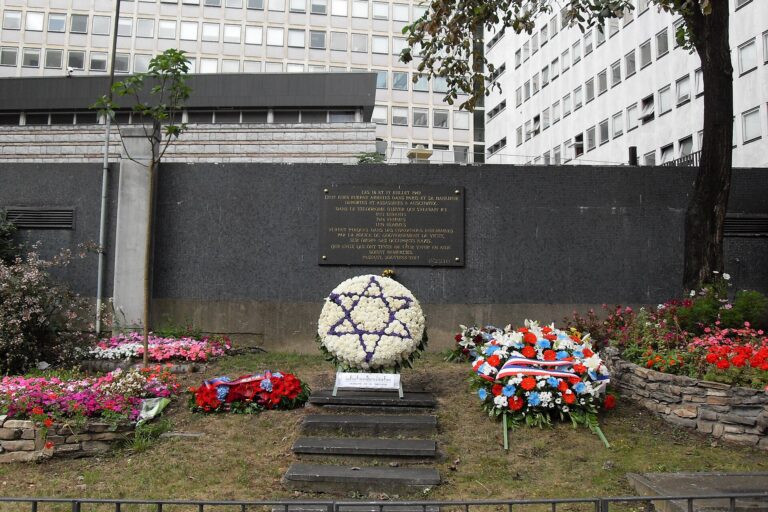
This week marks one of the darkest chapters in that history. Eighty-four years ago, on July 16 and 17, 1942, French authorities rounded up more than 13,000 Parisian Jewish men, women, and children in Paris. They confined them inside the Vélodrome d’Hiver, an indoor cycling arena commonly known as Vel d’Hiv for short, depriving them of food, water, sanitation, and medical care, before handing them over to the Nazis, and sending them on their way to their extermination in Auschwitz.
To understand what happened, it’s worth stepping back two years. In June 1940, the French government surrendered to Nazi Germany. The country was divided into two zones: the Occupation Zone to the north, under the rule of the Germans, and the so-called Free Zone to the south, under the rule of the puppet Vichy regime.
Paris fell under the German occupation zone.
The Nazis intended to deport the Jews in the north and the free zone to the death camps, but they lacked the manpower and local knowledge to carry out mass arrests on their own., They depended on the collaboration of the French police to identify, arrest, and process the victims.
The French police enthusiastically complied.
Starting in the early hours of July 16, thousands of French security officials fanned out across Paris, arresting Jewish families in coordinated raids. Men, women, children, and the elderly were violently ripped from their homes and dumped inside Vel d’Hiv.
Conditions inside the arena were horrific. For five long days, detainees were crammed into sweltering conditions with almost no food or water, overflowing toilets, little ventilation, and virtually no medical care. Though the exact fatalities remain unknown, it’s estimated that several hundred Jews died while trapped inside the stadium.

About a week later, the French police deported the internees to French transit camps, including Drancy, Pithiviers, and Beaune-la-Rolande. From there, Nazi authorities deported them on trains to death camps in Poland, primarily Auschwitz-Birkenau. Fewer than 100 survived.
The Vel d’Hiv roundup remains a sore memory in French history and has become one of the defining symbols of France’s collaboration with Nazi Germany. It is a stark reminder of the indifference and, at times, enthusiastic consent of the local authorities in the plight of France’s Jews.
Jewish history is a story of both tragedy and triumph. This week is no exception.
The Spanish Inquisition is finally abolished (July 15, 1834)
1834!?
Most people likely associate the historic horrors of the Spanish Inquisition with medieval torture chambers, public burnings at the stake, the conquest of the Americas, and the expulsion of Spain’s Jews in 1492, not with the decades after the Enlightenment. But it’s very much true: Until July 15, 1834, Spain’s infamous religious tribunal still officially existed, and Jews could not legally return to live openly in the country.
The story began more than three centuries earlier. In 1492, Ferdinand and Isabella issued the Alhambra Decree, ordering Spain’s Jews to either convert to Christianity or leave the kingdom. Historians estimate that tens of thousands converted, while tens of thousands more fled to Portugal, the Ottoman Empire, North Africa, Italy, and elsewhere, giving rise to the Sephardic diaspora that still exists today.
For over three centuries, Jewish life was virtually nonexistent in the country, a far cry from its former glory, as Spain was once the crown jewel of the Jewish world. Even so, inquisitors maintained their relentless search for Marranos, baptized Jewish converts to Catholicism who continued to practice Judaism in secret. These “crypto-Jews” were investigated, imprisoned, tortured, and sometimes executed for alleged heresy. Remarkably, those prosecutions continued well into the 19th century, when inquisitors tried Manuel Santiago Vivar under the charge of crypto-Judaism in 1818.

In the first few decades of the Spanish Inquisition, historians estimate the number of crypto-Jews to be roughly 20,000. Over the centuries, however, most families gradually assimilated into Christian society, disconnecting entirely from their Jewish heritage. One remarkable exception was the Chuetas of Mallorca, descendants of forced converts who preserved their distinct Jewish practices for centuries, resisting assimilation by continuing to marry within the group.
The Inquisition was finally abolished on July 15, 1834, during the liberal reforms that followed the death of King Ferdinand VII. Its abolition marked the end of one of Europe’s longest-running systems of religious persecution and opened the door, however slowly, to the return of Jewish life in Spain.
The revocation of the Spanish Inquisition marked a new era for Spanish-Jewish relations and ultimately enabled millions of Sephardic Jews and Bnei Anusim, descendants of Conversos, to reconnect with their Jewish heritage.
That doesn’t mean relations between Spain and its Jewish community have been uncomplicated ever since. Antisemitic customs and traditions lingered in some parts of the country for generations, Francisco Franco’s fascist dictatorship cast another long shadow over 20th-century Spain, and contemporary antisemitism has again risen in response to the conflict in the Middle East.

Still, there have also been meaningful attempts at reconciliation. In 2015, Spain offered descendants of the Sephardic Jews expelled in 1492 a pathway to citizenship as a form of reparations. Although the program expired in 2019, approximately 132,000 people applied, and more than 72,000 ultimately became Spanish citizens.
While it seems unthinkable that the Inquisition wasn’t abolished until 1834, here’s an even more unbelievable nugget of information: the Edict of Expulsion of 1492 that drove Spain’s Jews from the country wasn’t formally overturned until 1968, nearly five centuries after it was first issued.