
At a moment when young Jews are rediscovering Yiddish not as nostalgia but as an artform, Shane Baker, the executive director of the Congress for Jewish Culture and one of the most visible advocates for contemporary Yiddish theater, didn’t grow up hearing Yiddish at home. Baker — who is not Jewish — has become a central figure in the language’s contemporary revival.
His latest project, “Night Stories,” brings poems by Avrom Sutzkever to the stage, transforming Holocaust memory into living theater and proving that Yiddish is not only being preserved, but still evolving.
At the center of “Night Stories” is Baker’s lifelong mission to treat Yiddish as a living theatrical language rather than a relic of before World War II. Pulling from four works by Sutzkever, a Vilna-born writer who survived the Holocaust and continued writing until his death in 2010, the production stages encounters between memory and the present, survival and guilt, language and silence. Performed in Yiddish with English supertitles, the piece reflects Baker’s broader work as an educator and artist committed to making Yiddish literature accessible, emotionally immediate, and urgently relevant for contemporary audiences.
Finding Yiddish theater
Baker’s path into Yiddish began not at home, but in rehearsal rooms and footnotes. “I did not grow up with it,” he said plainly. “I heard a little bit here and there on TV and maybe in real life, but I encountered it in the arts.”
As he studied theater history more seriously, Yiddish kept resurfacing. “When you look into the history of theater in America, be it serious, legit stage… or be it comedy, as cheap and dirty as you want to get, Yiddish plays a huge role in both,” Baker told Unpacked, tracing a lineage from Stella Adler to the Catskills comedians. What started as intrigue became immersion when he moved to New York in the early 1990s and began reading deeply about Yiddish theater’s world-spanning past.
That reading quickly turned personal. Baker found himself forming relationships with artists who had lived that history, many of whom had survived war, censorship, and cultural collapse. “I was greatly impressed by the history of their lives,” he said. “Yiddish theater was never the easiest of rows to hoe.” Still, what struck him most was their refusal to quit. “None of them ever said in their own careers, ‘it’s time to let go,’” Baker recalled. “They kept their careers going as long as they could.”
That persistence, he said, continues to shape how he approaches the work today. “It’s not getting easier to make Yiddish theater,” Baker acknowledged, “but it’s still blossoming.” Even now, he pointed out, there are multiple active Yiddish theater groups in New York alone. “The Never Say Die attitude,” he added, “is very attractive and inspirational to me.”
Bringing Avrom Sutzkever to the stage
Baker’s relationship with “Night Stories” stretches back decades, long before the production existed. He first encountered Sutzkever’s work while working closely with his mentor, legendary Yiddish actress Luba Kadison Buloff. “We were going through her archives,” Baker recalled, sorting materials destined for Harvard and YIVO, when he came across a signed copy of Sutzkever’s prose. “I opened it up… and I started reading the stories.”
At the time, Baker was still early in his Yiddish studies, and the language challenged him. “The stories were very difficult for me,” he said. “So I started learning Yiddish on these stories on a higher level.” He described the process as painstaking and intimate. “I would read them. I’d write out the words I didn’t understand. I’d look them up. I’d go back. I’d reread the stories.” Over the next 30 years, he returned to them countless times.

For years, though, the question of staging them felt impossible. “A couple of them attracted me in a way that I wondered, could they be put on the stage?” Baker said. “And I never approached it because I couldn’t figure out a way.” That changed after the death of Yonia Fain, a close collaborator and co-president of the Congress for Jewish Culture, who also owned an autographed copy of the same book. This one, Baker said, carried a message that felt like a charge: Sutzkever described the volume as “a 180-page letter” to Fain. “I said, ‘I’ve got to do something with these,’” Baker recalled. “I’ve got to do something.”
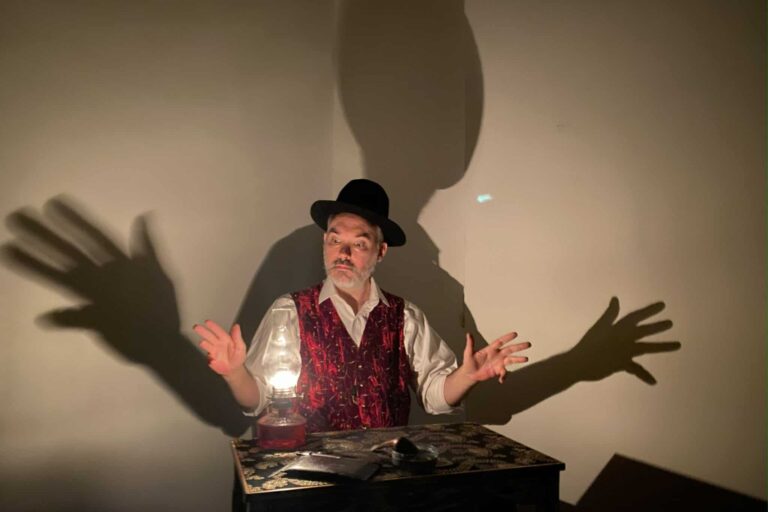
The theatrical breakthrough came not through spectacle, but restraint. Working with director Moshe Yassur, Baker finally found an entry point. “He said, ‘It’s very simple,’” Baker recalled. “‘You bring out a kerosene lantern… and you read the story by the light of this lantern.’” The choice did more than solve a staging problem. “It turned out that this created a shadow on the wall,” Baker said, “which was the other figure in the story.”
That minimalist approach became the backbone of “Night Stories,” a production that treats Sutzkever’s work as a living encounter rather than a historical reflection.
“It’s the opposite of Broadway in many ways,” Baker said, “but every bit as theatrical.” What emerged was an evening of stories that audiences across continents seemed to grasp intuitively. “To a person, everyone said, ‘I read the stories, and I did not understand them,’” Baker recalled of early performances. “But when we saw them on the stage, we understood.”
Building the bridge for “Night Stories”
Though the four pieces that make up “Night Stories” were not originally written to be performed together, Baker and his collaborators experience them as a single emotional journey.
“We do think that they are an arc,” Baker said. “I can’t tell you precisely how and why, but we know the stories must be told in the order that we tell them.”
The evening begins with what Baker describes as the most difficult story, a brief but harrowing piece set in the Vilna Ghetto. In it, the narrator reconstructs the final moments of a murdered child by studying handprints left behind. “He’s like a detective working from these clues,” Baker explained, deducing an entire life from the imprint of hands on a cellar window. The choice to open with this story is deliberate. “We wanted it to give absolute context,” Baker said. “We wanted it to be clear what happened.”

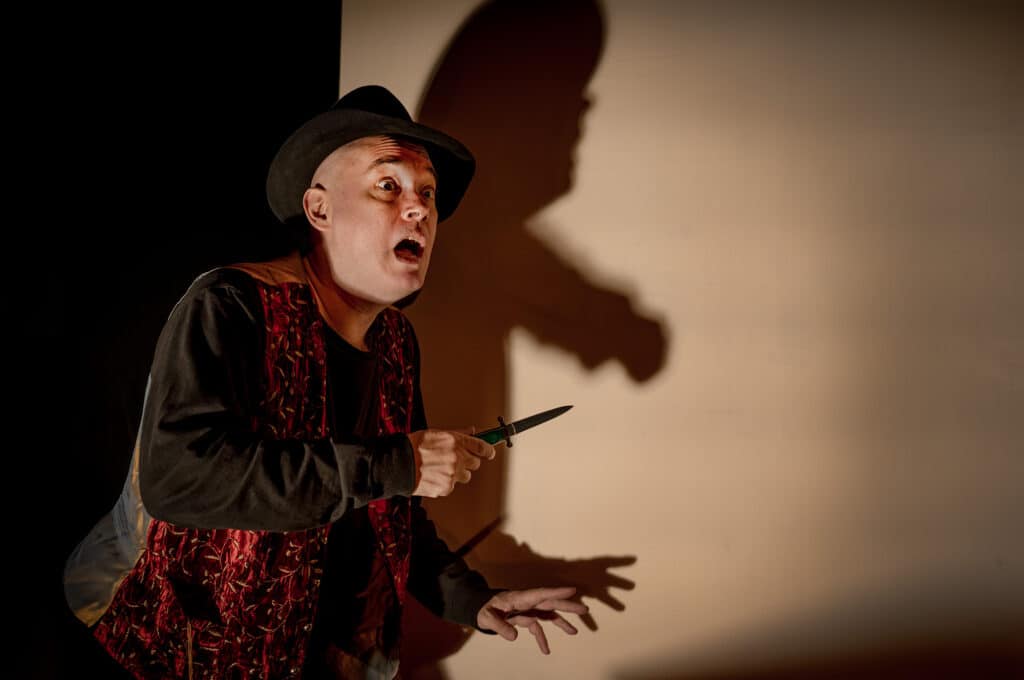
From there, the production moves forward in time, following Sutzkever as a writer in Tel Aviv, haunted by figures from his past. In one story, Baker described, the poet finds himself arguing with the shadow of a cyanide dealer from the ghetto, a confrontation shaped by survivor’s guilt and unresolved moral questions. “He’s trying to figure out, why did you sell it? Why didn’t you give it to people?” Baker said. “And he comes to a resolution.”
The later stories continue that reckoning, introducing characters who return as if summoned by memory. A woman in a park mistakes the poet for someone she knew in the swamps and seeks forgiveness for having survived.
“There are these people, lost souls, who are looking to be forgiven for having done what they did in order to survive,” Baker said. In each encounter, the poet becomes both witness and vessel, carrying stories that might otherwise vanish.
The final piece offers a quieter release. Set largely before the war, it unfolds as a Hanukkah story and gestures toward restoration without denying loss. “It’s much more merciful,” Baker said, noting that the destruction is compressed into a single sentence before the story returns to Tel Aviv. Taken together, the four works trace a movement from horror to reckoning to fragile continuity. “We feel the arc will be felt,” Baker said, “even if we can’t articulate it precisely.”
Making Yiddish accessible
Because “Night Stories” is performed in Yiddish with English supertitles, Baker is constantly thinking about how audiences listen, read, and move between the two. The goal, he said, isn’t to privilege fluency, but to create space for immersion.
“We’ve worked to slow down the Yiddish some,” Baker explained, noting that even confident speakers can struggle with the literary density of Sutzkever’s language.
That difficulty, Baker believes, is part of the experience. Rather than smoothing the language into something easier or more familiar, the production leans into its texture. “We’re taking a very heavily literary approach to Yiddish theater,” he said, one that foregrounds language as art rather than background. “We’re trying to make Yiddish literature accessible to people,” not by simplifying it, but by embodying it onstage.

The supertitles play a crucial role in that balance. Baker described them not as direct translations, but as careful adaptations. “People read slower than they hear,” he said, explaining that the English text is intentionally shortened. “We look to keep the titles at a readable level so people have a chance to look at the stage too.” Placement matters as much as phrasing. “We try to keep the titles as close to our heads as possible,” he added, so audiences can absorb both language and performance at once.
That approach reflects Baker’s broader philosophy about Yiddish theater today. “It’s a fight,” he admitted, referring to the constant negotiation between sound, meaning, and attention. “But people do it when they go to see French cinema or Italian cinema, so they can do it for Yiddish theater too.” For Baker, that effort is part of the invitation. Yiddish doesn’t need to be fully understood to be felt, and sometimes, he said, the stage reveals what reading alone cannot.
A new generation finds Yiddish
For Baker, the careful attention to language, pacing, and supertitles isn’t only about accessibility. It’s also about who is listening. Increasingly, he said, the audiences responding most strongly to Yiddish theater are younger people encountering the language for the first time.
“The people who are coming to Yiddish now are coming without having heard much as a child,” Baker said. “They know their grandparents spoke it, and they want to find it again.”
What’s drawing them in, Baker believes, isn’t nostalgia but artistry. “I do believe it’s largely artistic connections,” he said, pointing to theater, music, and performance as gateways. Right now, Yiddish offers a way into Jewish identity that feels creative rather than inherited, something you step into rather than receive. “This is something you can take home,” Baker said. “Even if you don’t do it all in Yiddish, you can use a little bit.”

Those small acts of adoption can have outsized meaning. Baker recalled meeting young audience members who began incorporating Yiddish words into their everyday rituals after seeing his work. “That was very moving to me,” he said.
For Baker, these moments signal that Yiddish’s revival is not about perfect fluency or cultural gatekeeping. Yiddish, he argues, should and will continue to grow. When the language is treated as living art, he argues, it gives new generations space to engage on their own terms, to listen before they understand, and to carry something forward simply because it moved them.
Ultimately, what Baker hopes audiences carry with them after “Night Stories” is awe. Awe at what Yiddish can hold, what it survived, and what it can still make possible. Sutzkever, he noted, believed he had made an agreement with the angel of poetry: that as long as he kept writing, he would be spared. He did survive, and he never stopped creating, inventing new Yiddish words until the end of his life.
For Baker, staging “Night Stories” is a way of extending that agreement forward. “I hope they’ll be in awe of what Yiddish can achieve,” he said. Not as a language frozen in loss, but as one that still commands attention, invites listening, and, against every expectation, continues to speak.