
The Jewish calendar is full of anniversaries, but so is the regular calendar.
Every week marks the anniversary of events that helped shape Jewish history, whether that’s a Nobel Prize-winning discovery, a pivotal Supreme Court decision, the birth of an iconic artist, the founding of a community, or a moment that changed the course of the Jewish people.
Welcome to Unpacked’s latest series, “This Week in Jewish History.” Each week, we’ll take a look back at the stories worth remembering and why they still matter today.
Check out previous editions here.
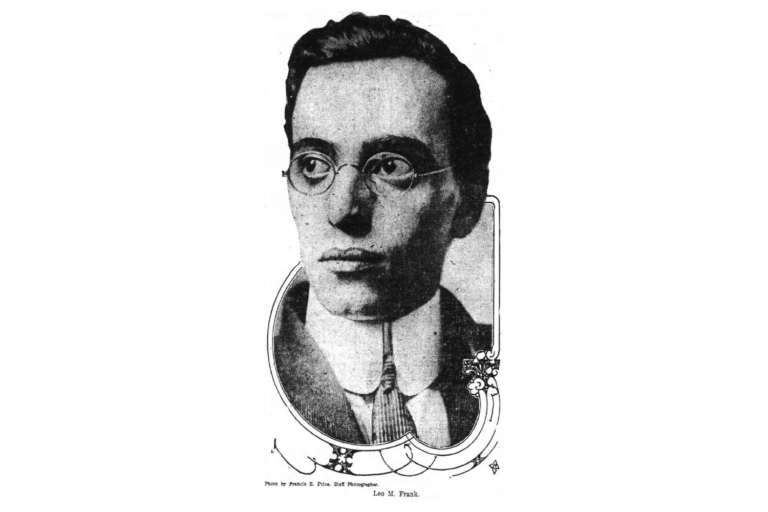
Leo Frank is kidnapped and lynched (August 17, 1915)
It’s hard to imagine a more racially charged atmosphere than early 20th-century Georgia. So when a 13-year-old white girl named Mary Phagan was found murdered in an Atlanta pencil factory in April 1913, there was little hope that the investigation and subsequent trial would leave race out of the equation.

Shortly after the murder, Jim Conley, a Black janitor at the National Pencil Company, was seen washing what appeared to be bloodstains from a shirt. When police questioned him, Conley initially insisted that he could not have committed the murder because notes had been found near Phagan’s body and he could not read or write. But after police determined that Conley could write and that the notes appeared to be in his handwriting, he changed his story.
This time, Conley alleged that Leo Frank, the factory’s Jewish American superintendent, had murdered Phagan and then dictated the notes for Conley to write. Despite the many holes and inconsistencies in Conley’s account, police embraced his accusation.
On May 24, 1913, Conley signed an affidavit implicating Frank — though it would hardly be the last time he changed his story — and Frank was arrested.
Frank’s arrest sparked a shocking media frenzy that was virtually unprecedented at the time. Newspapers published unverified rumors, promoted antisemitic conspiracies, and printed inflammatory headlines. The avalanche of yellow journalism stirred the public into an antisemitic fury, with angry crowds chanting, “Hang the Jew!” It also poisoned the atmosphere surrounding the trial, making a fair proceeding all but impossible.
Despite the glaring inconsistencies in Conley’s testimony and the weakness of other evidence against him, Frank was convicted and sentenced to death.

For two years, Frank appealed his conviction while maintaining his innocence. In 1915, Georgia Gov. John M. Slaton personally reviewed the case and concluded that it was far from clear-cut. He commuted Frank’s sentence to life in prison.
The public was livid. Since the murder, the media had promoted a distorted narrative, steeped in antisemitism, that portrayed Frank as a vicious child murderer despite the deeply flawed case against him. Following the governor’s decision, newspapers like The Jeffersonian suggested that the public take matters into its own hands.
And that’s when things got really ugly.
On the night of August 16, 1915, a mob of well-armed men abducted Frank from the state prison farm in Milledgeville, Georgia. They drove him to Marietta, Georgia, where they lynched him the following morning. The murder was treated as a public spectacle, with vendors reportedly selling souvenirs, including pieces of rope.
The ripple effects of the lynching cannot be overstated. Frank’s arrest, trial, abduction, and murder fueled a white supremacist frenzy that contributed to the resurgence of the Ku Klux Klan. The antisemitism surrounding the case also helped galvanize the newly founded Anti-Defamation League, which had vowed “to stop the defamation of the Jewish people.” Frank’s treatment in the press demonstrated in horrifying terms how defamatory rhetoric could help enable real-world violence.
Jewish history is a story of both tragedy and triumph. This week is no exception.
George Washington promises religious freedom to Jews (August 21, 1790)
Leo Frank’s abduction and lynching remain, to this day, one of the most tragic chapters in American Jewish history. But it is also, thankfully, a rare chapter. When we look at the American Jewish experience as a whole and compare it with Jewish life elsewhere, particularly in Europe and the Middle East, it’s clear that, for the most part, the United States has been good to its Jewish population.

That history of relative safety and acceptance is embodied in a letter written by George Washington on August 21, 1790.
Let’s rewind a little. On August 17, just four days earlier, Moses Seixas, warden of Newport, Rhode Island’s Hebrew Congregation, had written to Washington, thanking the first American president for the rights and freedoms afforded to Jews in the new nation. Seixas expressed his “deep sense of gratitude to the Almighty” that the American government, “erected by the Majesty of the People,” promised “liberty of conscience” and allowed all people to participate in civic life.
On August 21, Washington responded with a glowing letter — one that would help define the ideals of the American Jewish experience for the next two and a half centuries.
“The Citizens of the United States of America have a right to applaud themselves for having given to mankind examples of an enlarged and liberal policy: a policy worthy of imitation,” Washington wrote. “For happily the Government of the United States, which gives to bigotry no sanction, to persecution no assistance, requires only that they who live under its protection should demean themselves as good citizens, in giving it on all occasions their effectual support.”
He concluded with a biblical image of peace and security: “May the Children of the Stock of Abraham, who dwell in this land, continue to merit and enjoy the good will of the other Inhabitants; while every one shall sit in safety under his own vine and figtree, and there shall be none to make him afraid.”
Read more: How Jews helped shape the American Revolution — and the ‘First Salute’ that made history
Though just four paragraphs long, the letter had enormous and lasting significance. Washington had not merely promised to tolerate religious minorities; he affirmed that religious freedom belonged to them as a right. For Jews accustomed to living at the mercy of rulers who could grant or revoke their rights, this represented a profound departure from much of their historical experience.
Washington’s letter echoed the principles of religious liberty articulated in the First Amendment, which Congress had proposed in 1789 and the states ratified as part of the Bill of Rights in 1791. But for a Jewish community that had endured centuries of persecution, its message carried particular weight.
Every August, Touro Synagogue in Newport holds a public reading of the letter, reaffirming its enduring promise: that American Jews do not live in the United States merely through the tolerance of others, but possess the same rights and liberties as every other American.