
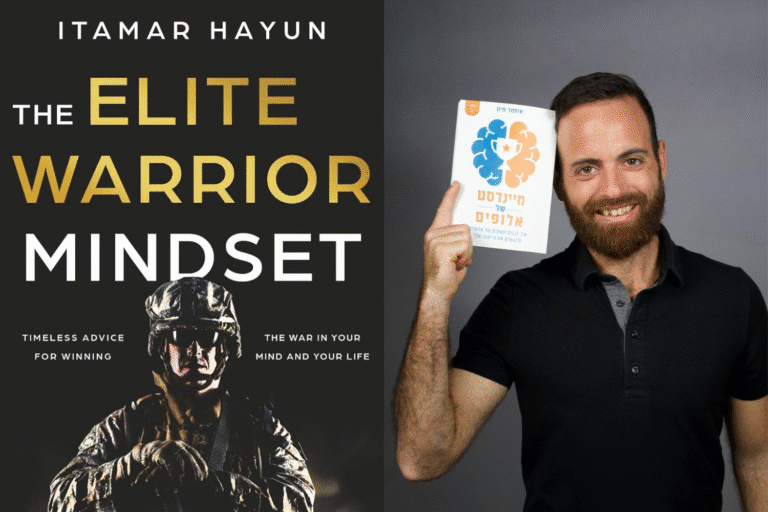
Itamar Hayun wears his many hats with practiced steadiness. At home, he’s the father to four-year-old Yonatan. In uniform, he has served as a reservist combat soldier in the Givati Brigade’s Sapper (Engineering and Demolitions) Unit.
“Since October 7,” Hayun, 32, told Unpacked, “we were among the first to enter Beit Hanoun in the Gaza Strip. Our mission was to take control of the area and demolish buildings using mines and other explosive devices. I have taken part in five intensive operational deployments, both in Gaza and in Judea and Samaria, and was always part of the fighting force on the ground.”
Away from active duty, Hayun is also a social entrepreneur, lecturer, and author who has spent years guiding business owners and building communities across Israel. His work centers on mental resilience, entrepreneurial thinking, and effective teamwork, a focus he says began early. “I was always curious about how people handle moments of extreme difficulty,” he explained, “first in the army and later in sales and business environments.”

Born in Haifa, Israel, and now living in Moshav Avihayil in the Hefer Valley, Hayun has written three books over the past five years. Now, his new book, “The Elite Warrior Mindset,” was recently published in both English and Hebrew.
Inside “The Elite Warrior Mindset”
“The Elite Warrior Mindset” is divided into two parts. The first lays out the mental tools a fighter needs in the field: focus, discipline, teamwork, a sense of history, and identity. The second shows how those same principles translate to civilian life, especially business: building a clear vision, managing stress, leading teams, and inspiring others to commit to a shared mission. The through-line is practical by design, and it mirrors Hayun’s day-to-day work guiding business owners.
Chapter themes include:
- Positive Thinking Under Fire
- Understanding Your “Why”
- Preparing for Combat (and Life)
- The Enemy Within: Managing Fear and Stress
- Translating Military Tools into Business and Daily Life

Hayun’s target audience includes anyone navigating challenges that demand mental toughness, as well as readers who simply want to strengthen their mindset. He places special emphasis on young adults ages 18 to 30, those at the beginning of adulthood who are looking for concrete, military-inspired tools they can apply in everyday life.
“My goal is to help people develop a warrior mindset,” Hayun said. “To face challenges head-on, not give up, and keep going even when they feel at their lowest. After October 7, our country was at one of its lowest points. I believe anyone can lift themselves up from wherever they are by adopting these tools, internalizing them, and staying committed over time. With persistence, real growth happens. It’s very important to me to make these tools accessible to everyone, especially people who don’t know where to start when it comes to strengthening themselves.”
The book’s origins, Hayun explained, are inseparable from that period. “It came directly from my personal experience on and after October 7, and the three intense weeks before the ground invasion of Gaza,” he said. “I realized that much of this war was mental, and that these essential tools need to be accessible to everyone.” For him, that accessibility includes the basics that hold under pressure: clarifying your personal “why,” grounding yourself in Jewish history and identity, building strong teams, learning how to work with other people, and practicing optimism not as a mood, but as a discipline.
Beyond the book
Hayun first introduced “The Elite Warrior Mindset” on a podcast conversation with Dr. Elana Heideman, CEO of The Israel Forever Foundation, an engagement organization that develops experiential learning opportunities meant to deepen personal connection to Israel as an integral part of Jewish life and identity. He’s now organizing English-language courses on building mental resilience, with a particular emphasis on American Jews facing rising antisemitism and looking for practical tools for navigating difficult moments, including how to respond internally.
Because, as Hayun puts it, a warrior’s mindset isn’t something you “pick up” overnight, he offered a blunt starting point: decide that you actually want it, and then get honest about the cost. “First, you have to make a real decision that you want to develop a Warrior’s Mindset,” he said. “Then you need to honestly ask yourself: what does that mean for me? What will it demand of me? How much time am I willing to invest? I see this as a ten-year journey. It’s not a quick fix. About 80% of it is purely mental work, between you and yourself. It’s about knowing your ‘why,’ choosing your environment carefully, and being aware of who is around you. It’s about defining where you want to go and what you’re willing to do to get there. It means developing self-discipline, making sacrifices, and committing to constant learning. Even when it’s hard, it’s an opportunity to improve yourself, and by doing that, to make the world around you better.”


Hayun is also launching a new project with a social vision: “Homes for Warriors.” He describes it as a social initiative that supports Israeli reserve combat soldiers and their families by helping them form new, security-oriented community groups in strategic areas. “We’re now building security-focused settlement groups in strategic areas of Israel,” he said. “This topic has gained significant momentum over the past six months, and I was even interviewed about it on Israeli TV. After October 7, we realized that fences are not enough. We need strong, connected communities serving as a human shield for the country’s security. Our vision is to create affordable housing and resilient communities that integrate security, education, and local economic development. We already have a growing community of around more than 2,300 reservist families. We work closely with regional councils, the Ministry of Settlement, and other government and civic bodies. We’re in advanced talks about several settlement sites, and our teams regularly meet with council heads and planning officials to move things forward. We’re also developing a dedicated website and mobile app to help connect reservists, manage community-building processes, and share opportunities for joining or founding new groups.”

His advice, he added, comes down to daily choices, especially when life feels heavy. “I want to remind everyone that every single day is an opportunity to get better,” Hayun said. “It can mean learning something new, reading, training, or choosing the people you want to spend time with. Every day you can make new decisions about where you’re going and how you want to live. Especially in difficult, challenging times, it’s important to pause and ask yourself why you do what you do, to connect to your own history and meaning. It’s about learning to work with others in a supportive, high-quality environment, and if you haven’t found that yet, keep looking. Keep asking questions, keep searching, until you find it. That’s how we truly grow.”
