
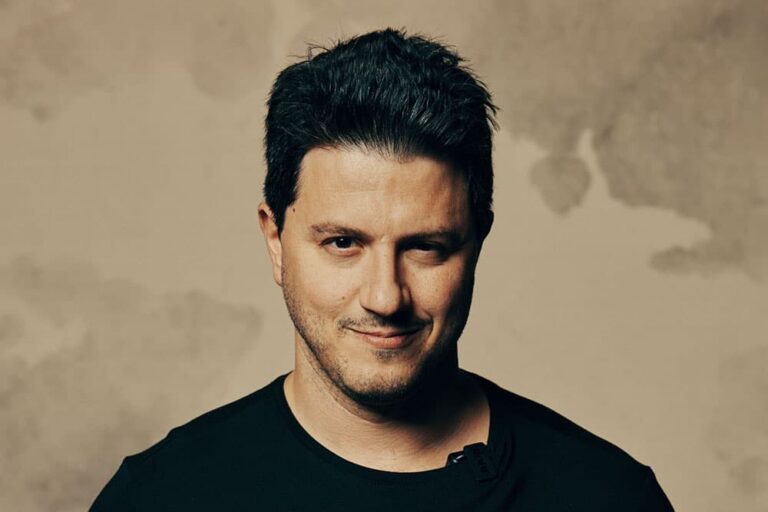
When comedian Jeremy Culhane recently portrayed Tucker Carlson on “Saturday Night Live,” many Jewish comedy fans couldn’t help but wonder: why not Ami Kozak?
Kozak, who has built a sizable following online with nearly 310,000 followers on TikTok and 211,000 on Instagram, is known for his uncanny impressions of figures like President Donald Trump and conservative commentator Jordan Peterson. But it’s his take on Carlson that has generated the most buzz. Kozak nails not just Carlson’s high-pitched, almost surreal laugh, but the halting, elliptical cadence that defines his on-air persona.
So when “SNL” took its own shot at Carlson, Kozak wasn’t exactly impressed.
“‘SNL’ used to rock the boat,” he said. “In the age of the online space, they tried to parody [Joe] Rogan taking horse pills. I thought that was pretty lame. When they went after Tucker, it was generic. They didn’t go after any of the absurdity or any of the things that I make fun of. They play it too safe, which makes it not fun.”
When Ami Kozak took on Tucker Carlson
Carlson has become a frequent target of Kozak’s satire in part because of the sheer absurdity of some of his claims. Among other things, Carlson has suggested that Chabad was a driving force behind the attack on Iran, promoted the false idea of a “Greater Israel Project,” praised the Taliban’s drug rehabilitation programs while downplaying its repression and terrorism, and falsely claimed that Israeli President Isaac Herzog was on Epstein Island.
It’s nearly impossible not to laugh when he breaks into Carlson’s signature cackle, as he does in a viral spoof of Carlson’s claim that he was detained at Ben-Gurion Airport. But for Kozak, the humor is tied to something deeper.
“At first, I didn’t know if it was that strong,” he said. “Then I did it again a year or two later and got a big reaction. He continuously gives me new material, where satire gets closer and closer to the real thing as what he says gets crazier and crazier.”
From comedian to commentator
In the aftermath of October 7, Kozak said he became more outspoken as a political commentator. And while he often mocks Carlson, his criticism is serious.
“It is clear that Tucker has a weird obsession with Israel,” Kozak said. “He has nothing bad to say about the Iranian regime or terrorists, but he is deeply concerned with absurd conspiracies about Israel. It’s shameful, and he wants to confuse young Americans.”
Kozak argues that Carlson’s commentary, particularly in the digital media ecosystem, risks shaping how younger audiences understand Israel and global politics, often by distorting threats and redirecting attention.
“Tucker is fixated on manufactured fanaticism that doesn’t exist and ignores the real fanatics who are actually committing crimes against innocent people,” Kozak said. “I don’t know the motivation behind his flipped morality. He talks about decay and decline in the West — but doesn’t mention Iran.”
Debate, not dismissal
Kozak’s approach is not to avoid these conversations, but to engage them directly.
Before podcaster Candace Owens, in his view, veered into outright antisemitism, Kozak appeared on her show to debate comedian and commentator Dave Smith, who had gained prominence after discussing the Middle East on Joe Rogan’s podcast despite having never visited the region.
In that exchange, Kozak calmly dismantled Smith’s arguments while still keeping the tone conversational, even getting Owens and Smith to laugh with an impression of journalist Douglas Murray. But he was also clear on substance: Hamas seeks Israel’s destruction, and there is no moral equivalency to be drawn.
In another conversation, he politely corrected Owens when she incorrectly claimed that all Muslims in Jerusalem were required to live in the Muslim Quarter.
Some questioned why he engaged at all. Kozak’s answer is simple: “People should not confuse civility with approval. You can show up, disagree, and still act like a mensch.”
Building an audience — and a method
That approach carries over into Kozak’s podcast, “Ami’s House,” which he co-hosts with Michael Weber. The show, which has around 20,000 subscribers, focuses on long-form conversations that prioritize detail over outrage.
Kozak emphasizes listening as much as arguing — using debate not as performance, but as a way to test and strengthen ideas.
At the same time, Kozak draws clear boundaries.
He believes antisemitism should be confronted — but not allowed to consume everything.

“You don’t have to lower your standards for what you’re willing to tolerate in polite company,” he said. “But if you’re obsessing over haters, it can be destructive to spend all your energy trying to eliminate every instance of antisemitism or racism.”
Instead, he argues for focusing inward — on building a strong, educated Jewish community — rather than allowing adversaries to dictate priorities.
There are also limits to engagement. Kozak is open to debate, but not with those acting in bad faith, such as Holocaust deniers or those who deny the events of October 7.
“There are people who are misinformed, and there are people who are deliberately lying,” he said.
In an online environment crowded with outrage, conspiracy, and performance, Kozak’s guiding principle is simple:
“My main point is that the truth is the most important thing,” he said. “That should be our goal.”