
The Jewish calendar is full of anniversaries, but so is the regular calendar.
Every week marks the anniversary of events that helped shape Jewish history, whether that’s a Nobel Prize-winning discovery, a pivotal Supreme Court decision, the birth of an iconic artist, the founding of a community, or a moment that changed the course of the Jewish people.
Welcome to Unpacked’s latest series, “This Week in Jewish History.” Each week, we’ll take a look back at the stories worth remembering and why they still matter today.
Check out previous editions here.
World War II breaks out (September 1, 1939)
Few events have shaped the trajectory of Jewish history as profoundly as the Second World War. The Nazis began making life unbearable for German Jews almost as soon as Hitler rose to power in 1933. But it was World War II that enabled the regime to expand its campaign of persecution into a systematic attempt to murder every Jew in Europe.
To understand what happened on September 1, 1939, we must first rewind to the end of the First World War. After Germany’s defeat, the Treaty of Versailles stripped the country of territory and helped reestablish an independent Poland. Among the lands transferred to Poland was a corridor to the Baltic Sea that separated East Prussia from the rest of Germany. The Nazis bitterly resented these territorial losses and aggressively demanded their reversal.
In March 1938, Nazi Germany annexed Austria in a move known as the Anschluss. Although the annexation drew international condemnation, Britain and France did little to stop it.
Opinions within Austria were more complicated. After World War I, many Austrians had supported unification with Germany. But as Hitler and the Nazi Party consolidated power, moderate Austrians and members of the non-Nazi left increasingly turned against the idea.
Nevertheless, when German troops crossed into Austria on March 12, 1938, they faced no military resistance. Enormous crowds gathered in the streets to cheer Hitler and his entourage. The Nazis later staged a heavily coerced and propagandized referendum, claiming that more than 99% of voters supported the annexation. Jews, Roma and many political opponents were excluded from voting altogether.
Later that year, Britain, France, Germany and Italy signed the Munich Agreement, forcing Czechoslovakia to surrender the Sudetenland, a border region with a large ethnic German population, to Nazi Germany. British and French leaders hoped that acquiescing to Hitler’s demands would preserve peace and prevent him from seizing the rest of the country.
They were wrong.
Rather than appeasing Hitler, these territorial gains emboldened him. In March 1939, German forces occupied the Czech lands, shattering the agreement reached just months earlier. Hitler then turned his attention to Poland, demanding the return of the Free City of Danzig — a semi-autonomous city under the protection of the League of Nations, with significant ties to Poland — as well as permission to build a German-controlled route across the Polish Corridor.
For Britain and France, that was a step too far. Both countries pledged to defend Poland if Germany attacked.
So Hitler turned to the Soviet Union.
On August 23, 1939, Nazi Germany and the Soviet Union signed the Molotov-Ribbentrop Pact, publicly promising not to attack one another. A secret protocol attached to the agreement divided much of Eastern Europe into German and Soviet spheres of influence, including plans to partition Poland between them.
The Nazis still wanted a pretext for war. On August 31, 1939, SS operatives dressed as Polish soldiers staged an “attack” on a German radio station near the Polish border. To make the deception appear convincing, they left behind the bodies of murdered prisoners dressed in Polish uniforms. Hitler then cited this fabricated act of aggression as justification for invading Poland.
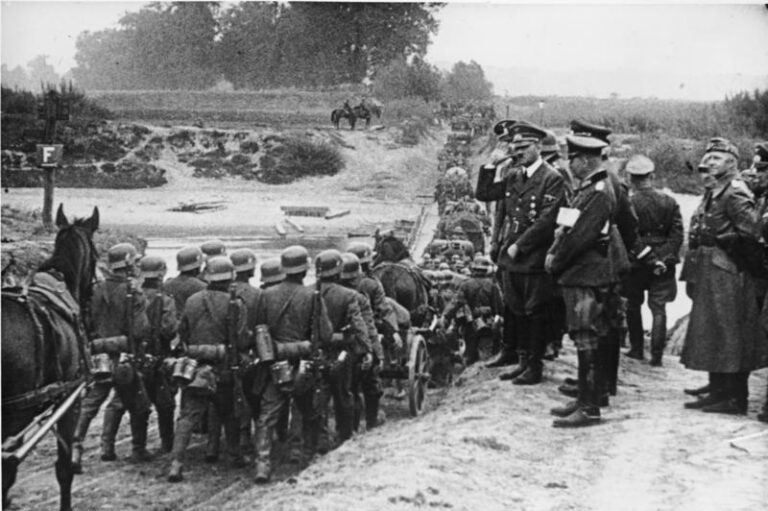
The next morning, Germany launched its assault. Roughly 1.5 million German troops poured across the border, supported by fast-moving tanks, infantry, and overwhelming air power. The attack demonstrated the devastating effectiveness of what became known as Blitzkrieg, or “lightning war”: a rapid, coordinated offensive designed to overwhelm the enemy before it could mount an effective defense.
The Luftwaffe bombed Polish airfields, cities, railways and communication networks. Although Nazi propaganda later claimed that Poland’s air force had been destroyed within days, many Polish pilots and aircraft continued fighting throughout the campaign. Still, Germany quickly gained control of the skies, leaving Polish ground forces increasingly isolated.
Britain and France declared war on Nazi Germany on September 3. But they provided Poland with little immediate military assistance. On September 17, the Soviet Union invaded from the east, forcing Polish troops to fight on two fronts.
Poland never formally surrendered. Nevertheless, by October 6, its conventional military resistance had been crushed, and Germany and the Soviet Union had divided the country between them. A Polish government-in-exile and an extensive underground resistance movement would continue the fight throughout the war.
An estimated 100,000 Jews served in the Polish armed forces during the 1939 campaign. As many as 30,000 were killed in battle, while thousands more were captured by German or Soviet forces. Most of those who survived the invasion would later be murdered in the Holocaust.
Jewish history is a story of both tragedy and triumph. This week is no exception.
The Jews of Holland are emancipated (September 2, 1796)
Jewish life in the Netherlands dates back to the medieval period, though those early communities, like so many others across Europe, were repeatedly decimated by persecution, expulsion and antisemitic violence. In the late 16th century, Sephardic “New Christians” fleeing the Spanish and Portuguese Inquisitions began settling in Amsterdam. There, many returned openly to Judaism, laying the foundations of the modern Dutch Jewish community.
Ashkenazi Jews soon followed. Beginning in the early 17th century, they arrived from Central and Eastern Europe, fleeing war, violence and extreme poverty. Over time, Amsterdam became such an important center of Jewish religious, intellectual and commercial life that it earned the nickname “the Dutch Jerusalem.”

Given the Netherlands’ longstanding reputation as a haven of relative religious tolerance, it may seem surprising that Dutch Jews were not granted equal citizenship until the end of the 18th century.
Even more surprisingly, the Netherlands was only the second European country, after France, to grant Jews full civic equality.
The roots of Dutch Jewish emancipation can be traced to the French Revolution. In 1795, French-backed revolutionaries overthrew the Dutch Republic and established the Batavian Republic, which was heavily influenced by the revolutionary ideals of liberty and equality. One year later, on September 2, 1796, its National Assembly passed the Emancipation Decree, declaring that Jews could no longer be excluded from the rights and privileges of citizenship.

For Dutch Jews, the decree was monumental. It lifted legal restrictions on where they could live, travel and work. Jews could vote, stand for election and hold public office. They were no longer treated as members of a semi-autonomous community governed primarily by its own religious authorities, but as individual citizens with the same civic rights — and responsibilities — as their non-Jewish neighbors.
The shift, however, was neither immediate nor equally felt. Wealthier Jews were the first to benefit from new educational, professional and political opportunities. For the impoverished Jewish majority, legal equality did not instantly erase entrenched poverty or social discrimination. At the beginning of the 19th century, much of the Dutch Jewish population still depended on charitable assistance.
Still, emancipation gradually transformed Dutch Jewish life. As Jews entered schools, professions and civic institutions that had previously been closed to them, they became more integrated into Dutch society. Over the following century, many adopted the Dutch language in place of Yiddish or Portuguese, while religious observance declined among some segments of the community. As would later happen elsewhere in Europe, emancipation opened unprecedented doors for Jews — while also raising difficult questions about assimilation, communal autonomy and what might be lost in the effort to become fully accepted.