
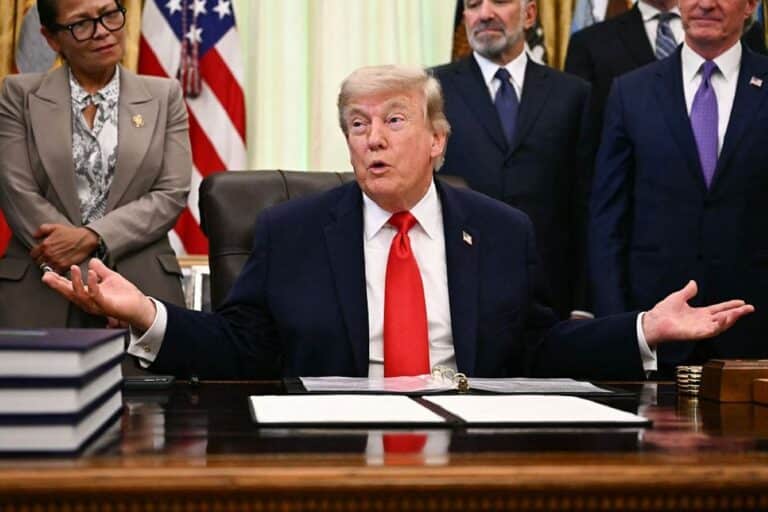
United States President Donald Trump announced on Thursday that Iran and the U.S. were finalizing a Memorandum of Understanding to stabilize the ceasefire between the two countries. However, shortly after Trump’s statement, Iranian officials emphasized that a deal had not yet been finalized and that negotiations were ongoing.
The development came just a day after the U.S. launched expansive strikes on Iran on Tuesday and Wednesday evening, the most serious confrontation between the two countries since their ceasefire in April. The strikes followed the downing of a U.S. military helicopter by Iran, and as Trump warned that he was losing patience with the talks aimed at reaching a lasting calm.
Two overlapping conflicts are driving the escalation. The first is between the U.S. and Iran. It began with U.S. and Israeli strikes in February and has since settled into a fragile, frequently violated ceasefire as the two sides try to negotiate a lasting deal.
The second is in Lebanon, where Israel has spent months fighting Hezbollah, the Iran-backed militia. The two conflicts are closely linked because Iran has refused to finalize any agreement with Washington while Israel keeps striking its allies in Lebanon, which means a flare-up in Beirut could drag the U.S. and Iran back toward direct conflict. That’s, in part, what happened over the past week.
The U.S. strikes came shortly after a fresh round of fighting between Israel and Iran. That escalation was touched off by an Israeli strike on Hezbollah in Beirut’s Dahiyeh suburb, a Hezbollah stronghold. Iran responded by launching a barrage of ballistic missiles at northern Israel, prompting retaliatory Israeli strikes in return.
Less than 24 hours after it began, both Israel and Iran agreed to halt their fire, in part under pressure from Trump. But the conditions they set for continued quiet laid the groundwork for future escalations.
The Israeli strikes on the Dahiyeh had come in response to intensified rocket and drone attacks by Hezbollah in recent weeks. In the days leading up to the operations, Iranian officials warned that Tehran would respond directly to strikes in the Dahiyeh suburbs. A planned Israeli strike in Dahiyeh the previous week was reportedly called off due to pressure from Trump.
The fighting has remained limited so far, but it has revealed just how thin the ceasefire has worn, and how quickly it can give way.
How did we get here?
The current conflict began on February 28, when Israel and the U.S. launched strikes on Iran, mainly targeting Iran’s nuclear and missile programs, as well as other military, government, and economic targets in the country. The opening salvo killed Iran’s Supreme Leader, Ali Khamenei.

In response, Iran launched barrages of missiles and drones at Israel and the Gulf states and closed the Strait of Hormuz to shipping, choking off roughly a quarter of the world’s seaborne oil trade and triggering a global fuel crisis. Hezbollah joined the war on March 2, launching rocket and drone attacks on Israel to support their patrons in Iran.
After about a month of fighting, the U.S. and Iran agreed to a ceasefire on April 8, brokered by Pakistan and conditioned on Iran reopening the Strait of Hormuz. Direct talks in Islamabad days later, between U.S. Vice President JD Vance and Iranian parliament speaker Mohammad Bagher Ghalibaf, failed to produce a lasting deal. Trump responded by ordering a naval blockade of Iran. Additionally, while Iran and Pakistani mediators claimed Lebanon was included in the ceasefire, clashes continued between Hezbollah and Israel. Nevertheless, the truce between Iran and the U.S. largely held in the months that followed, at least until recently.
Why did the talks keep failing?
Every round of negotiation since the April ceasefire has run aground on the same handful of issues, as both sides have red lines that remain entirely incompatible.
Iran has been demanding the right to continue to levy tolls on and restrict ships transiting the Strait of Hormuz and to continue enriching uranium. It’s also demanded that the U.S. lift all sanctions on the country and release billions of dollars that have been held frozen abroad due to sanctions.
Wondering why enrichment is such a big deal? Check out our explainer here.
The U.S.’s demands are a mirror image of Iran’s. Washington is ordering the reopening of the Strait of Hormuz without any tolls or restrictions, the dismantling of Iran’s uranium enrichment program, and the removal of Iran’s stockpile of highly enriched uranium.
The most recent talks have aimed to get the sides to agree on a temporary Memorandum of Understanding, an agreement that would decide what future talks would focus on and stabilize the current ceasefire. However, even those efforts have failed, as Iran is demanding the lifting of sanctions as a prerequisite for any such memorandum, and the U.S. is demanding at least some concessions on nuclear issues. Iranian officials have emphasized that they will not discuss any nuclear issues until after a memorandum of understanding is reached.
Additionally, mixed messaging from Iran has made reaching a deal even more difficult. For example, while some officials have indicated Iran would agree to reopen the Strait of Hormuz without any restrictions, others have insisted that Iran would demand to maintain some form of control over the Strait. Part of the problem is that in the aftermath of the strikes that killed Iran’s supreme leader and many other senior officials, rival factions in Iran have been fighting over who will control the country going forward.
Many analysts describe the situation as currently split between two broad coalitions. On one side are the hardliners, mainly officials from the IRGC and radical clerics, who are against any concessions and favor a return to war with the U.S., despite the costs. On the other side are pragmatists, including the country’s president, Masoud Pezeshkian. The pragmatists favor an agreement over a return to war, even if it means conceding some points. The split between the two sides isn’t clean cut, as some officials are on the fence, and in terms of practical power, the hardliners appear to have the upper hand at the moment.

With the leadership divided and the status of Iran’s new Supreme Leader, Mojtaba Khamenei, still unclear three months into the war, negotiations have repeatedly faltered because there is no clear, unified Iranian position to discuss. When concessions appeared to be on the table, they were often rapidly removed once the proposal was passed by more hardline members of the Iranian government.
Reports concerning the status of negotiations have also often been contradictory, with mediators and officials from both sides rapidly fluctuating between optimism and pessimism. Trump has repeatedly stated over the past two months that Iran and the U.S. were just days away from a deal, while simultaneously expressing frustrations with Iranian negotiators for dragging their feet. Pakistani and Qatari mediators have generally expressed optimism about a deal being within reach, although both warned this week that a deal seemed to be getting further away. Iranian officials have tended to be more pessimistic about the prospects of an agreement, although they’ve also periodically insisted that a deal was close to receiving final approval, often right before reports indicated that the two sides were still stuck on the same issues they’d butted heads over for the past few months.
The ongoing conflict between Israel and Hezbollah in Lebanon is another sticking point. While Israel, the U.S., and the Lebanese government have been treating Hezbollah as its own front, Iran has increasingly insisted that it will only accept a deal that includes a ceasefire for Hezbollah. Both Israel and the Lebanese government have rejected Iran’s interference in that conflict, as they argue that Iran is attempting to maintain control over Lebanese internal affairs through Hezbollah.
The Lebanon flashpoint
As part of an effort to escape Iranian interference, Israel and the Lebanese government, which Hezbollah is a part of, agreed to their own ceasefire on April 16, which has been extended a few times periodically since. The deal came just days after Israeli and Lebanese officials held the highest-level direct negotiations between the two countries since 1993.
However, neither Israel nor Hezbollah complied with that agreement. Hezbollah’s drone and rocket attacks continued and even intensified, and the IDF continued its operations in southern Lebanon and beyond.
Over the past few weeks, the situation has rapidly escalated. One of the most significant changes has been an increase in Hezbollah’s use of fiber-optic and first-person-view drones, which are significantly harder to take down than regular drones. Hezbollah also widened its attacks on northern Israel, with rocket and drone attacks reaching further south to Tiberias and Safed.
The IDF responded to the new attacks with expanded airstrikes. Over the past few weeks, the IDF also advanced past the Litani River in southern Lebanon, moving deeper into the country to secure a buffer zone to protect northern Israel and to destroy Hezbollah strongholds in the area. Two weeks ago, the IDF struck the town of Choueifat, the first strike in the Beirut area in almost three weeks, targeting Ali al-Husni, the head of the missile force in the Imam Hossein Division, an Iranian militia that works with Hezbollah.
With the exchange of fire escalating, Israeli Prime Minister Benjamin Netanyahu and Israeli Defense Minister Israel Katz announced on June 1 that the IDF would be expanding strikes into the Dahiyeh suburbs of Beirut in response to the intensification of Hezbollah’s attacks on Israeli communities.
Iranian officials warned that any such strikes would effectively end efforts to reach a deal with the U.S. Iran’s Islamic Revolutionary Guards Corps (IRGC) additionally threatened to launch attacks on northern Israel if the strikes on the Dahiyeh suburbs took place.
After the Iranian threats were published, Trump ordered Netanyahu to cancel the planned strikes. Trump additionally said the U.S. had spoken with Hezbollah and secured an agreement that would end the attacks by both sides.
Just two days later, during direct negotiations between Israeli and Lebanese diplomats, a new ceasefire agreement was reached, which would lead to the withdrawal of Israeli forces from Lebanon and the disarmament of Hezbollah. However, the agreement stipulated that the terrorist group agree to halt its attacks on Israel and withdraw from southern Lebanon.
Hezbollah’s Secretary-General, Naim Qassem, categorically rejected the deal, saying that his organization would only agree to a ceasefire once Israel entirely withdrew from Lebanese territory. He described the deal as “futile, humiliating, and shameful for Lebanon,” and a “roadmap for the extermination of a segment of the Lebanese people and the enslavement of the rest.”
The strike in Beirut and Iran’s response
The fighting between the IDF and Hezbollah continued over the following days, culminating with rocket fire towards northern Israel on Sunday morning and an Israeli strike on the Dahiyeh suburbs in response.

Iranian leaders warned that they would respond to the strikes, and later that night, they acted on their threats, launching several barrages of missiles at northern Israel. The Iran-backed Houthis joined the fight as well for the first time since April, launching one missile on Monday morning and a drone on Monday night.
Trump quickly told reporters that he would order Netanyahu not to respond, insisting that the U.S. and Iran were close to a deal and that an escalation would harm ongoing negotiations. “The Iranian strikes didn’t hurt anybody,” Trump told Axios. “Hopefully Israel is not going to retaliate.”
The president additionally claimed that Israel had not coordinated its strikes on the Beirut area with the U.S., a claim Israeli officials denied.
Despite Trump’s comments, Israel launched strikes on Iranian air defenses and a petroleum complex used to produce materials for ballistic missiles in southwestern Iran on Monday morning. Iran responded with further barrages of missiles on Israel.
On Monday afternoon, Trump posted that both Israel and Iran were looking for an immediate ceasefire, adding that “final negotiations on ‘Peace’ are proceeding, subject to ignorance or stupidity getting in its way.” The president emphasized that the U.S. blockade on Iran would remain in place until a final agreement between the U.S. and Iran was reached.
A short while later, Iran’s IRGC stated that it considered the round of fighting over, but only on condition that Israel halt all operations in southern Lebanon. The statement was an escalation of Iran’s earlier statements, expanding its threat to respond to Israeli strikes across Lebanon instead of just those in the Beirut area.
Israeli officials also stated that they considered the round of fighting over, but emphasized that they would not accept the equation Iran and Hezbollah were trying to implement.
Netanyahu stressed in a statement on Monday evening that “In the last 24 hours, Iran and Hezbollah tried to impose a new equation upon us. And it is an equation I find intolerable and unacceptable.”
“They thought they would fire at Israel from Lebanese territory and from Iran – and we would not act. That did not happen, and it will not happen. Not on my watch!” Netanyahu added, warning that any further attacks by Iran would be responded to with “overwhelming force.” Israel’s defense minister stated similarly that Israel would respond to any Hezbollah attacks on northern Israel with strikes on the Dahiyeh suburbs.
The helicopter downing and the U.S. response
Despite Trump’s urgency in halting the clashes between Israel and Iran, the U.S. was pulled into a direct clash with Iran on Tuesday, after an American Apache helicopter was downed on Monday night by an Iranian drone off the coast of Oman.
In response, the U.S. launched strikes on Iranian air defenses and radar systems near the Strait of Hormuz. Iran said that the strikes also hit two water reservoirs near Sirik in southern Iran and retaliated by launching missiles and drones at Bahrain, Kuwait, and Jordan.
The situation escalated further on Wednesday after Trump signaled that he had lost patience with Iran as the two sides continued to fail to reach a lasting agreement.
“Iran is all talk and no action,” Trump wrote on Wednesday afternoon. “The Bully of the Middle East is DEAD!!! They’ve taken too long to negotiate a deal that would have been great for them, now they will have to pay the price!!!”
Shortly afterward, the president told reporters that he had decided to renew strikes on Iran because he felt that it had been dragging its feet in negotiations.

Later in the day, U.S. Secretary of War Pete Hegseth added that the U.S. military would launch “strong and clear” strikes on Iran to increase pressure on the country to accept U.S. demands. Hegseth emphasized that Iran would continue to be given opportunities to sign a deal, but that, if it failed to do so, the U.S. would launch further strikes on Thursday night.
The shift in the U.S.’s position came after Qatari negotiators reportedly traveled to Tehran to bridge the gaps preventing a deal and arrange direct negotiations between Iran and the U.S. However, those efforts reportedly failed, prompting Trump to renew strikes.
On Wednesday night, the U.S. acted on its threats, launching renewed strikes on Iranian military surveillance capabilities, communication systems, and air defense sites, mainly near the coast. Iran again retaliated against U.S.-aligned states in the region, launching missiles and drones at Bahrain, Kuwait, and Jordan.
By Thursday, the standoff had escalated further. Iran’s military declared the Strait of Hormuz closed to all marine traffic and warned that any vessel attempting to cross would be targeted, although Central Command insisted the waterway remained open and that commercial ships were still passing through with U.S. security.
On Thursday morning, the Iranian Foreign Ministry warned that the new strikes made the ceasefire between Iran and the U.S. “practically meaningless.”
Later that day, Trump announced that there would be additional strikes on Iran on Thursday night, adding that the U.S. would also take control of Iranian oil infrastructure at Kharg Island and other locations “in the not too distant future.”
However, several hours later, the president announced that he was canceling the planned strikes, saying that discussions on a deal had been brought to the highest level of Iranian leadership and approved. Trump added that “Discussions and final points have been, in both concept and great detail, [and] approved by all parties involved, including the United States, Israel, Saudi Arabia, UAE, Qatar, Turkey, Pakistan, Bahrain, Kuwait, Jordan, Egypt, and others. The Naval Blockade will remain in full force and effect until this Transaction is finalized.”
Trump claimed that the time and place of the agreement’s signing would be announced shortly. However, Trump has posted nearly identical posts several times in the past month, raising doubts about the accuracy of the president’s statement.
The Memorandum of Understanding is intended to stabilize the ceasefire, but it is still a temporary agreement only expected to remain in effect for about 60 days. During that period, the two sides are meant to discuss outstanding issues, such as Iran’s nuclear and missile programs, before signing a final agreement for a lasting peace. What will happen if a deal isn’t reached in that time span, and whether either side is willing to budge on the red lines that prevented a deal before the war isn’t clear.
On Thursday evening, Trump spoke with Netanyahu about the pending agreement. In a statement by his office, Netanyahu said that Trump had assured him that the removal of enriched material, the dismantling of enrichment infrastructure, limits on missile production, and the cessation of Iran’s support for its terrorist proxies in the region would be included in any final agreement with Iran.
Iranian sources rejected Trump’s claim that a deal had been reached on Thursday evening. A spokesperson for the Iranian Foreign Ministry stressed that while negotiations were ongoing, an agreement had not yet been finalized, and Iranian leaders had not made a final decision about the current proposal. “The status of the negotiations was clear to us from the beginning, and most of the text was finalized, but the Americans kept changing their positions,” the spokesperson said, adding that the U.S. strikes had affected the diplomatic process.