
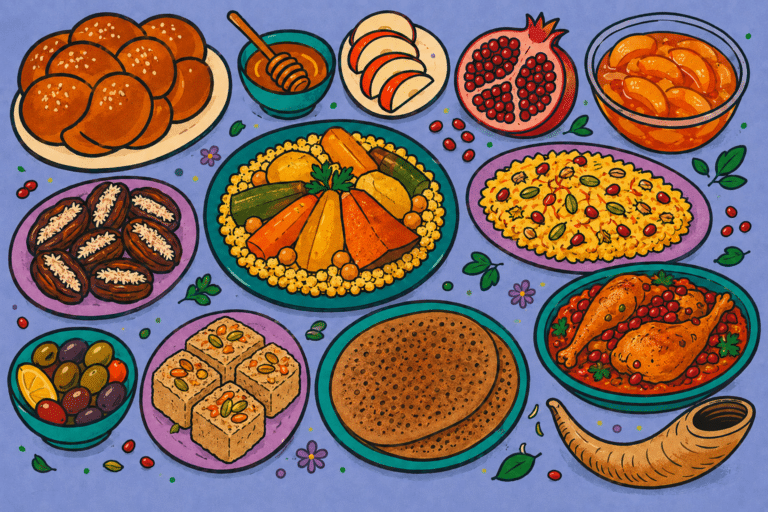
For many North American Jews, Rosh Hashanah tastes like apples dipped in honey. There’s probably a round challah on the table, perhaps dotted with raisins, followed by brisket, kugel and a sticky slice of honey cake.
But apples and honey are only one expression of a much larger Jewish tradition.
Across centuries and continents, Jewish communities transformed the ingredients around them into edible wishes for the year ahead. Many of these traditions center on simanim, symbolic foods eaten with short prayers known as yehi ratzon, or “may it be Your will.” The practice is rooted in the Talmud, which recommends placing symbolic foods — including squash, fenugreek, leeks, chard and dates — before oneself at the beginning of the year. Later traditions developed blessings to accompany them.
The foods were chosen partly for their characteristics and partly for linguistic puns. Dates, or temarim, accompany a wish that hatred and enemies come to an end, using a Hebrew word with a similar sound. Leeks, called karti, evoke the hope that enemies will be “cut off.” The resulting meal is both dinner and word game, turning the table into a collection of hopes for sweetness, prosperity, protection and peace.
The underlying wishes may be shared, but the foods and rituals used to express them look strikingly different from one community to the next.
Here are some of the ways Jews around the world have welcomed the new year.
Bukharan Jews
Bukharan Jews trace their roots to Central Asia, particularly present-day Uzbekistan and Tajikistan, where rice dishes are central to festive meals.
Plov, rice cooked with meat, carrots and spices, is the region’s best-known celebratory dish, while Bukharan Jews also prepare oshi bakhsh, a green rice dish packed with herbs and meat.
Eastern European and German Ashkenazi Jews
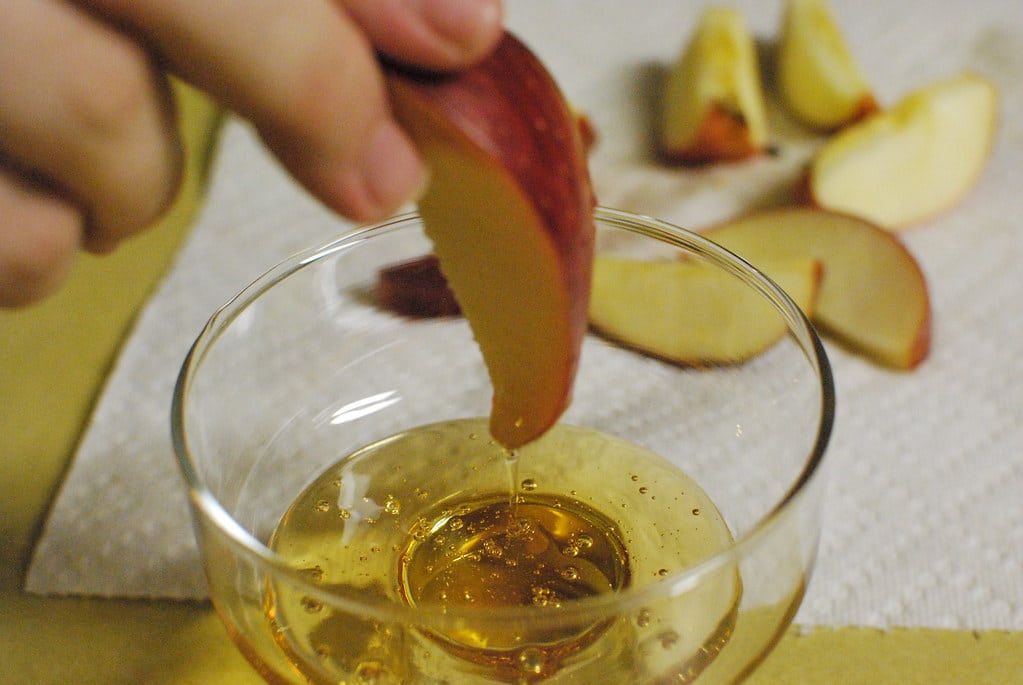
The now-ubiquitous custom of dipping apples into honey developed among Ashkenazi Jews in medieval Europe. Apples appear in Jewish mystical and biblical imagery, while honey expresses the hope that the coming year will be sweet. The practice can be dated to Medieval Jewish sources from the 14th century,
In Eastern Europe, the holiday table expanded to include round challahs, often baked with raisins. Their shape has been interpreted as representing the cycle of the year, continuity and God’s crown. Challah is dipped into honey instead of the salt customarily used on Shabbat.
Read more: The ultimate Rosh Hashanah challah guide: Recipes, tutorials, and tips
Carrots also became a favorite Rosh Hashanah food. The Yiddish word for carrots, meren, resembles a word meaning “to increase,” inspiring a wish that the community’s merits and blessings multiply. They are often served in tzimmes, a sweet dish of cooked carrots that may also include dried fruit, sweet potatoes and honey.
Other Ashkenazi staples include honey cake, apple cake, brisket, kugel and sweetened poultry. Some families avoid sour, bitter or sharp-tasting foods, hoping not to invite a bitter year.
The medieval Jewish community of Worms, Germany, observed a nonculinary tradition as well: People were encouraged to settle their debts before Rosh Hashanah so they could enter the Day of Judgment with a clean slate.
Ethiopian Jews
Beta Israel developed in relative isolation from the rabbinic Jewish communities of Europe, North Africa and the Middle East. As a result, many customs that now seem nearly universal — including apples and honey and the elaborate Rosh Hashanah seder — weren’t historically central to Ethiopian Jewish practice.
Ethiopian Jews traditionally call Rosh Hashanah Brenha Serkan, meaning “the rising of the dawn.” The name reflects one of the community’s most distinctive practices: On the morning of the holiday, religious leaders known as kessim began the first of the day’s three prayer services before sunrise.
Beta Israel historically observed Rosh Hashanah for one day rather than the two days customary elsewhere in the diaspora. Worshippers dressed in fresh white clothing, and wealthier members of the village hosted large feasts so that no one in the community would go without a holiday meal. Lamb, the most expensive meat available to many families, was reserved for the occasion.
Traditional observance emphasized prayer, communal gathering and the spiritual significance of the day. Food reflected Ethiopian Jewish life, including injera, dabo, stews, and honey.
Today, many Ethiopian-Israeli families combine foods and customs inherited from Ethiopia with practices encountered in Israel.
Georgian Jews
Georgian Jews traditionally prepare chicken cooked in pomegranate juice or molasses for Rosh Hashanah. The dish pairs one of Georgia’s signature ingredients with one of the holiday’s most recognizable symbolic fruits.
Pomegranates are eaten on Rosh Hashanah as a sign of abundance and a wish that the coming year be filled with good deeds. In the Georgian kitchen, however, they aren’t simply placed on the table or eaten seed by seed. Their juice becomes a tart, deeply colored sauce for chicken, turning a familiar holiday symbol into the centerpiece of the meal.
Greek and Romaniote Jews
Greek Jewish life includes both Sephardic communities descended largely from Jews expelled from Spain and the much older Romaniote community, whose presence in the region stretches back more than two millennia.
Rosh Hashanah meals reflect the produce and flavors of the eastern Mediterranean. Seder plates may include Romaniote green bean and tomato stew fasolakia, leeks, squash, greens, dates, apples, pomegranates and the head of a fish. The larger meal can feature stuffed vegetables, fish, rice dishes and syrup- or honey-soaked pastries.
Hasidic Jews
Among some Hasidic communities, preparing for Rosh Hashanah once meant purchasing and sharpening a new knife for the household.
The custom is associated with the prayer for sustenance recited during the High Holiday season. The new knife was treated as a segulah, or auspicious sign, for abundant sustenance in the coming year.
Although the custom isn’t universally practiced — and buying someone a knife may sound more ominous than sweet to contemporary ears — it reflects a theme that runs through many Rosh Hashanah traditions: Ordinary household objects can become symbols of what a family needs in the year ahead.
For tens of thousands of Breslov Hasidim, celebrating Rosh Hashanah means making a pilgrimage to Uman, Ukraine near the grave of Rebbe Nachman of Breslov.
Rebbe Nachman taught that Rosh Hashanah held particular spiritual significance and urged his followers to spend the holiday with him. His followers continued gathering at his grave after his death, even when Soviet repression made the journey dangerous.
Today, the pilgrimage draws worshippers from Israel, the United States, and Jewish communities around the world. For several days, parts of Uman transform into a temporary Jewish city filled with prayer spaces, kosher food stands, singing, dancing and enormous communal meals.
Indian Jews
India is home to several Jewish communities with separate histories, so there is no single “Indian Jewish” Rosh Hashanah table.
For Bene Israel Jews from the Mumbai region, one Rosh Hashanah specialty is a pale, custard-like halwa made with milk or coconut milk, sugar and cardamom. In India, it was traditionally thickened with a wheat-derived ingredient known as chick; after immigrating to Israel, many cooks began using cornstarch or agar-agar instead. Some Bene Israel families also serve sweets such as coconut halwa, laddu and malpua, a syrup-soaked pancake often made with fruit.
Cochin Jews developed a different Rosh Hashanah specialty: a rich cake made with semolina, eggs, sugar, ghee, nuts and raisins. Although both communities drew on ingredients such as coconut, cardamom and tropical fruit, Bene Israel and Cochin Jewish cuisines aren’t interchangeable. Each adapted the holiday to the ingredients and cooking traditions of its own region.
Italian Jews
Italian Jews developed one of the most elaborate versions of the Rosh Hashanah seder.
Read more: What is a Rosh Hashanah seder? A guide to Sephardic simanim & traditions
In Rome, the plate may contain nine foods, including figs, fennel, leeks, pumpkin, dates, chard, pomegranate, apples, and a fish or lamb’s head, with blessings recited in Hebrew and Italian.
The holiday meal might continue with seasonal Italian Jewish dishes, including pasta, fish, roasted meats, and vegetables prepared in the distinctive style of Italian Jews.
Iraqi Jews
Historically, some Iraqi Jewish families raised a ram in the weeks before Rosh Hashanah. A ritual slaughterer visited the home on the eve of the holiday, and the animal was prepared for the feast.
Its head was presented separately. Before eating it, the family expressed the hope that they would “be a head and not a tail” — leaders rather than followers — in the coming year. Many families use a fish head for the same blessing.
The seder also includes dates, leeks, pumpkin, greens and other symbolic foods. The meal may continue with fragrant rice, stuffed vegetables and kubbeh. Iraqi Jewish cuisine’s fondness for dates gives the fruit both a ritual and practical place at the holiday table.
While many Ashkenazi Jews dip apples in honey, some Iraqi Jewish families serve apples cooked in sugar instead. The custom is associated with Rabbi Yosef Hayyim of Baghdad, known as the Ben Ish Chai, who preferred sugar to honey for Rosh Hashanah, reportedly because of honey’s complicated symbolism in Kabbalistic tradition. Iraqi apple preserve — often scented with cardamom or rosewater — is consequently a New Year specialty, served as one of the symbolic foods at the holiday meal.
Moroccan Jews
For many Moroccan Jews, families traditionally prepare seven cooked vegetables, although the exact selection varies. They may be served separately or together in couscous with seven vegetables. The number seven recalls that Rosh Hashanah arrives in Tishrei, the seventh month of the Hebrew calendar, and reflects seven’s broader significance in Jewish tradition.
Moroccan families also observe a Rosh Hashanah seder filled with dates, pumpkin, leeks, chard or beets, black-eyed peas, and pomegranates. A fish or lamb’s head may accompany the blessing that the family “be a head and not a tail” in the coming year.
The meal commonly continues with couscous, tagines, stuffed vegetables, and dishes that combine meat with dried fruit, as sweetness runs through every course of the meal.
Persian Jews
Persian Jewish Rosh Hashanah celebrations are known for elaborate seder plates and meals filled with herbs, fruit, rice, nuts, and saffron.
The symbolic foods may include dates, pomegranates, apples with honey, beets, leeks, fried zucchini and fresh herbs. They are followed by distinctly Persian celebratory dishes such as jeweled rice, tahdig and shirin polo, a sweet rice dish scattered with dried fruit, nuts and fragrant citrus peel.
Some families prepare khoresht-e beh, a sweet-and-sour stew made with quince, whose brief fall season coincides with Rosh Hashanah. Others serve fesenjan, a rich stew of ground walnuts and pomegranate molasses. Both dishes embody the Persian culinary preference for combining fruit with savory ingredients.
In addition, some Persian Jews traditionally recite the entire Book of Psalms twice — 300 chapters — in the home of a person who died during the preceding year. The number 300 corresponds to the numerical value of the Hebrew word kaper, meaning “forgive” or “atone.”
Syrian Jews
Syrian Jews pair the symbolic-food seder with dishes such as stuffed vegetables, kibbeh, rice, and sweet pastries. Foods are chosen not only because they taste festive, but because their names or characteristics can carry wishes for prosperity and protection.
Aleppian Jews also practiced a distinctive custom before the holiday. After receiving a haircut, a customer would offer the barber an Arabic expression of happiness. The barber answered with a blessing that God grant the customer complete happiness. According to tradition, the exchange occurred in Arabic because Hebrew, the holy language, wasn’t considered appropriate for the barbershop.
Tunisian Jews
Tunisian Jewish families also conduct a seder built around symbolic vegetables, fruits and blessings. Tables may include pumpkin, dates, pomegranates, black-eyed peas, couscous and sweet pastries.
On the island of Djerba, home to one of the world’s oldest continuously existing Jewish communities, children historically took part in an especially local Rosh Hashanah ritual.
In the days before the holiday, they combed the island’s olive orchards for fruit that had fallen from the trees. The olives were pickled in salt and carried through the streets on the morning before Rosh Hashanah. The children announced that they had zeitun yehi ratzon — olives over which families could recite a blessing asking that their merits multiply like olive saplings.
Turkish Jews
While honey may seem inseparable from Rosh Hashanah, some Turkish Sephardic Jews traditionally avoided it.
Following the teachings of Rabbi Chaim Palachi, the influential 19th-century chief rabbi of Izmir, families worried that unfiltered honey might contain pieces of bees, which aren’t kosher. Instead, they dipped apples into sugar, preserving the wish for sweetness without using honey.
Palachi also recorded the custom of saving a piece of matzah from Passover and eating it on Rosh Hashanah. The matzah expressed the hope that just as the Israelites were delivered from danger in Egypt, the family would be protected from harmful decrees in the coming year.


Some families even connected the two holidays socially by inviting their Passover guests to return for the Rosh Hashanah feast.
Yemenite Jews
Dates, pomegranates, gourds, and greens appear at Yemenite Jewish Rosh Hashanah tables, connecting locally available ingredients to the holiday’s traditional blessings.

Yemenite Jews also preserved distinctive shofar traditions. According to the ancient Baladi custom, some worshippers rise especially early and sound 30 shofar blasts at or even before dawn. These come in addition to the blasts sounded during the morning and Mussaf services.
The practice reflects the Midrashic instruction to act before evil can take the initiative, a way of ensuring that the first sound of the new year is a call to repentance.
To learn more about global traditions, check out Unpacked’s guide to Yom Kippur and Sukkot customs from Jewish communities around the world.